
Rutiodon — a Late Triassic phytosaur
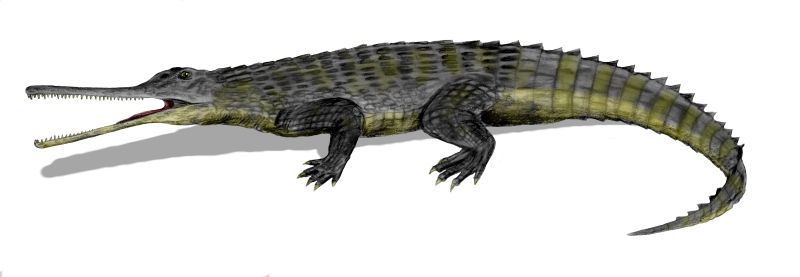
Rutiodon was a crocodile-like phytosaur of the Late Triassic in eastern North America; semi-aquatic ambush predator with nostrils set high on the skull and convergent features with modern crocodilians.
Overview
Rutiodon is a genus of phytosaur, a group of archosauriform reptiles that lived during the Late Triassic. Phytosaurs resembled modern crocodiles in general body shape and lifestyle but are not direct ancestors of today's crocodilians. Fossils assigned to Rutiodon come primarily from Triassic deposits in eastern North America and show an animal adapted to life hunting at the water's edge.
Image gallery
9 Images


Appearance and anatomy
Rutiodon had a long, narrow snout armed with conical teeth suitable for grasping slippery prey. A diagnostic feature of phytosaurs, including Rutiodon, is the placement of the external nostrils far back on the skull, close to or above the eyes. This unusual nostril position likely helped the animal breathe while most of the body remained submerged. Limb proportions and a flattened tail indicate a semi-aquatic, swimming-capable predator.
Key characteristics
- Long, narrow rostrum with interlocking teeth for catching fish and small vertebrates.
- External nostrils located high on the skull near the eyes rather than at the tip of the snout.
- Robust body and tail adapted for propulsion in water; limbs suited for walking at the shoreline.
- Convergent skull and body form with crocodilians, an example of similar ecological pressures producing similar shapes.
Fossil record and scientific history
Specimens referred to Rutiodon were first studied in the 19th century by early American paleontologists and have been revised by subsequent researchers. Like many Triassic reptiles, its taxonomy has been subject to revision as new material and better comparative work emerged. Fossils are most commonly reported from fluvial and lacustrine sediments where Rutiodon would have hunted along rivers and lakes.
Ecology, behavior and cultural depiction
Rutiodon was probably an ambush predator that fed on fish and smaller terrestrial animals. Paleontologists infer behavior from anatomy and preserved environments: long jaws, rear-positioned nostrils and a powerful tail fit a stealthy aquatic hunter that could lunge from the water to grab prey at the shore. Reconstructions of such behavior appear in popular media; for example, Rutiodon is depicted in the documentary When Dinosaurs Roamed America and related program materials have shown dramatized scenes of it confronting small theropods such as Coelophysis. Some portrayals emphasize sudden ambushes—jumping from the water to snatch prey—and speculative vocalizations or roars used for dramatic effect, though actual sounds made by phytosaurs are unknown.
Distinctive significance
Rutiodon and other phytosaurs illustrate convergent evolution: they evolved crocodile-like bodies independently of true crocodilians. Phytosaurs were important predators in Triassic freshwater ecosystems but disappeared by the end of the Triassic, leaving later ecological roles to other archosaurs. For readers wanting to explore further, museum exhibits and specialized paleontology literature discuss Rutiodon's anatomy, fossil history, and the evolving scientific interpretation of phytosaurs' place in archosaur evolution.
Related articles
Author
AlegsaOnline.com Rutiodon — a Late Triassic phytosaur Leandro Alegsa
URL: https://en.alegsaonline.com/art/84917