
Plate boundary
Zones where Earth's tectonic plates meet and interact; types include divergent, convergent (subduction and continental collision), transform, and conservative margins, with characteristic geology and hazards.
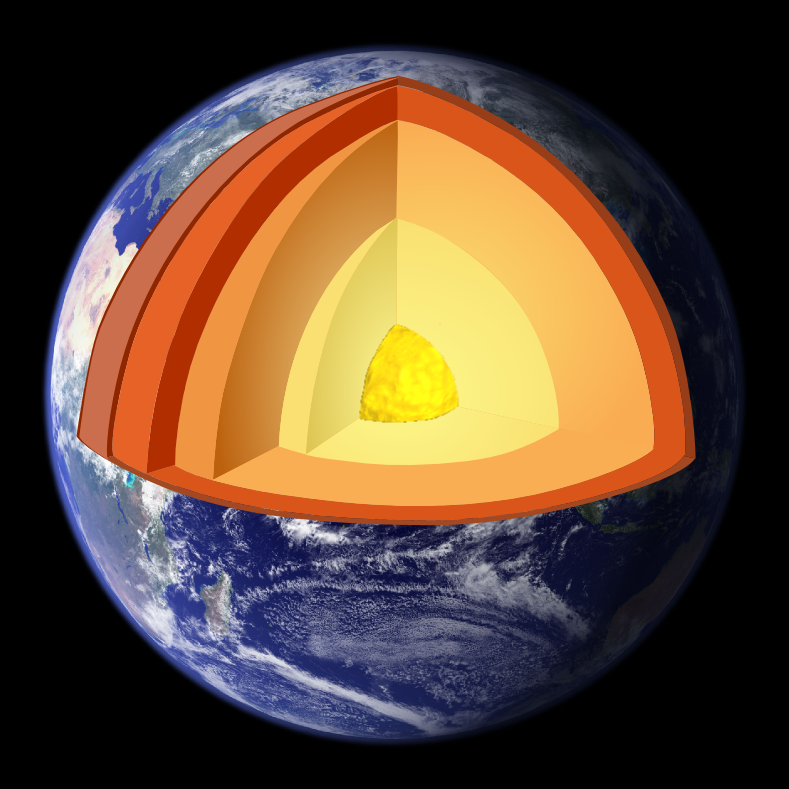
Plate boundaries are the linear or broad zones where two or more of Earth's tectonic plates meet and interact. These margins control where lithosphere is created, altered and destroyed, and they concentrate much of the planet's seismicity, volcanism and mountain building. Understanding plate boundaries explains the distribution of ocean basins, mountain belts, volcanic arcs, rift valleys and many natural hazards that affect societies.
Image gallery
7 Images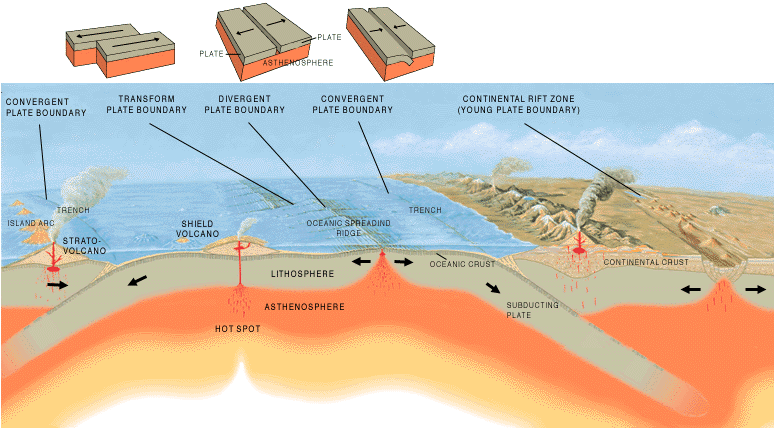


Types of plate boundaries
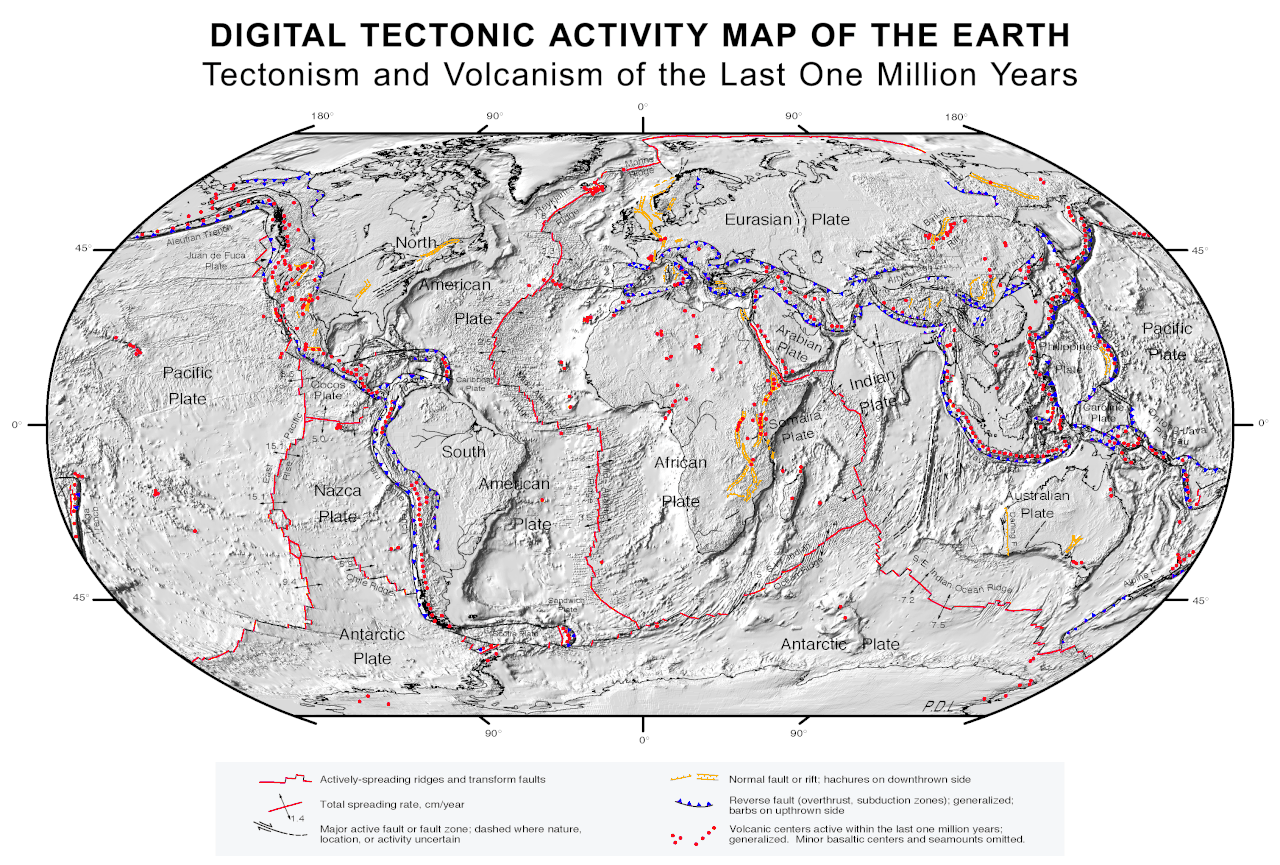
- Divergent (spreading) boundaries: At divergent margins plates move apart and mantle rock rises to form new oceanic crust. This process builds mid-ocean ridges and can initiate continental rifting. Typical features include axial rift valleys, basaltic volcanism and hydrothermal vent systems. Classic examples are the Mid-Atlantic Ridge and active rifting in Africa, such as the Great Rift Valley; general descriptions are found under spreading boundaries.
- Convergent (collision) boundaries: Convergence occurs when plates move toward one another. If an oceanic plate is involved it usually subducts beneath the overriding plate, forming a trench, an accretionary prism and a volcanic arc. Where two continental plates collide, crustal shortening produces high mountain ranges through sustained orogeny. Subduction-related regions along the West coast of the Americas illustrate arc volcanism and powerful quakes, while the collision of India with Asia is the archetype of continental collision; see also literature on orogeny. The term collision boundaries is commonly used for zones dominated by continent–continent convergence.
- Transform (strike-slip) boundaries: At transform or fault boundaries plates slide laterally past each other. These margins do not normally create or destroy large amounts of lithosphere but concentrate shear strain and produce frequent, often shallow earthquakes. Transform faults commonly link segments of mid-ocean ridges or join subduction zones; examples and mechanics are discussed under transform faults, and the seismic hazards they produce are summarized under earthquakes.
- Conservative boundaries: Some margins are described as conservative in the sense that there is little net creation or loss of crust at the boundary, though they can still be sites of significant deformation and seismicity.
Geological features and processes
Different boundary types produce characteristic landforms and rock records. Divergent margins build new oceanic crust and expose ophiolite sequences in some uplifted regions; subduction zones generate volcanic arcs, deep seismic zones and high-pressure metamorphic rocks. Continental collisions thicken crust and uplift mountain belts, producing extensive erosion and sedimentary basins at their margins. Other associated features include back-arc basins, foreland basins, accretionary prisms and hydrothermal deposits that can host mineral resources.
Hazards and human relevance
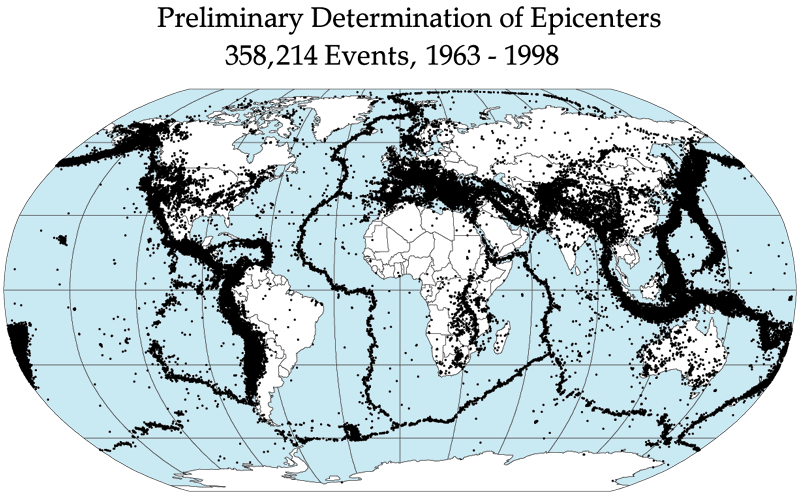
Most large earthquakes, many tsunamis and most volcanic eruptions are concentrated near plate boundaries. Subduction zones are responsible for some of the largest recorded earthquakes and explosive volcanic activity, while transform faults produce damaging surface rupture and strong ground shaking. Mapping boundaries helps prioritize hazard mitigation, land-use planning and the siting of infrastructure; it also guides exploration for geothermal systems and certain mineral deposits.
Research, mapping and complexity
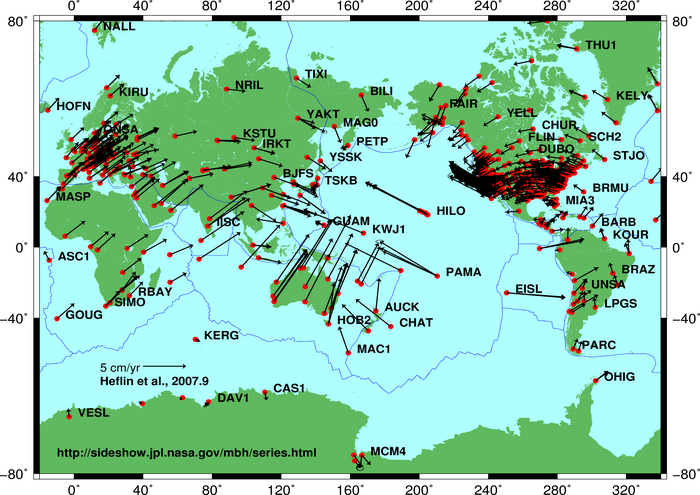
Plate boundaries may be narrow faults or broad diffuse zones where deformation is distributed across hundreds of kilometres. Modern geodesy (GPS), seismic imaging, geological mapping and oceanographic surveys refine our understanding of boundary motions and evolution. Scientists study how boundaries change through time as plates reorganize, rifts evolve into ocean basins or old margins become reactivated.
Examples for study
Well-studied examples cited above illustrate typical outcomes: spreading at the Mid-Atlantic Ridge, continental rifting in the Great Rift Valley, subduction along the West Americas margin and the India–Asia continental collision. Introductory and thematic resources include pages on spreading boundaries, transform faults, volcanism at plate margins, and reviews of orogenic processes. Further technical summaries and hazard guides are available in geoscience literature and institutional reports (mountain building, seismic risk, collision mechanics).
Continued research into plate boundaries integrates field observations, laboratory experiments and numerical models to explain how these zones control the long-term evolution of Earth's surface and interior, and how they influence environments and societies in the short term.
Related articles
Author
AlegsaOnline.com Plate boundary Leandro Alegsa
URL: https://en.alegsaonline.com/art/77333