
Mars Orbiter Mission (Mangalyaan)
India's first interplanetary probe, launched by ISRO in 2013 and placed in Mars orbit in 2014. Mangalyaan demonstrated affordable deep-space capability and delivered imaging and atmospheric science from orbit.
The Mars Orbiter Mission (MOM), widely known as Mangalyaan, is India's first spacecraft to travel to another planet. Launched by the Indian Space Research Organisation (ISRO) on 5 November 2013, it arrived at Mars and entered orbit on 24 September 2014. The project combined a technology demonstration of ISRO's ability to design, launch and operate an interplanetary spacecraft with a suite of scientific investigations designed to observe the Martian surface, atmosphere and near-space environment. Its success made India the first Asian nation to reach Mars orbit and one of the few space agencies to achieve Mars orbit insertion on its maiden interplanetary attempt.
Image gallery
10 Images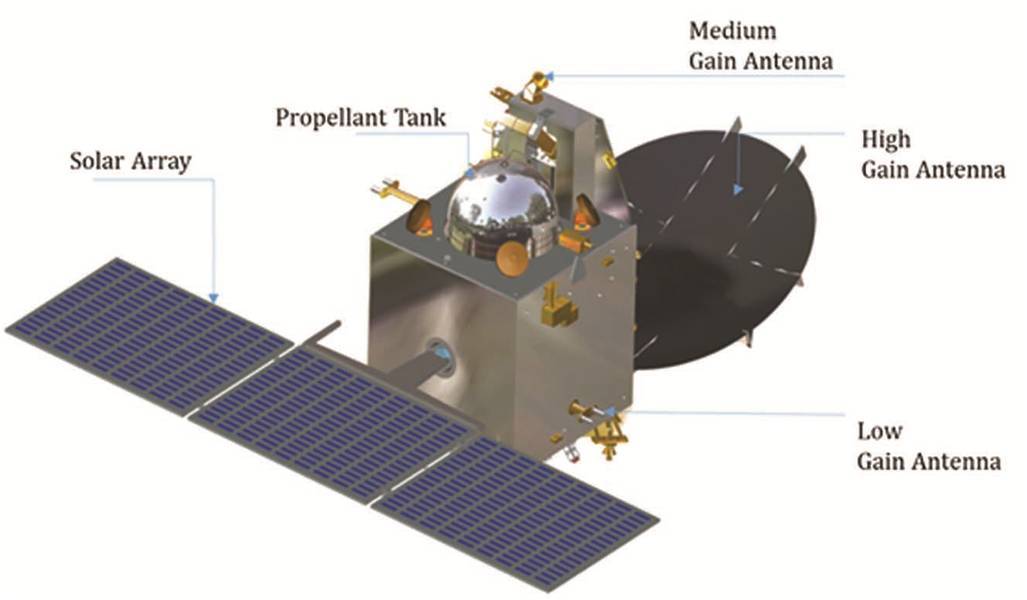


Background and development
The mission was conceived as a relatively low-cost, rapidly developed program to build national capability in planetary exploration. It drew on ISRO's experience with launch vehicles and orbiting satellites while introducing systems for deep-space navigation, long-duration communication and autonomous operations. The project emphasized simplicity, reliability and cost-effectiveness in spacecraft design and mission planning.
Launch, trajectory and orbit
MOM was launched on a Polar Satellite Launch Vehicle (PSLV) variant from the Satish Dhawan Space Centre at Sriharikota. After an initial Earth-bound phasing and a heliocentric transfer, a critical Mars orbit insertion burn placed the spacecraft into an elliptical polar orbit around Mars. The orbit allowed repeated coverage across a wide range of latitudes and local times, balancing opportunities for imaging, atmospheric observation and long-term monitoring.
Spacecraft and instruments
The orbiter carried a small, focused science payload alongside systems to validate interplanetary operations. Primary instruments included:
- Mars Colour Camera (MCC) — for wide-angle color imaging of surface features, polar caps and weather phenomena.
- Thermal Infrared Imaging Spectrometer (TIS) — to map thermal properties and infer surface mineralogy.
- Methane Sensor for Mars (MSM) — to search for methane and constrain its spatial and temporal variability.
- Lyman-Alpha Photometer (LAP) — to observe hydrogen and deuterium emissions and study atmospheric escape processes.
- Mars Exospheric Neutral Composition Analyser (MENCA) — to measure the composition of the upper atmosphere and exosphere.
Scientific results and operations
MOM returned color imagery of surface features and weather systems, measurements of thermal behaviour and compositional data from the upper atmosphere. The methane experiment did not report a persistent global source but helped define constraints on variability and informed subsequent investigations by other missions. Operationally, MOM demonstrated long-duration deep-space communication and mission planning on a modest budget; it continued to operate and provide data well beyond its initial planned life.
Legacy and further resources
Beyond scientific output, Mangalyaan had a notable cultural and strategic impact: it boosted domestic interest in space science, strengthened ISRO's international standing in planetary exploration, and laid groundwork for follow-up missions. For official summaries and technical details see the mission overview. Operational updates and data releases were shared through project portals and science archives such as the project data portals. For broader context on national activities consult resources on India’s space activities and regional developments at regional space history.
Questions and answers
Q: When was the Mars Orbiter Mission launched?
A: The Mars Orbiter Mission was launched on 5 November 2013.
Q: What is the Mars Orbiter Mission?
A: The Mars Orbiter Mission is a space probe that has been orbiting Mars since 24 September 2014.
Q: Who launched the Mars Orbiter Mission?
A: The Mars Orbiter Mission was launched by the Indian Space Research Organization (ISRO).
Q: Is the Mars Orbiter Mission India's first interplanetary mission?
A: Yes, the Mars Orbiter Mission is India's first interplanetary mission.
Q: Is India the first Asian nation to reach Mars orbit?
A: Yes, India is the first Asian nation to reach Mars orbit.
Q: Was India successful on its first attempt at reaching Mars?
A: Yes, India was the first nation to reach Mars on its first try.
Q: What is another name for the Mars Orbiter Mission probe?
A: Another name for the Mars Orbiter Mission probe is Mangalyaan.
Related articles
Author
AlegsaOnline.com Mars Orbiter Mission (Mangalyaan) Leandro Alegsa
URL: https://en.alegsaonline.com/art/62243
Sources
- spaceflight101.com : "Mars Orbiter Spacecraft completes Engine Test, fine-tunes its Course"
- isro.gov.in : "Mars Orbiter Mission Spacecraft"
- doi.org : 10.18520/v109/i6/1061-1069
- timesofindia.indiatimes.com : "India to launch Mars Orbiter Mission on November 5"
- isro.gov.in : "Mars Orbiter Mission: Launch Vehicle"
- heraldsun.com.au : "India becomes first country to enter Mars' orbit on their first attempt"
- isro.org : "Mars Orbiter Spacecraft Successfully Inserted into Mars Orbit"
- isro.gov.in : "PSLV-C25/Mars Orbiter Mission - ISRO"
- nssdc.gsfc.nasa.gov : "NASA - NSSDCA - Spacecraft - Details"
- nationalgeographic.com : "Dear Mangalyaan: What India's Mars mission means to me"
- space.com : "India's First Mission to Mars to Launch This Month"