
Mars Climate Orbiter — NASA mission and unit‑conversion failure
NASA's Mars Climate Orbiter (launched 11 Dec 1998) was designed to study Martian weather and relay data. It was lost during Mars orbit insertion on 23 Sep 1999 after a units conversion error caused a navigation failure.
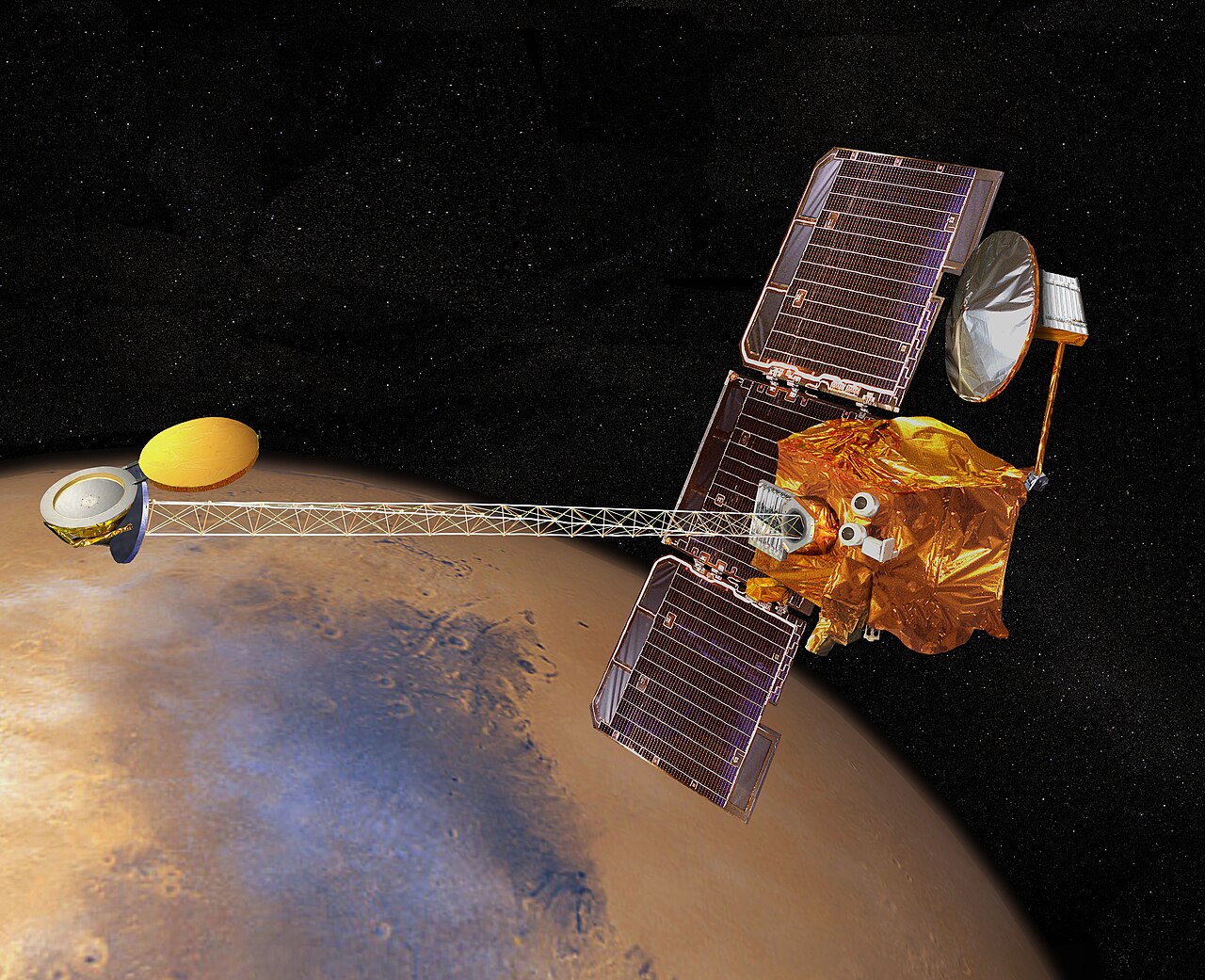
The Mars Climate Orbiter was an American robotic spacecraft launched to study the atmosphere and climate of Mars and to serve as a communications relay for surface missions. Launched on 11 December 1998 as part of the Mars Surveyor program, the probe carried instruments intended to observe temperature, dust and water vapor in the Martian atmosphere and to assist future landers by relaying data back to Earth. Contact with the vehicle was lost during the planned orbital insertion maneuver on 23 September 1999.
Image gallery
10 Images



Mission objectives and scientific goals
The principal goals for the orbiter were to characterize the Martian climate system on regional and global scales, to monitor atmospheric conditions such as dust storms and water vapor, and to improve models of seasonal and daily variation. In addition to remote sensing of atmospheric properties, the spacecraft was intended to act as a telecommunications relay for the Mars Polar Lander and other surface assets. The mission combined atmospheric science with an operational role to support Mars exploration.
Spacecraft design and subsystems
The orbiter carried a suite of instruments and standard spacecraft systems: a propulsion and attitude-control system for trajectory corrections and orbit insertion, a radio communications package to send science and relay data, and remote-sensing sensors for atmospheric and climate measurements. Navigation was performed by ground teams using telemetry and tracking data; on-board software controlled maneuvers and interpreted commands from Earth. The overall design followed conventional patterns for orbiters of the era, balancing instrument capability, propulsion margin, and communications bandwidth.
Failure during orbital insertion and investigation
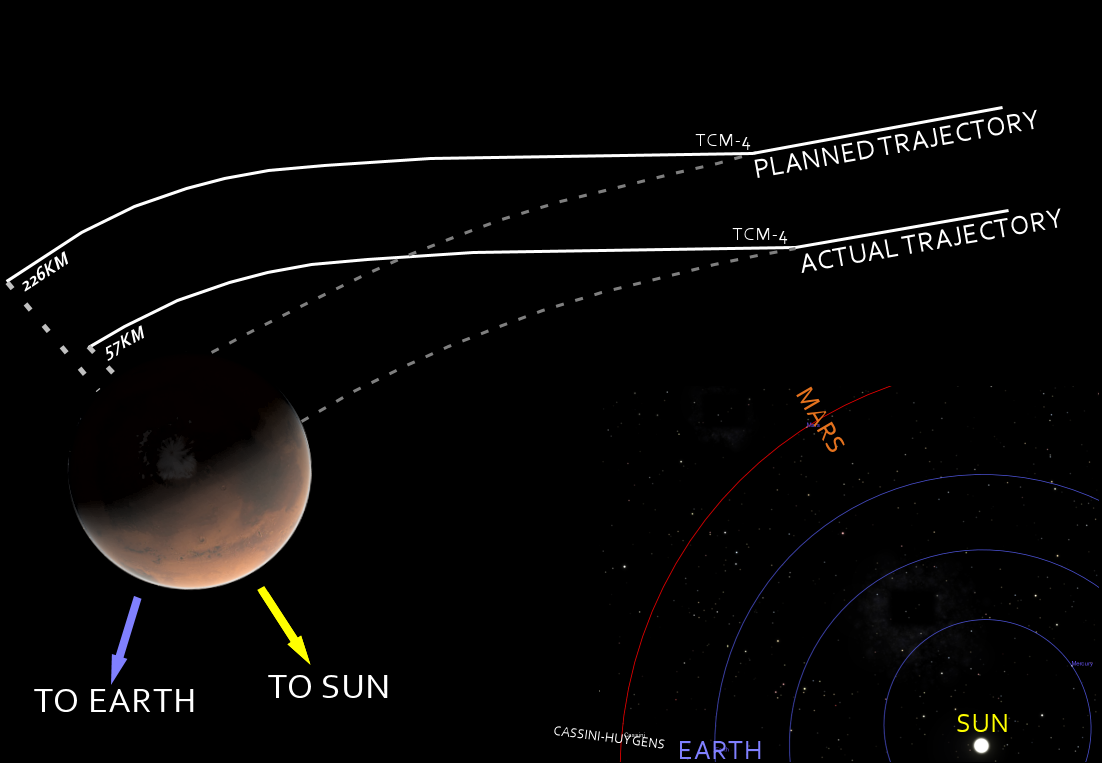
During the critical orbit insertion phase in September 1999 the spacecraft followed a trajectory that brought it far closer to Mars than planned. Ground teams lost contact during or shortly after the maneuver and the spacecraft did not complete its mission. A subsequent mishap investigation found that a failure in systems integration and verification led to a units mismatch between software components: one piece of flight software produced thruster impulse data in non‑SI (imperial) units while another routine expected SI (metric) units. That discrepancy caused the navigation calculations to be incorrect and the planned burn to place the vehicle on an unintended trajectory.
The exact fate of the orbiter remains uncertain: it likely either burned up in the Martian atmosphere after a deeper-than-intended passage or passed through the atmosphere and was deflected into a heliocentric (solar) orbit. The accident report also identified weaknesses in testing, interface control, and project oversight that allowed the error to pass undetected through development and mission operations. The board's findings led to procedural and managerial changes within the program to reduce the risk of similar integration errors.
Timeline and key facts
- Launch: 11 December 1998.
- Loss of contact during Mars orbit insertion: 23 September 1999.
- Primary cause identified: units conversion mismatch between teams and software modules, leading to incorrect navigation inputs.
- Program context: part of the Mars Surveyor family and intended to support the Mars Polar Lander.
Legacy and lessons learned
The loss of the Mars Climate Orbiter became a widely cited example of the consequences of inadequate interface control and unit consistency in complex engineering projects. It reinforced the importance of rigorous verification of software and data formats, clear responsibility for engineering interfaces, and independent testing of critical mission elements. The mishap influenced subsequent mission planning and practices in spacecraft development, emphasizing standardization of units, more comprehensive systems engineering, and improved cross‑organization communication.
For more technical background and historical context see the mission overview and official summaries: mission overview, program documentation, and general notes on unit systems such as the difference between SI and imperial units: units explanation.
Related articles
Author
AlegsaOnline.com Mars Climate Orbiter — NASA mission and unit‑conversion failure Leandro Alegsa
URL: https://en.alegsaonline.com/art/62237
Sources
- llis.nasa.gov : Mars Climate Orbiter Mishap Investigation Board Phase I Report
- cnn.com : "Metric mishap caused loss of NASA orbiter"