
Mars flyby
A Mars flyby is a spacecraft close pass of Mars that gathers scientific and engineering data without entering orbit or landing; used by robotic probes for reconnaissance, instrument tests and trajectory design.
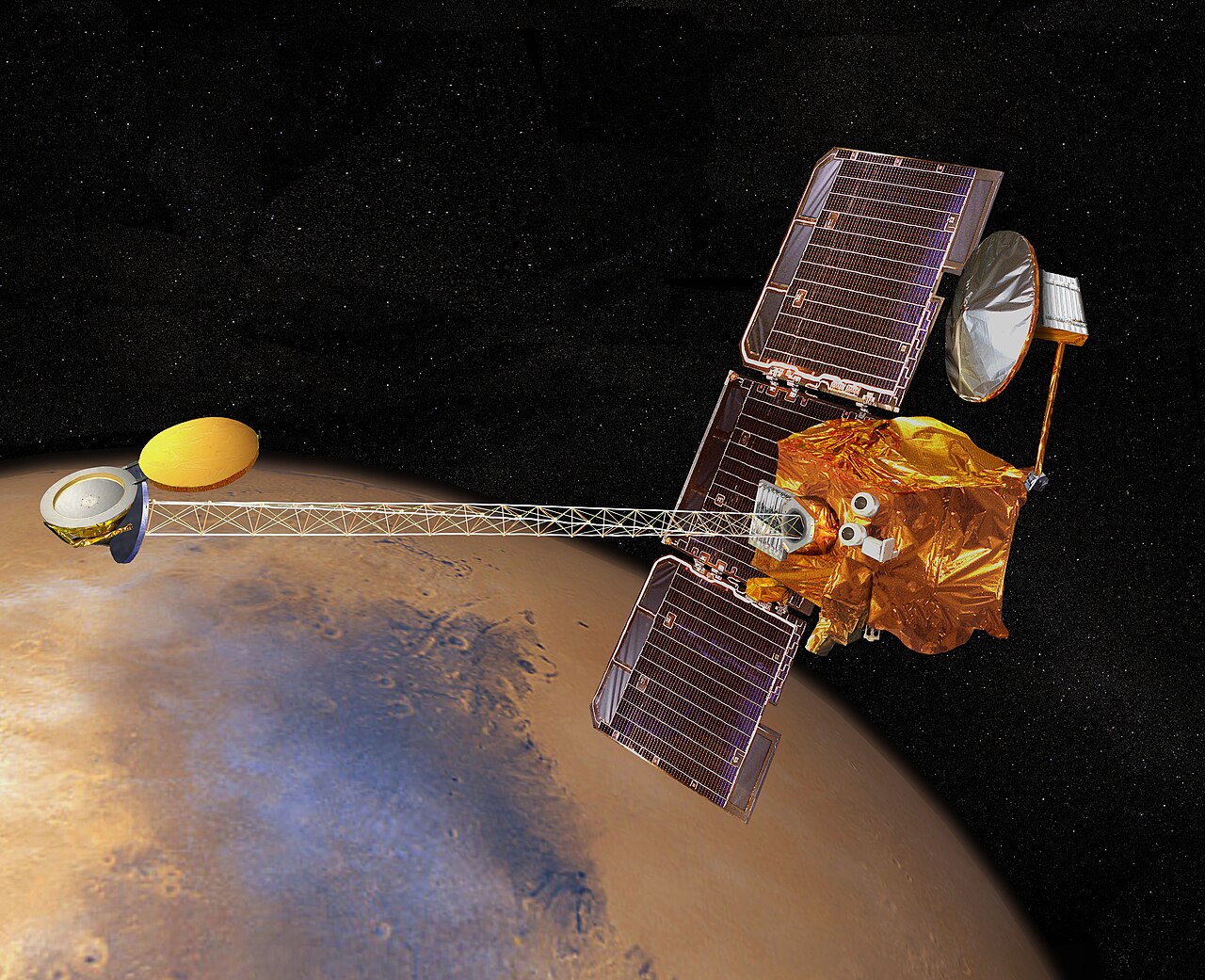
Mars flyby describes an encounter in which a spacecraft makes a close pass of Mars without attempting to insert into planetary orbit or to land on the surface. Flybys are normally conducted by robotic, unmanned probes and by spacecraft architectures sometimes called a "flyby bus," designed to support a brief, high-speed encounter with a concentrated set of instruments before continuing on a heliocentric or interplanetary path.
Image gallery
9 Images


Purpose and scientific value
Flybys provide a fast, lower-cost means to obtain close-up data. Typical scientific objectives include global imaging, short-term atmospheric profiling by radio occultation, dust and plasma environment measurements, magnetic field sampling, and particle detection. Because the encounter is brief, instruments and operations are optimized for rapid data collection, precise pointing and high-rate telemetry.
Spacecraft design and operations
- Trajectory: Flybys follow a hyperbolic or near-hyperbolic path relative to the planet. The relative speed is usually high, so viewing geometry and illumination change quickly during approach and departure.
- Payload and timing: Cameras, spectrometers, magnetometers and charged-particle detectors are common. Observations are scheduled in advance and often run autonomously during the closest approach period.
- Communications and navigation: Accurate tracking and timing are essential. Mission teams rely on preplanned sequences and robust telemetry links to downlink the burst of data gathered at encounter.
- Advantages: Flybys avoid the fuel and complexity of orbit insertion or landing, which lowers cost and reduces mission risk. They can also be used for gravity-assist maneuvers to adjust trajectories with minimal propellant.
History and examples
Flyby missions were central to early exploration of Mars. The first successful close-up reconnaissance was carried out by a Mariner-series spacecraft, which returned the first detailed photographs of Martian terrain and revealed a thin atmosphere and heavily cratered regions. Subsequent Mariner flybys provided additional imaging and atmospheric data that shaped later orbiter and lander missions.
Limitations and uses in mission planning
Unlike an orbiter, a flyby cannot provide continuous monitoring of a region, and unlike a lander it cannot perform in-situ surface experiments or long-duration sampling. Mission designers choose flybys when reconnaissance, instrument testing, or trajectory requirements make a brief encounter preferable. Flybys can also support future missions by identifying landing-site candidates or validating instruments before commitment to more complex missions.
Flyby concepts have also appeared in human exploration studies: crewed flyby proposals would allow astronauts to travel past Mars and return to Earth without descent, reducing risk at the cost of foregoing surface access. For technical overviews and mission summaries, see general references on spacecraft design, orbital mechanics, and comparative studies of landing systems and robotic missions. For a concise planetary context, consult an accessible Mars overview.
Questions and answers
Q: What is a Mars flyby?
A: A Mars flyby is a method used by spacecraft to pass near the planet Mars, but not enter orbit or land on it.
Q: What kind of spacecraft have used the Mars flyby method?
A: Unmanned space probes have used the Mars flyby method to collect data on Mars and other worlds.
Q: What is a spacecraft that is built for a flyby called?
A: A spacecraft that is built for a Mars flyby is also known as a "flyby bus" or "flyby spacecraft".
Q: Are there any humans on board during a Mars flyby?
A: No, there are no humans on board during a Mars flyby, it is an unmanned mission.
Q: What is the purpose of using the Mars flyby method?
A: The purpose of using the Mars flyby method is to collect data on Mars and other worlds.
Q: Is a spacecraft that is built for a Mars flyby capable of landing on Mars?
A: No, a spacecraft that is built for a Mars flyby is not capable of landing on Mars.
Q: Are there any other names for a spacecraft that is built for a Mars flyby?
A: Yes, a spacecraft that is built for a Mars flyby is also known as a "flyby bus" or "flyby spacecraft".
Related articles
Author
AlegsaOnline.com Mars flyby Leandro Alegsa
URL: https://en.alegsaonline.com/art/62238
Sources
- history.nasa.gov : NASA SP-2001-4521
- news.bbc.co.uk : Space probe performs Mars fly-by - BBC
- books.google.com : Joseph A. Angelo - Encyclopedia Of Space And Astronomy (2006) - Page 171
- planetary.org : "Dawn Journal: Aiming away from a bull's eye at Mars"
- space.com : "Asteroid-Bound Probe Zooms Past Mars"
- esa.int : ESA - Rosetta successfully swings-by Mars
- nssdc.gsfc.nasa.gov : NSSDC - Nozomi
- planet4589.org : "Launch Log"
- russianspaceweb.com : "Russia's unmanned missions to Mars"
- astronautix.com : "Mars"
- burro.astr.cwru.edu : The Soviet Mars program
- nssdc.gsfc.nasa.gov : NASA - Mars 6