
Mars: Overview, Characteristics, and Exploration
Mars is the fourth planet from the Sun, a cold, rocky terrestrial world with polar ice, a thin CO2 atmosphere, large volcanoes and canyons, two small moons, and a long history of robotic exploration.
Overview
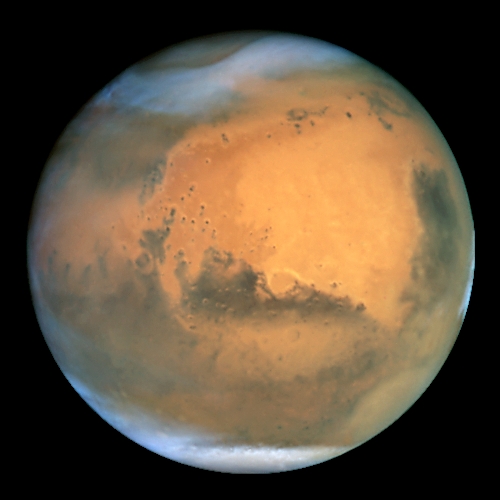
Mars is the fourth planet from the Sun and a well-studied member of the Solar System. It is commonly classed among the inner worlds of the inner Solar System and is a terrestrial planet with a solid, rocky surface. Its distinctive reddish hue gave rise to the association with classical mythology: the planet's name derives from the mythological Roman god of war, reflecting its color in the night sky.
Image gallery
10 Images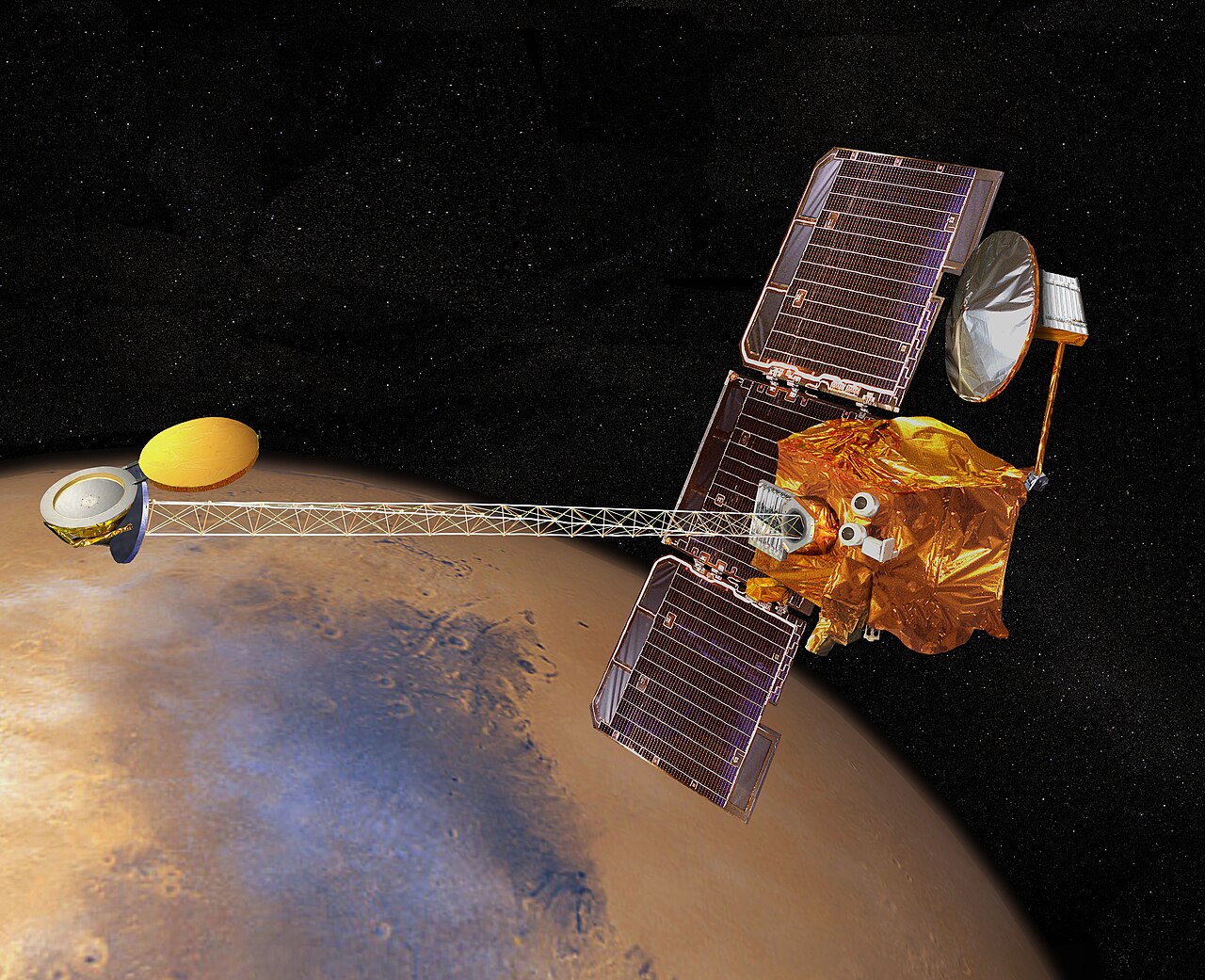



Physical characteristics
Mars has a thin atmosphere dominated by carbon dioxide, and seasonal frost and polar caps that include layers of frozen water and solid carbon dioxide. Surface features range from broad volcanic plains to deep canyons and large impact basins. The planet is home to the Solar System's most prominent shield volcanoes, including the feature often described as the largest volcano known on rocky planets.
Surface, climate, and geology
The Martian surface shows widespread evidence of past liquid water: dry river channels, sedimentary rocks and minerals altered by water, and substantial subsurface ice. Present conditions are cold and arid, with global and regional dust storms that can obscure the surface. Seasonal changes, driven by axial tilt, affect the extent of the polar ice caps and the distribution of frost. These features make Mars a key subject in studies of planetary climate change and habitability.
Moons and internal structure
Mars is orbited by two small moons, Phobos and Deimos, which are irregular in shape and may be captured remnants from the early Solar System. The planet's interior shows a layered structure with a crust, mantle and core, and its surface gravity—substantially lower than Earth's—affects atmospheric retention and surface operations for probes and future visitors.
History of observation and naming
People have observed Mars since antiquity and recorded changes in its brightness and position. Systematic telescopic study began in the 17th century and expanded with modern planetary science to include spectroscopy and imaging. For accounts of cultural and scientific records, see summaries of historical observations.
Exploration and missions
Robotic exploration of Mars relies on space probes in orbit and on the surface. Early landers such as the Viking program provided the first direct surface measurements, and subsequent missions have included orbiters, stationary landers and mobile rovers. Contemporary programs aim to return samples to Earth and to prepare for human missions; for programmatic overviews, consult resources on Mars exploration.
Scientific importance and future prospects
Mars preserves a long record of planetary processes and offers accessible targets for studying past climates, potential biosignatures and in-situ resources such as subsurface ice. Current and planned missions continue to refine knowledge of its geology, atmosphere and potential for future human presence, involving international collaboration and a range of scientific instruments.
Questions and answers
Q: What is the fourth planet from the Sun?
A: The fourth planet from the Sun is Mars.
Q: Is Mars a terrestrial or gas giant planet?
A: Mars is a terrestrial planet.
Q: What are some features of Mars?
A: Some features of Mars include polar ice caps of frozen water and carbon dioxide, the largest volcano in the Solar System, and some very large impact craters.
Q: Why is it called "Mars"?
A: It is called "Mars" because it appears red in color, which was associated with war in Roman mythology.
Q: How do we explore Mars?
A: We explore Mars through space probes such as Viking program landers.
Related articles
Author
AlegsaOnline.com Mars: Overview, Characteristics, and Exploration Leandro Alegsa
URL: https://en.alegsaonline.com/art/62246
Sources
- books.google.com : Mars and How to Observe It
- ui.adsabs.harvard.edu : 2012P&SS...67..147H
- doi.org : 10.1016/j.pss.2012.02.006
- hdl.handle.net : 20.500.11937/32270
- astronomycafe.net : What is the typical temperature on Mars?
- marsrover.nasa.gov : Mars Exploration Rover Mission: Spotlight
- mars.jpl.nasa.gov : "Mars: Extreme Planet" · web.archive.org · web.archive.org
- anl.gov : "APS X-rays reveal secrets of Mars' core"
- discovermagazine.com : Mars, in Earth's Image
- bbc.co.uk : bbc.co.uk/news/science-environment-34379284
- daleandersen.seti.org : daleandersen.seti.org
- onlinelibrary.wiley.com : onlinelibrary.wiley.com/doi/10.1029/2006GL025946/abstract
- nasa.gov : nasa.gov