
Lungfish (Dipnoi): anatomy, evolution, behavior and distribution
Lungfish are freshwater lobe-finned fishes with both lungs and gills. This article summarizes their anatomy, evolutionary importance, behavior (including aestivation), species distribution, and conservation.
Overview
Lungfish are members of the subclass Dipnoi, a group of lobe-finned fishes notable for having functional lungs as well as gills. They share a close evolutionary relationship with the coelacanths and with the early lobe-finned fishes that led to the first tetrapods. Like other sarcopterygians, lungfish possess paired, lobed appendages — sometimes referred to as fins or, in distant relatives, limbs — attached to the body through a robust skeletal connection to a pelvis or shoulder girdle by a single major bone comparable to a femur or humerus.
Image gallery
10 Images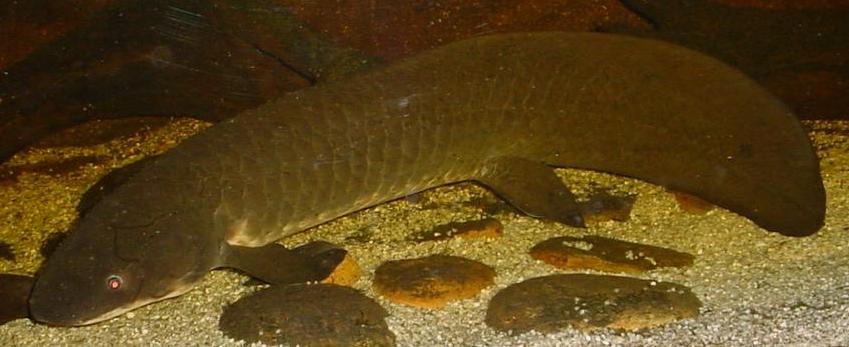


Anatomy and physiology
Lungfish are primarily freshwater fishes that combine gill breathing with air-breathing lungs (lungs and gills coexist). Their lobed fins contain internal bones and musculature that allow subtle, crawling movements along the substrate rather than rapid swimming. The respiratory arrangement lets lungfish extract oxygen from water when it is abundant and from air when water is hypoxic or absent.
Behavior, aestivation and life cycle
Lungfish live in seasonal or variable waters such as small lakes and rivers that can shrink or dry. When habitat conditions deteriorate they can enter a prolonged state of torpor called aestivation, a type of dormancy related to hibernation and dormancy. During aestivation a lungfish burrows into mud, secretes a mucus cocoon, lowers its metabolic rate and relies mainly on its lungs for oxygen. Reported lengths of dormancy vary by species and circumstance, ranging from weeks to several months and, in some cases, years.
Evolutionary significance
Dipnoi are important to understanding the water-to-land transition because their anatomy preserves features intermediate between aquatic fishes and early tetrapods. Their combination of lungs and robust, lobed fins illustrates one pathway by which vertebrates adapted to breathe air and support themselves in shallow, unstable environments. Paleontologists compare lungfish to both coelacanths and the early stem-tetrapods to reconstruct those evolutionary steps.
Distribution and species
Only a few lungfish species survive today. There are commonly cited totals of eight living species: six are native to Africa, one to South America and one in Australia (Australia). The African genera (Protopterus spp.) are well known for prolonged aestivation, the South American form (Lepidosiren) has similar habits, while the Australian species (Neoceratodus) is more fully aquatic and seldom estivates.
Uses, conservation and notable facts
Lungfish have limited direct economic value as food in some regions but are scientifically valuable for studies of vertebrate evolution, physiology and air-breathing. Several species face threats from habitat loss, water pollution and alteration of river systems; conservation status varies by species and locality. Notable features include their long evolutionary history, unique respiratory duality, and the ability of many species to survive extended drought by aestivation.
- Related groups: coelacanths, early tetrapod ancestors (tetrapods).
- Key traits: lobed fins (fins/limbs), limb girdles (pelvis/shoulder), single major limb bone (femur/humerus), lungs (lungs) and gills (gills).
- Habitats: small lakes and rivers, often seasonal.
- Behavioral adaptation: aestivation, a form of dormancy.
- Geographic distribution: Africa, South America, and Australia (Australia).
Related articles
Author
AlegsaOnline.com Lungfish (Dipnoi): anatomy, evolution, behavior and distribution Leandro Alegsa
URL: https://en.alegsaonline.com/art/59946