
Gill
A gill is a respiratory organ that extracts dissolved oxygen from water; found in fish, many amphibians, some invertebrates, and also as a spore-bearing structure in certain fungi.
A gill is a body structure that enables gas exchange between an animal (or, in a different sense, a fungus) and an aquatic environment. In animals, gills allow oxygen dissolved in water to enter the bloodstream and permit carbon dioxide to leave. The fundamental requirement for gill function is a thin, moist surface with a large area exposed to flowing water so dissolved gases can diffuse across membranes.
Image gallery
7 Images
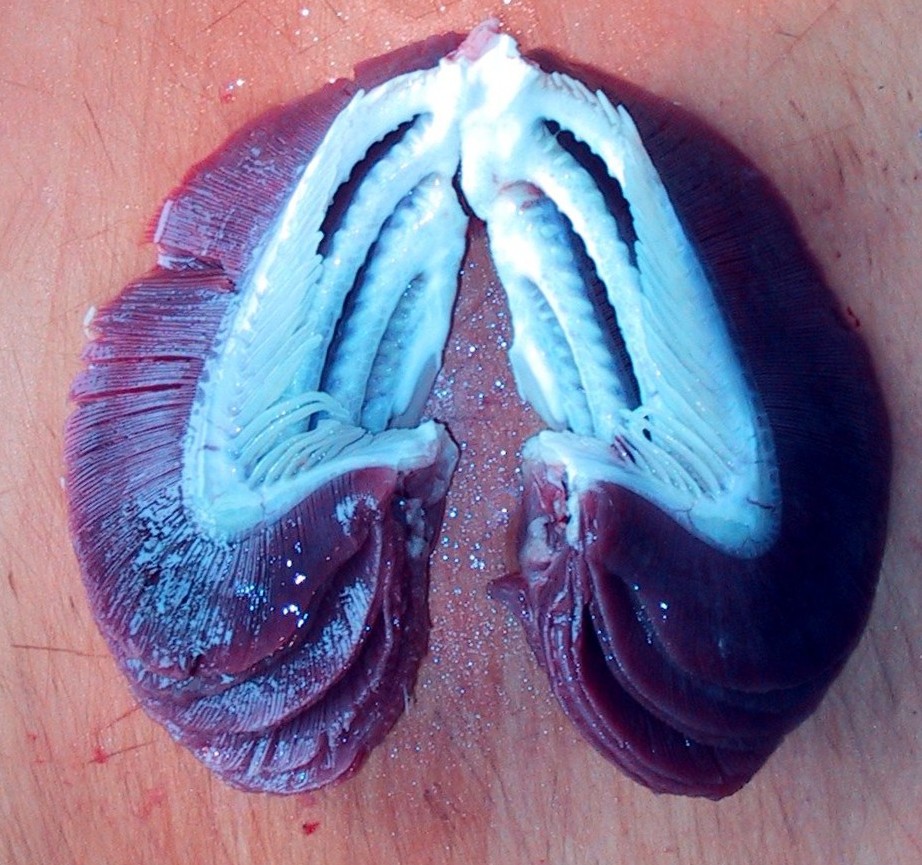


Basic structure and function
Animal gills typically consist of filaments or lamellae — thin, often feathery projections that increase surface area. Water passing over these surfaces carries dissolved oxygen close to blood vessels. Oxygen diffuses from water into blood while carbon dioxide moves the opposite way. This exchange is supported by countercurrent flow in many fish gills, a mechanism that maintains a favorable gradient for oxygen uptake. See general examples such as fish, amphibians, and other aquatic animals that use gills.
Where gills appear in animals
Gills occur in several animal groups but vary in form. In bony fish, gills are enclosed behind gill covers and composed of rows of filaments. The thin walls of these filaments are rich in blood vessels, so oxygen passes rapidly into the circulatory system (blood) while carbon dioxide is released. Many frogs have gills during their larval stage, hidden at the sides of the head, and mammals descended from such ancestors do not retain them. Sharks and rays show exposed gill slits along the sides of the head or neck (sharks), and certain amphibian larvae like salamanders display external, feathery gills that project from the head.
Alternatives and special cases
Not all aquatic respiration uses classical gill anatomy. Some insects possess a plastron: a dense patch of hydrophobic hairs that traps a thin air film against the body and keeps the spiracles open for gas exchange (spiracles). Other invertebrates have modified body surfaces or internal structures that achieve the same goal. These adaptations allow prolonged submersion without surfacing for air.
Gills in fungi
In a totally different context, the word "gill" describes the thin plates found beneath the caps of many mushrooms in the agaric group. These fungal gills are not respiratory organs; rather, they are the primary spore-bearing surfaces where reproductive cells (spores) develop and are released. Standard references treat mushroom gills as essential for spore production and dispersal in many species (mushrooms, spores).
Ecological and evolutionary significance
Gills have enabled animals to exploit aquatic habitats across multiple lineages. Their forms reflect evolutionary solutions to maximizing gas exchange while minimizing water loss or damage. Because gills are delicate and exposed, many species combine respiratory adaptations with behaviors or anatomical features (such as protective covers or strong water currents produced by ventilation) to maintain efficient oxygen uptake. For further reading on aquatic respiration and organisms that rely on gills, consult resources about dissolved oxygen and organismal physiology (carbon dioxide handling) as well as summaries about specific groups like fish and amphibians.
- Typical animal gill features: thin membranes, large surface area, rich blood supply (blood).
- Varieties: internal gills (bony fish), exposed gill slits (sharks), external feathery gills (some larvae) (sharks, salamanders).
- Non-animal use of the term: mushroom gills that bear spores (mushrooms).
- Related adaptations: plastrons and spiracle-based systems in aquatic insects (spiracles).
For concise introductions and images of different gill types, see general biology overviews and specialized texts on aquatic respiration and mycology (other aquatic animals, frog-life histories). Additional multimedia and databases can be found through curated educational portals and scientific summaries (fish, dissolved oxygen, amphibian resources).
Related articles
Author
AlegsaOnline.com Gill Leandro Alegsa
URL: https://en.alegsaonline.com/art/38839