
Macaque (genus Macaca) — overview, behaviour, distribution and human interactions
Macaques (genus Macaca) are Old World monkeys found mainly in Asia and parts of Africa. This article outlines their traits, social systems, distribution, role in research, and conservation concerns.
The macaques belong to the genus Macaca, a well-known group of Old World monkeys in the subfamily Cercopithecinae. As a genus they are distinguished from many other primates by a combination of flexible diets, pronounced social systems and an ability to occupy a variety of ecosystems. Their prominence in both field studies and laboratory research has made them one of the most studied nonhuman primate groups.
Image gallery
10 Images


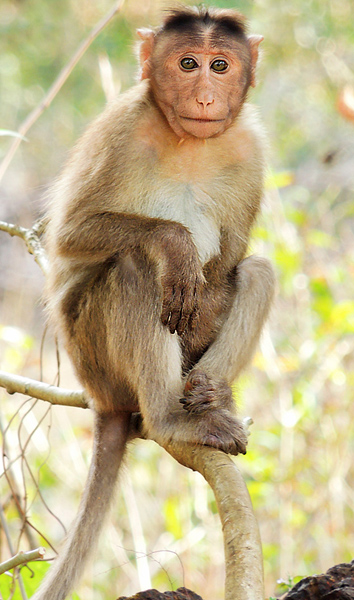


Distribution and species
There are around 22 species commonly recognised in this genus. Most species occur across Asia, from tropical lowlands to temperate and montane forests. Several species also live in Africa: many are found in parts of sub-Saharan regions such as forested or savanna-edge habitats (sub-Saharan Africa), while one North African species has a small, long-known population on Gibraltar (Gibraltar). Their broad geographic range reflects both evolutionary adaptability and, in some cases, long histories of contact with humans.
Physical traits and ecology
Macaques vary in size and appearance but share several characteristic features: relatively short faces compared with apes, a hair-covered body with areas of bare skin on the face, and tails that range from long to very short or absent. They are generally omnivorous, eating fruits, leaves, seeds, invertebrates and sometimes human food. Many species are both arboreal and terrestrial, showing behavioral flexibility that helps them exploit forests, mangroves, mountains and urban environments.
Behaviour and social structure
Macaques live in social groups characterized by stable hierarchies and frequent social grooming. Group composition and dominance relations can differ between species: some societies are matrilineal, with rank inherited through female lines, while males may transfer between groups. Communication involves vocalizations, facial expressions and tactile interactions. Tool use and culturally transmitted behaviors have been documented in several macaque populations, underlining their cognitive and social complexity.
Research, human interaction and conservation
Macaques are widely used in neuroscience, vision research and biomedical studies because of anatomical and physiological similarities to humans. At the same time, their presence in agricultural or urban areas can lead to conflict, and tourism interactions—such as visits to Gibraltar’s macaques—raise ethical and management questions. Conservation status varies: some species remain common and adaptable, while others face habitat loss, hunting and population decline, prompting targeted protection efforts.
Notable species and examples
- Rhesus macaque (often used in medical and behavioral research).
- Japanese macaque (famous for living in snowy mountain areas and bathing in hot springs).
- Long-tailed or crab-eating macaque (adaptable and coastal in parts of Southeast Asia).
- Barbary macaque (the North African species with a well-known population on Gibraltar).
- Celebes crested macaque (a striking black species of Sulawesi that is of conservation concern).
For further reading on taxonomy, ecology and specific species, see summaries and resources about the genus Macaca and general primate overviews among studies of Old World monkeys. Detailed regional accounts often draw on field surveys in Asia and Africa, while species lists and nomenclature are maintained in specialist databases and conservation assessments (species lists). Practical visitor information or management plans sometimes reference the Gibraltar population (Gibraltar).
Questions and answers
Q: What is a macaque?
A: A macaque is a genus of Old World monkeys in the subfamily Cercopithecinae.
Q: How many species of macaques are there?
A: There are 22 species of macaques.
Q: Where do macaques live?
A: Macaques inhabit sub-Saharan Africa and Asia.
Q: Which macaque species is well-known?
A: The Gibraltar 'ape' is a well-known species of macaque.
Q: Why are macaques of interest to human researchers?
A: Macaques are of interest to human researchers for their social structures and their usefulness in animal testing, particularly regarding eyesight.
Q: What is the subfamily of macaques?
A: Macaques belong to the subfamily Cercopithecinae.
Q: Are macaques similar to baboons?
A: Macaques are similar to baboons as they are both Old World monkeys, but they belong to different genera.
Related articles
Author
AlegsaOnline.com Macaque (genus Macaca) — overview, behaviour, distribution and human interactions Leandro Alegsa
URL: https://en.alegsaonline.com/art/60270
Sources
- myfox8.com : "Wikimedia refuses to remove animal selfie because monkey 'owns' the photo"
- telegraph.co.uk : "Wikipedia refuses to delete photo as 'monkey owns it'"
- commons.wikimedia.org : Macaca