
Argentinosaurus — giant titanosaur of the Late Cretaceous
Argentinosaurus was a colossal titanosaurian sauropod from Argentina. Known from fragmentary remains, it is considered among the largest dinosaurs, though size estimates remain uncertain.
Overview
Argentinosaurus is a genus of enormous titanosaurian titanosaurid sauropod sauropod dinosaur first named in 1993. Its name means "Argentina lizard," reflecting the country where its remains were found. The animal lived in what is now Argentina on the continent of South America during the Cretaceous period. Although only partial bones have been recovered, Argentinosaurus is often cited among the largest terrestrial animals ever to have lived.
Image gallery
10 Images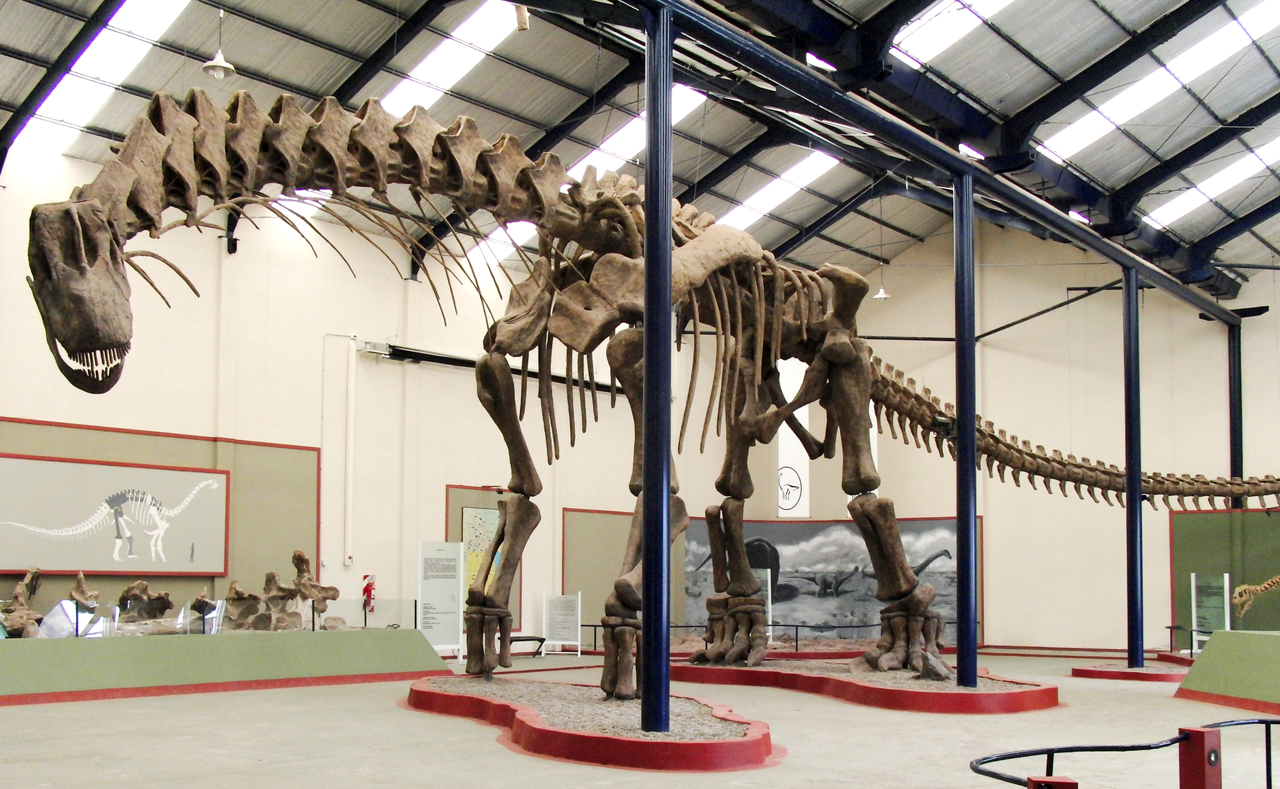


Discovery and naming
The genus was formally described by Rodolfo Coria and José Bonaparte in 1993, based on fossil material recovered from the Neuquén Province. The type specimens include large back vertebrae, ribs, a sacrum and a tibia, among other fragments. These elements were sufficient to indicate a very large titanosaur, but not enough to present a complete skeletal reconstruction.
Anatomy and size estimates
Known bones such as the dorsal vertebrae, sacrum and tibia show the characteristic sauropod body plan: an elongated neck and tail, massive barrel-shaped body and column-like limbs for supporting great weight. Size estimates vary because the remains are incomplete; conservative reconstructions scale Argentinosaurus from better-known titanosaurs, while other estimates extrapolate from the dimensions of its preserved vertebrae and limb fragments. For comparison and methodological context researchers have used smaller, well-described taxa like Saltasaurus as reference models and also compared results to more complete giants such as the subadult Dreadnoughtus.
Paleoecology and significance
Argentinosaurus would have been a herbivore, feeding on a variety of plant material available in Cretaceous South American ecosystems. Its enormous size likely influenced its feeding range, thermoregulation, and interactions with contemporary predators. Fossils were recovered from sediments in Neuquén Province, a region that has produced many important dinosaur finds and helps reconstruct the environments these giant sauropods inhabited.
Uncertainties, comparisons and legacy
Because the holotype remains fragmentary—principally vertebrae, ribs and the sacrum—many details about Argentinosaurus are debated. Paleontologists therefore treat its size estimates with caution and often rely on comparative anatomy with other titanosaurs. References to Argentinosaurus in popular media emphasize its giant status, but specialists emphasize the inferential nature of its reconstruction. Ongoing discoveries and improved methods for estimating mass and proportions continue to shape our understanding of this iconic giant.
Key characteristics
- Taxonomic group: titanosaurian sauropod (titanosaurid).
- Geographic provenance: Argentina, South America.
- Geologic age: Cretaceous.
- Notable material: dorsal vertebrae, ribs, tibia, sacrum.
- Comparative taxa used in study: Saltasaurus, Dreadnoughtus.
For further reading and specimen details, consult specialized paleontological literature and museum resources that catalogue finds from Neuquén and other South American fossil beds. General introductions and summaries are available through major reference works and curated online portals about dinosaurs and Mesozoic terrestrial ecosystems (dinosaur resources, sauropod summaries).
Related articles
Author
AlegsaOnline.com Argentinosaurus — giant titanosaur of the Late Cretaceous Leandro Alegsa
URL: https://en.alegsaonline.com/art/5477
Sources
- dml.cmnh.org : dml.cmnh.org
- dx.doi.org : "A gigantic, exceptionally complete titanosaurian sauropod dinosaur from southern Patagonia, Argentina"
- doi.org : 10.1038/srep06196
- biomedcentral.com : "A universal scaling relationship between body mass and proximal limb bone dimensions in quadrupedal terrestrial tetrapods"
- doi.org : 10.1186/1741-7007-10-60
- geol.umd.edu : geol.umd.edu/~tholtz/dinoappendix/HoltzappendixWinter2011.pdf