
Armadillo: overview, anatomy, behavior, and conservation
Armadillos are New World placental mammals with a protective armored carapace. This article summarizes their anatomy, behavior, distribution, taxonomy, interactions with people and conservation issues.
The armadillo is a distinctive group of mammals in the order Cingulata that are native to the Americas. The common English name derives from Spanish meaning "little armored one" and refers to the bony or leathery plates that cover much of the body. Armadillos are placental mammals with a variety of sizes, habits and ecological roles. For a concise classification overview see classification.
Image gallery
4 Images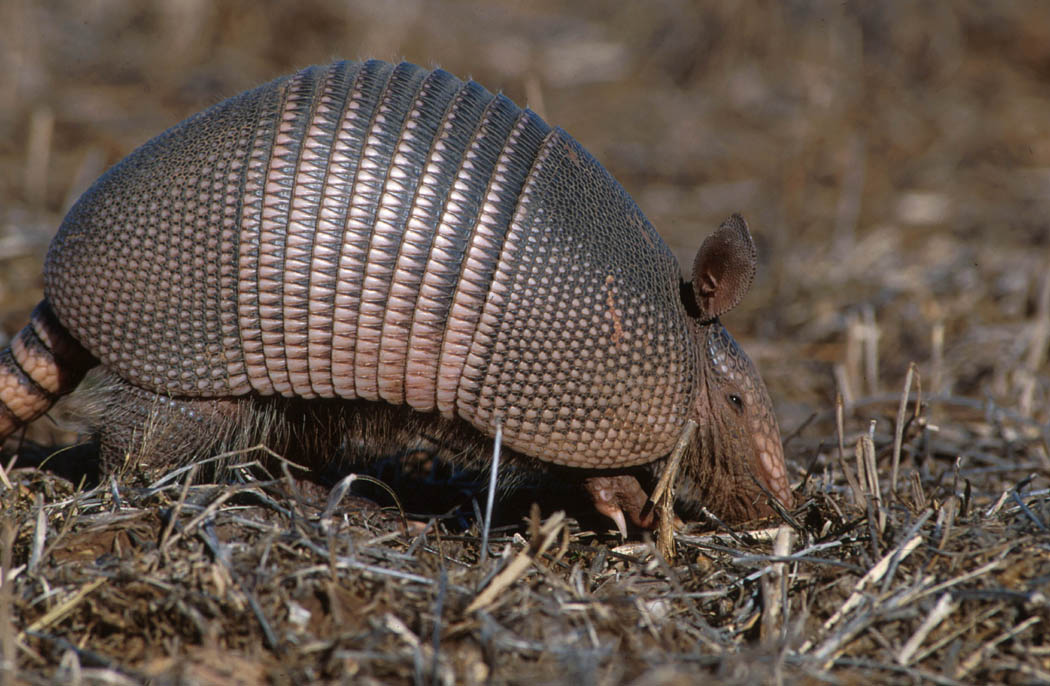

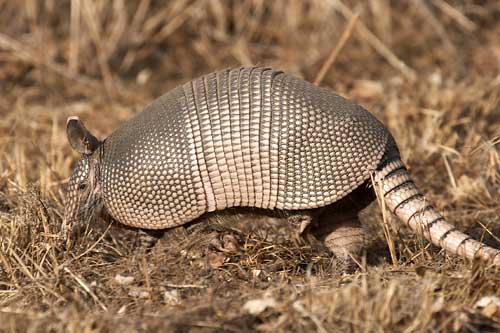

Physical characteristics and adaptations
Most armadillos possess an external covering of osteoderms—plates of dermal bone—overlaid by a tough epidermis. The arrangement of these plates varies: some species have flexible bands that allow the animal to bend or curl, while others have more rigid shields on the head and back. Limbs are short and robust, equipped with strong claws for digging burrows and excavating prey. Dental structure is generally simple and homodont, reflecting diets that often emphasize invertebrates. For comparative anatomy and detailed notes see anatomical notes and skeletal features.
Distribution and habitat
Armadillos occur from South America through Central America and, for a few species such as the nine-banded armadillo, into North America. Most species are concentrated in South and Central America and have been well documented in countries across the region; for regional checklists consult regional lists and distribution maps. Habitats include open grasslands, dry scrub, savanna, and diverse forest types. Some species are specialists in seasonally flooded forests or thorn scrub, while others prefer more open, arid landscapes.
Behavior and diet
Many armadillos are primarily nocturnal or crepuscular, emerging to forage during cooler hours. They are often solitary and territorial, using scent marking and burrows for shelter and rearing young. Diets vary by species but commonly include ants, termites, beetles, grubs and other invertebrates; some species also consume fruit, small vertebrates and plant matter. For ecological studies and diet analyses see feeding ecology and dietary studies.
Reproduction and life history
Reproductive systems differ among species. A few armadillo species are notable for producing multiple genetically identical offspring from a single fertilized egg, a phenomenon sometimes referred to in general terms in mammalian reproduction literature; other species have single or few young per litter. Gestation, litter size and parental care vary, and the use of burrows is important for sheltering young. For lifecycle and reproductive details see reproduction and life history.
Taxonomy and evolution
The living armadillos belong to several genera within Cingulata. There are roughly twenty recognized species in about ten genera, though exact numbers can change as taxonomic research progresses. Fossil relatives show that cingulates once included much larger and more diverse forms. For taxonomic treatments and fossil background consult taxonomy, species list and fossil record.
Human interactions and cultural significance
Armadillos have featured in folklore and material culture across their range and sometimes appear in popular media. They may be hunted for meat in parts of their range and can be victims of road mortality in regions where roads intersect core habitat. Certain species have been studied in public health research because of associations with specific pathogens; these studies have prompted practical advice on safe handling and disease surveillance. See human interactions and public health notes for guidance.
Conservation and threats
Several armadillo species face threats from habitat loss, fragmentation, hunting and incidental mortality. Some species with small ranges or specialized habitat needs are of conservation concern and may be listed on regional or international assessments. Conservation measures include habitat protection, monitoring of populations, research into life history, and measures to reduce road mortality and unsustainable hunting. For conservation status and action plans see conservation resources.
- Key traits: dermal armor, digging adaptations, variable diet.
- Range: primarily South and Central America; some species extend into North America.
- Conservation focus: habitat protection, research and mitigation of human impacts.
For further reading and authoritative species accounts consult regional field guides, taxonomic databases and conservation assessments linked above. Research on armadillo ecology continues to refine understanding of their roles in ecosystems, responses to land-use change and requirements for effective conservation management.
Questions and answers
Q: What order do armadillos belong to?
A: Armadillos belong to the order Cingulata, which is a group of New World placental mammals.
Q: What is the meaning of the word "armadillo"?
A: "Armadillo" is a Spanish word that means "little armored one".
Q: How many living genera of armadillos are there?
A: There are about 10 living genera of armadillos.
Q: What is the average length of an armadillo, including its tail?
A: The average length of an armadillo, including its tail, is about 75 centimeters or 30 inches.
Q: What is the largest size an armadillo can grow to?
A: The giant armadillo is the largest armadillo species, growing up to 100 cm or 39 inches in length and weighing 30 kg or 66 lbs.
Q: Where are armadillo species found?
A: All species of armadillos are found in the Americas, mostly in South and Central America around Paraguay.
Q: Are all species of armadillos endangered?
A: Many species of armadillos are endangered.
Related articles
Author
AlegsaOnline.com Armadillo: overview, anatomy, behavior, and conservation Leandro Alegsa
URL: https://en.alegsaonline.com/art/5649
Sources
- species.wikimedia.org : Dasypodidae
- britannica.com : "armadillo (mammal) : Introduction -- Britannica Online Encyclopedia"
- nature.ca : "Giant Armadillo: Natural History Notebooks"
- edis.ifas.ufl.edu : "The Nine-banded Armadillo (Dasypus novemcinctus)"
- valdosta.edu : "Polyembryony in Armadillos"
- links.jstor.org : "Polyembryony in the Armadillo: genetic or physiological?"