
Army ant (legionary ant)
Army ants are a group of over 200 ant species noted for large cooperative raids, nomadic colonies that form living nests (bivouacs), and a major role as tropical predators exhibiting convergent evolution.
Overview
Army ants, also called legionary ants or sometimes marabunta in local usage, comprise more than 200 species of ants within the family Formicidae. They are best known for highly coordinated, collective hunting events called raids in which thousands of individuals move together to overwhelm prey. Unlike many other ant species, army ants do not construct permanent nests; instead they form temporary living enclosures made from the interlocked bodies of workers known as bivouacs.
Image gallery
6 Images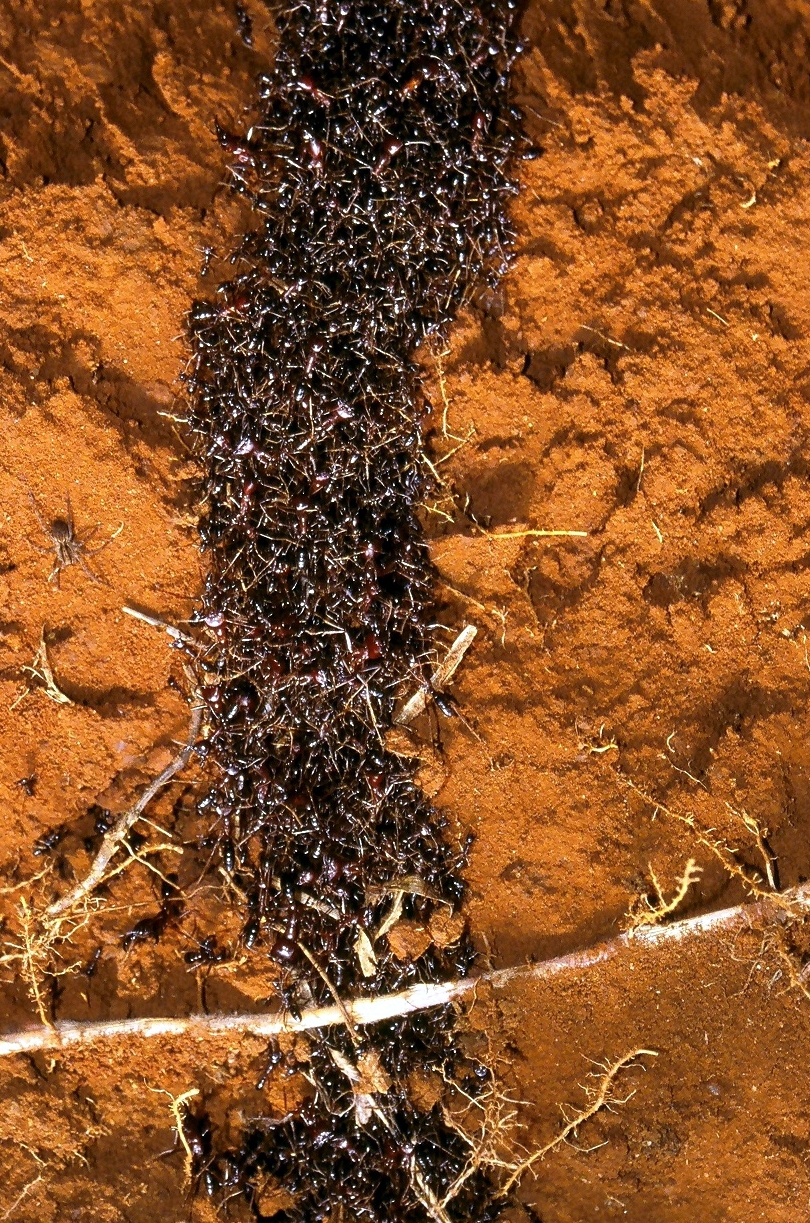


Key characteristics
- Nomadic lifestyle alternates with short stationary phases when brood is reared.
- Large, coordinated raids that can strip areas of arthropods and small animals.
- Distinct castes including small workers and large soldier morphs with reinforced mandibles.
- A wingless, highly fecund queen often central to colony reproduction and movement.
Behavior and colony structure
Army ant colonies operate as tightly integrated units. During nomadic periods the colony travels in columns or fan-shaped swarms searching for food; these raids are efficient at capturing insects, other arthropods and occasionally small vertebrates. When the colony finds a suitable site to rear young it forms a bivouac by clustering workers around the queen and brood. Communication during raids and nest movements relies on pheromones and tactile signals.
Life cycle and reproduction
Many species exhibit cyclical behavior with alternating statary (stationary) and nomadic phases. The statary phase allows for intensive feeding of developing larvae and colony growth, while the nomadic phase follows when larvae require frequent feeding and the colony must move to new foraging areas. Reproduction depends on the queen's egg-laying; some species produce new queens and males seasonally, and others reproduce by budding of the colony.
Distribution, convergent evolution and taxonomy
Army ants are largely tropical and occur in the New World (e.g., genus Eciton) and Old World (e.g., driver ants of the genus Dorylus). The similar suite of behaviors across unrelated lineages is an example of convergent evolution, sometimes called legionary behavior, in which different ant groups independently evolved mass raiding and nomadism. For lists of species and taxonomic details see species accounts and family summaries such as Formicidae overviews.
Ecological role and notable interactions
Army ants act as keystone predators in many tropical ecosystems. Their raids flush out prey and provide feeding opportunities for a variety of other animals; specialist birds, known as ant-followers, track swarms to catch insects and small animals fleeing the ants. Human observers have long been fascinated by the spectacle of mass raids and the living bivouac, which illustrate complex collective behavior without central planning. For more on raid dynamics see resources about ant raids and studies of convergent evolution.
Distinctions: Not all nomadic or aggressive ants are true army ants; the term refers to species that combine obligate group raiding, a nomadic colony cycle, and formation of bivouacs rather than fixed nests.
Questions and answers
Q: How many ant species are considered army ants?
A: Over 200 ant species are considered army ants.
Q: Why are they called army ants?
A: They are called army ants due to their aggressive predatory groups looking for food, known as "raids", in which many ants look for food at the same time in one place, attacking other animals collectively.
Q: Do army ants build permanent nests like most ants?
A: No, army ants do not build a nest like most other ants. Instead, they build a living, temporary nest with their bodies.
Q: What family do all army ant species belong to?
A: All army ant species are part of the ant family, Formicidae.
Q: What is the name for the behavior where many ants attack other animals collectively?
A: The behavior where many ants attack other animals collectively is called "raids".
Q: What is "legionary behavior"?
A: "Legionary behavior" is a behavior where many ants attack other animals collectively. It has evolved independently in several kinds of ant species, and is an example of convergent evolution.
Q: What is convergent evolution?
A: Convergent evolution is when unrelated organisms evolve similar adaptations in response to similar environmental challenges. In the case of army ants, several different ant species have evolved the same "legionary behavior" independently.
Related articles
Author
AlegsaOnline.com Army ant (legionary ant) Leandro Alegsa
URL: https://en.alegsaonline.com/art/5755