
Arthrodires (Arthrodira) — jointed-neck placoderm fishes of the Devonian
Extinct order of armored, jawed placoderms with a distinctive head–thorax joint; diverse in form and ecology during the Devonian and lost in the Late Devonian extinctions.
The arthrodires (order Arthrodira) were a diverse and widespread group of armored, jawed fishes within the class Placodermi that radiated during the Devonian Period. Their name, meaning "jointed neck," refers to a distinctive movable joint between the head shield and thoracic shield that increased gape and changed feeding mechanics. Arthrodires are known from abundant fossil remains and represent some of the best-known early jawed vertebrates.
Image gallery
10 Images


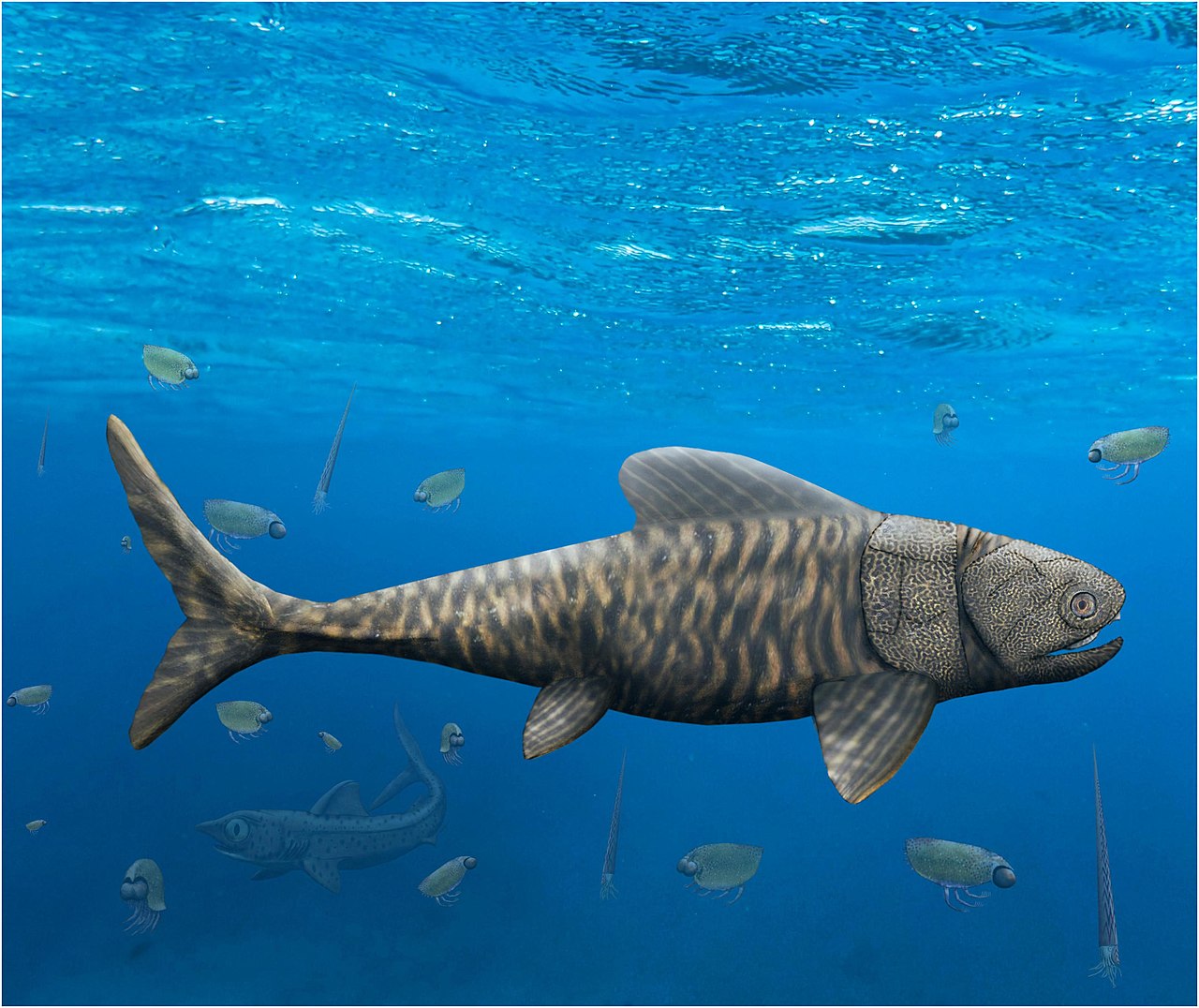


Anatomy and distinguishing features
Arthrodires are characterized by heavy dermal armour formed from interlocking bony plates covering the head and the front part of the body. The posterior margin of the skull shield articulated with the anterior thoracic shield by a specialized joint, allowing the head portion to be raised relative to the body. Like other placoderms, arthrodires lacked true teeth: instead, they possessed sharpened edges or blade-like structures on their jaw plates that served as biting surfaces. Many specimens preserve reinforced orbital rings that supported and protected the eyes, a feature that aided vision and is comparable in function to sclerotic elements seen in other vertebrate groups.
Feeding mechanics and lifestyles
The head–thorax joint and robust jaw plates gave arthrodires a range of feeding capabilities. When the lower jaw depressed, the head shield often rotated upward, creating a larger gape that could accommodate large prey or create suction. Some forms evolved stout, crushing plates for eating hard-shelled invertebrates, while others developed shearing jaw surfaces suited to slicing flesh. Body shapes varied from dorsoventrally flattened taxa adapted to life near the seafloor, to more streamlined, actively swimming predators.
Diversity, size range and notable genera
The order included a wide span of sizes and ecologies. Small, nearshore or benthic genera such as Arctolepis had broad armored bodies, whereas several Late Devonian arthrodires reached very large sizes and occupied apex-predator roles. Well-known large forms reconstructed from fossils show powerful skulls and jaw plates capable of delivering strong bites; size estimates differ among species and specimens, and precise figures are subject to ongoing study. At the same time, tiny, long-snouted or narrowly built arthrodires illustrate how the group repeatedly evolved specialised feeding strategies.
Fossil record and geographic distribution
Arthrodires are recorded from Devonian marine and marginal-marine deposits worldwide and are particularly common in strata that preserve armored fishes. Their bony plates fossilize well, so arthrodire remains are important components of Devonian vertebrate assemblages. Fossils include complete skull shields, isolated plates, and occasional articulated skeletons that inform reconstructions of anatomy, growth and diversity.
Extinction and paleobiological significance
Arthrodires were abundant and ecologically varied through much of the Devonian but declined during the late Devonian biotic crises and were gone by the end of that interval. Their disappearance was part of a larger suite of extinctions that restructured marine ecosystems and opened ecological opportunities later filled by other jawed vertebrates. Arthrodire fossils remain central to studies of early jaw evolution, functional morphology of feeding systems, and patterns of diversification and extinction in deep time.
Classification and research
Within placoderms, Arthrodira is treated as a major order containing numerous families and genera. Research continues on their relationships to other early jawed vertebrates, the detailed mechanics of their jaws and neck joint, and the reasons for their ecological success and eventual decline. New fossil discoveries and modern imaging techniques keep refining our knowledge of arthrodire anatomy and life history.
Further reading and resources
- Placodermi classification and overview
- Devonian period context and environments
- Late Devonian extinction events and evidence
- Marine and marginal niches occupied by Devonian fishes
- Anatomy of armour plates and the jointed skull
- Large arthrodire predators and notable specimens
- Apex predator roles in Devonian ecosystems
- Benthic feeding strategies and durophagy
- Post-Devonian diversification of other jawed fishes
- Carboniferous faunal turnover and ecological recovery
Because arthrodires are known from robust bony plates, they are frequently used to correlate Devonian strata and to investigate paleoecological patterns. Ongoing paleontological work continues to clarify the tempo of their evolution and the anatomical innovations that made them a dominant component of Paleozoic seas.
Questions and answers
Q: What is the order of extinct fishes called?
A: The order of extinct fishes is called Arthrodires (Arthrodira).
Q: How long did the arthrodires survive for?
A: The arthrodires survived for about 50 million years.
Q: What feature do arthrodires share with birds and some ichthyosaurs?
A: Arthrodires share a bony ring around their eye sockets with birds and some ichthyosaurs.
Q: How large was Dunkleosteus, one of the largest members of this group?
A: Dunkleosteus, one of the largest members of this group, was a true superpredator that measured 3 to 9 m in length.
Q: What is the misconception about arthrodires?
A: The misconception about arthrodires is that they were sluggish bottom-dwellers that were outcompeted by more advanced fish.
A common misconception is the arthrodires were sluggish bottom-dwellers that were outcompeted by more advanced fish. But during their reign, the arthrodires were one of the most diverse and numerically successful vertebrate orders of the Devonian. They occupied a vast spectrum of roles from apex predator to detritus-nibbling bottom dweller. The arthrodires were one of many groups eliminated by the mass extinctions of the late Devonian. This let other fish such as sharks diversify into the vacant ecological niches during the Carboniferous period.
Q: How did Arctolepis look like?
A: Early arctolepis, such as genus Arctolepis, had well-armoured bodies with flattened shapes.
Q: What type surface did placoderms use for biting?
A: Placoderms used sharpened edges on a bony plate as a biting surface instead distinct teeths .
Related articles
Author
AlegsaOnline.com Arthrodires (Arthrodira) — jointed-neck placoderm fishes of the Devonian Leandro Alegsa
URL: https://en.alegsaonline.com/art/6262