
French colonial empire: origins, development, and legacy
Comprehensive overview of the French colonial empire: its two phases, major territories, institutions, economic and social impacts, decolonization, and long-term legacies including language and law.
Overview
The French colonial empire was a global network of territories governed or controlled by France from the 16th century through the mid-20th century. Historians commonly describe two broad phases: the early overseas possessions in the Americas and Asia that rose and fell between the 1500s and the Napoleonic era, and a later expansion centered on Africa, Southeast Asia and the Pacific that reached its height in the late 19th and early 20th centuries. These phases are often called the First and Second French colonial empires. For a concise review of the 17th–18th-century expansion see 17th–18th-century expansion, while North American operations are discussed at French North America and Indian trade at French India.
Image gallery
10 Images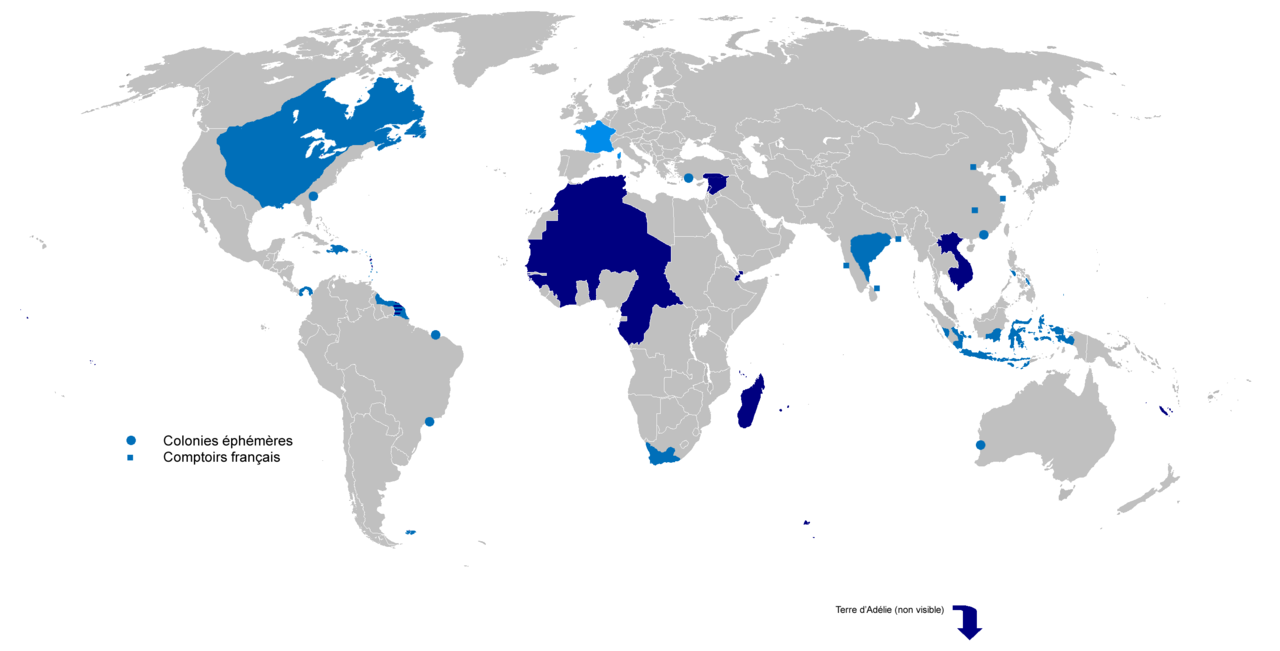



Characteristics and institutions
French colonial rule combined commercial interests, missionary activity, and state-building. Colonies were governed through a mix of chartered companies, military governors and civilian administrators. Like other European empires of the era, France participated in the Atlantic slave trade, importing enslaved people from Africa to work in plantation economies; this connection to slavery is examined alongside broader European imperial practices at European empires and the transatlantic trade at the slave trade. The main African regions involved in forced migration are described at West and Central Africa. The violent slave revolts and the larger social upheavals they caused—most notably the Haitian Revolution—had decisive consequences for the empire; the uprising in Saint-Domingue is outlined at Haitian Revolution and the colony itself at Saint-Domingue.
History and major turning points
The First French colonial empire established footholds in the Caribbean, parts of North America, and India but suffered a major setback after defeats in European wars. Losses in the global conflict usually called the Seven Years' War forced France to cede many territories to rival powers; see Seven Years' War. The Napoleonic period and diplomatic exchanges led to temporary returns and transfers: for example, Louisiana (New France) changed hands and was later sold to the United States; relevant episodes are discussed at Louisiana and New France and the Napoleonic era at Napoleonic Wars. After about 1850 France undertook a renewed program of overseas expansion that built the Second Empire.
Territories and economic role
The later imperial project focused on Africa and parts of Asia and the Pacific. France created large colonial possessions across West and North Africa and established Indochina in Southeast Asia and settlements in the South Pacific; see overviews at French Africa, French Indochina, and French Pacific territories. Colonies supplied raw materials and markets for metropolitan industry, while administrators and missionaries promoted French language and Catholicism as elements of cultural assimilation; further context on language and religion policies appears at French language policy and religious missions.
- Typical colonial institutions: governor, colonial council, commercial companies.
- Economic model: extraction of raw materials, plantation agriculture, and trade with metropolitan France.
- Demographic patterns: relatively few settlers overall, with the notable exception of settler colonialism in Algeria.
Decolonization and legacy
The two world wars accelerated political change and exposed the limits of imperial control. After World War II nationalist movements grew across French territories, and a process of decolonization unfolded through the 1940s to the 1960s, culminating in independence for most colonies. The end of colonial rule was uneven—some transitions were negotiated, others were protracted and violent. The long-term legacy of French colonialism includes the spread of the French language, legal and administrative systems, and cultural ties that continue within international networks such as the Francophonie. At the same time, colonial rule left legacies of economic extraction, social division, contested memory and calls for historical reckoning and restitution.
Notable distinctions and continuing debates
Scholars distinguish France’s model of assimilation and centralized administration from settler colonial approaches elsewhere, yet the reality varied greatly by place and period. Debates continue about the scale and impact of economic exploitation, the cultural effects of missionary work and language policy, and the responsibilities of former imperial powers for colonial-era injustices. Contemporary discussion often centers on memorialization, the politics of language and identity, and the economic and diplomatic ties between France and its former colonies.
Related articles
Author
AlegsaOnline.com French colonial empire: origins, development, and legacy Leandro Alegsa
URL: https://en.alegsaonline.com/art/36587