
French Republican calendar
A secular calendar introduced during the French Revolution that reorganized months, weeks and day names into a decimal-inspired system used officially from 1793 to 1805.
Overview
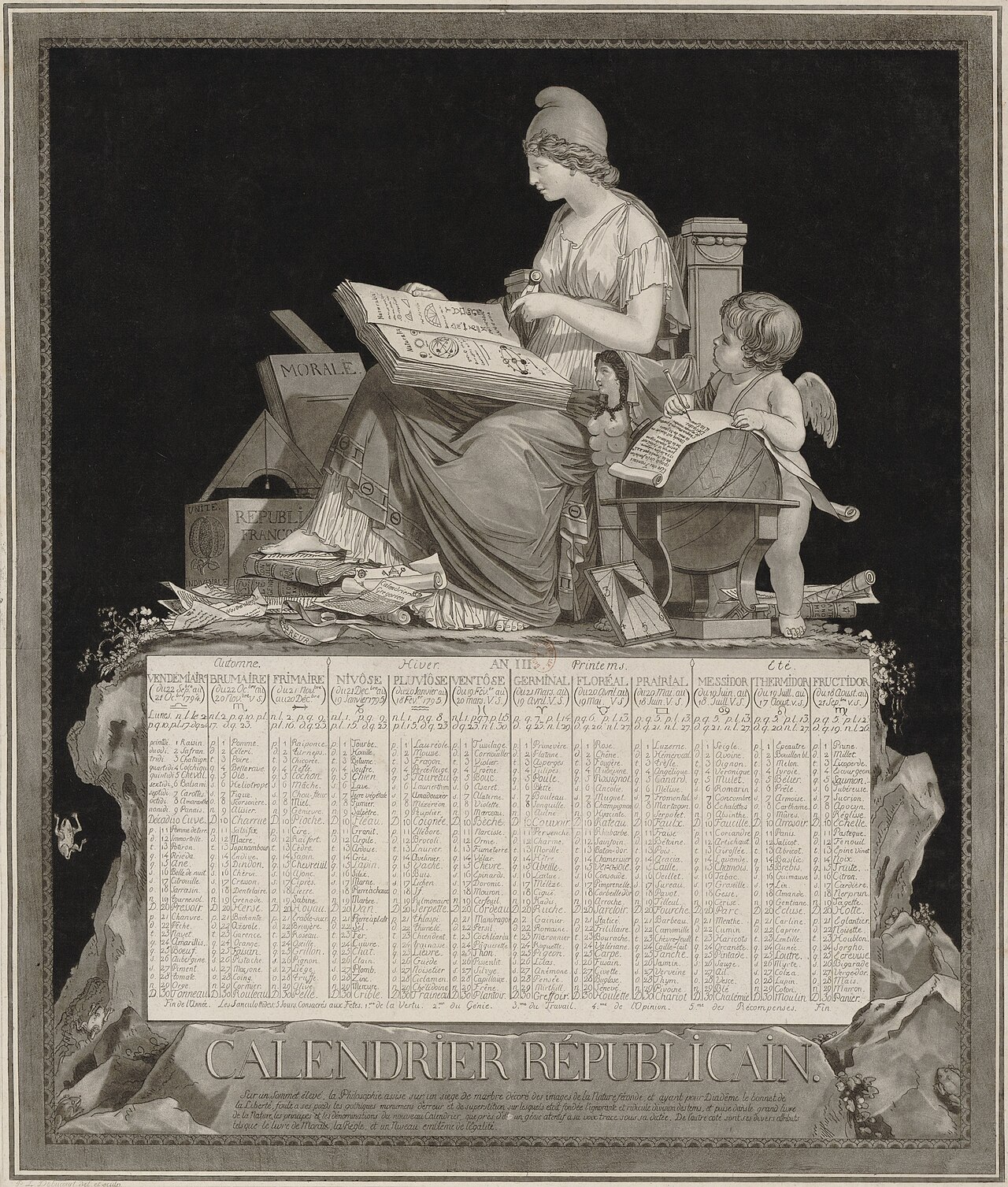
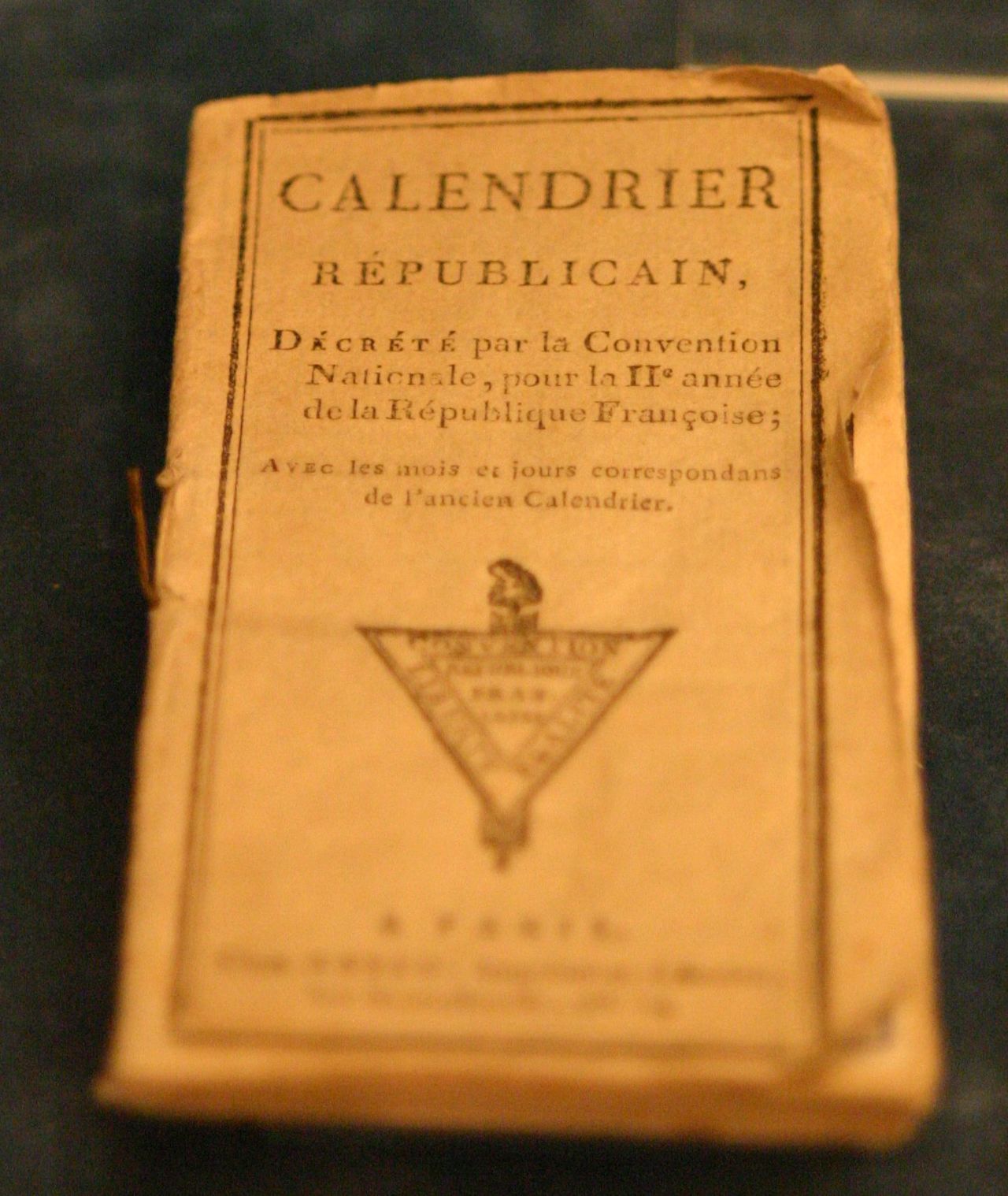
The French Republican calendar (in French calendrier républicain) was a revolutionary reorganization of the civil calendar introduced during the French Revolution. Enacted in 1793 and retroactively beginning on 22 September 1792, it sought to remove religious and royal references and to rationalize timekeeping. The reform replaced the seven-day week with a ten-day décade and assigned new month and day names based on seasonal and agricultural themes. The law remained in official use until the early 19th century, and the system was briefly revived in the Paris Commune of 1871.
Image gallery
10 Images





Structure and names
The calendar divided the year into twelve months of 30 days each, grouped into three ten-day weeks. Each day had a unique name—most commonly taken from plants, animals or tools—rather than the traditional saints' days. At the end of each year five complementary days (six in leap years) were appended; these were known collectively as the Sans-culottides and were devoted to festivals. Leap years were intended to keep the calendar aligned with the autumnal equinox, but the exact rule proved complex in practice.
- Months (examples): Vendémiaire, Brumaire, Frimaire, Nivôse, Pluviôse, Ventôse, Germinal, Floréal, Prairial, Messidor, Thermidor, Fructidor.
- Complementary days: five ordinary festival days; a sixth was added in certain leap years.
- Weeks: 10-day décades rather than 7-day weeks.
History and implementation
The reform was part of a wider revolutionary effort to secularize institutions and to introduce decimal principles into public life. Decimal time (dividing the day into 10 hours of 100 minutes each) was proposed and even experimentally used in some contexts, but it never achieved broad practical acceptance. The Republican calendar did see official use from the mid-1790s until it was discontinued under Napoleon; however, dates recorded in its system appear frequently in revolutionary archives, literature and governmental acts, creating an enduring legacy for historians and archivists. A famous modern reference point is the coup of 18 Brumaire Year VIII, better known by its Gregorian equivalent, 9 November 1799.
Uses, legacy and distinctions
Beyond its short official lifespan, the calendar influenced symbolic politics, art and historiography. It offered a strong example of how language and measurement can be mobilized for ideological ends. Researchers must still convert Republican dates to the Gregorian calendar when consulting period documents. For those interested in technical or cultural details, several modern resources explain the month names, conversion methods and the experiments with decimal time: see a general discussion of the reform here, and an overview of decimal time proposals here.
Notable facts
On the calendar's day-naming scheme, each day commemorated some element of productive life—crops, tools or livestock—rather than saints. This emphasis on seasonal cycles and labor made the system uniquely tied to agrarian rhythms. Although short-lived as law, the French Republican calendar remains a notable example of radical calendar reform and of the French Revolution's attempt to reframe daily life.
Related articles
Author
AlegsaOnline.com French Republican calendar Leandro Alegsa
URL: https://en.alegsaonline.com/art/36612