
Final Solution
The Nazi plan to systematically persecute and exterminate European Jews and other targeted groups during World War II; its policies, methods, camps, victims, and legacy.
Overview
The term "Final Solution" (German: Die Endlösung) refers to the Nazi regime's program to annihilate the Jewish population of Europe and to persecute other groups deemed undesirable. Developed and implemented during World War II under the authority of Nazi Germany, it combined administrative measures, deportations, mass shootings and industrialized killing in purpose-built camps. The policy was an escalation from earlier discriminatory laws and forced emigration policies to a centrally coordinated plan of mass murder.
Image gallery
10 Images


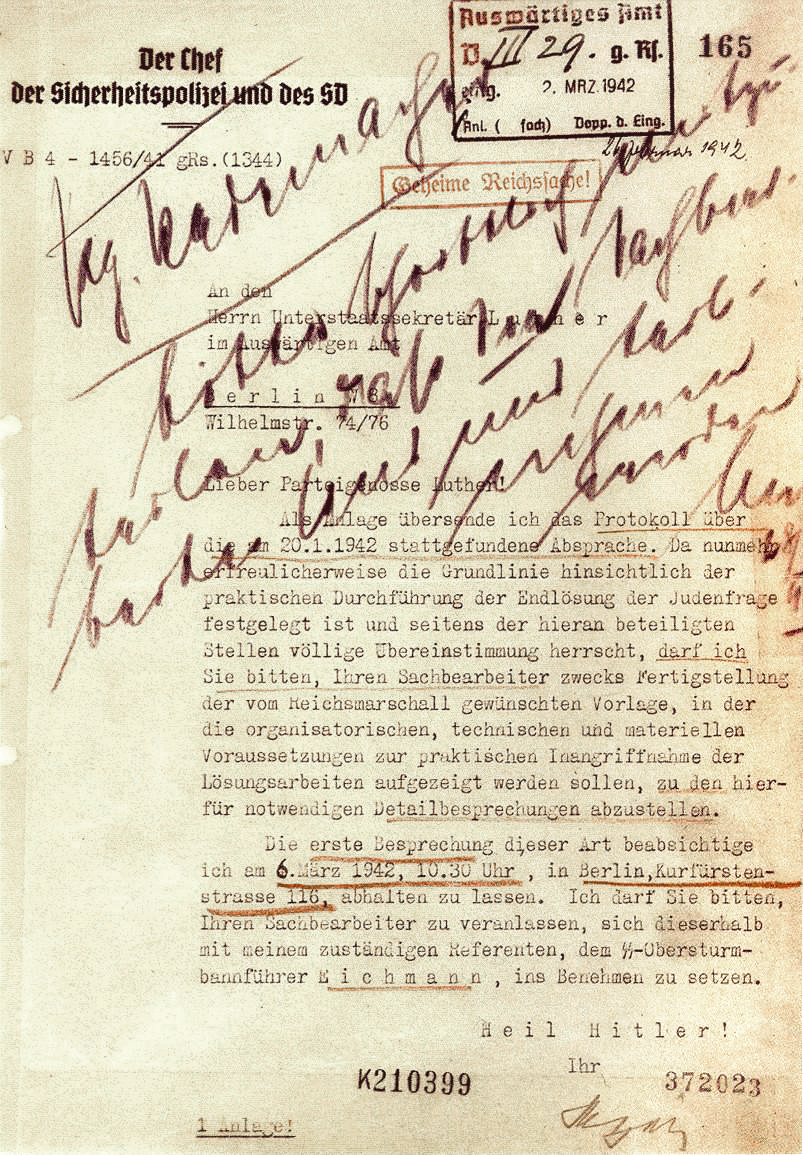


Origins and policy development
In mid-1941 senior Nazi officials began translating genocidal rhetoric into concrete orders. A directive from leaders of Nazi Germany and their security organs charged SS and police units with planning and executing a "complete solution" to what they called the Jewish question. High-level coordination involved figures who issued, endorsed or implemented policies; contemporaneous events on the Eastern Front and within occupied territories shaped timing and methods. The plan targeted not only Jews but also Roma and Sinti and other groups persecuted under racial and political pretexts.
Methods and implementation
Early phases included mass shootings by mobile killing squads; later, the regime expanded to use gas chambers, deportation trains and fixed extermination sites. Mobile gas vans were one method used before larger facilities were completed; exhaust gases were directed into sealed compartments to kill those locked inside. The program also involved extensive bureaucratic organization—transportation, registration, forced labor and the concealment of mass murder behind euphemistic paperwork.
Camps, operations and victims
Operation-level plans were given names and overseen by SS leadership. Some killing centers were established as part of operations in occupied Poland and elsewhere. Well-known sites associated with systematic killing include camps set up during the period of Operation Reinhard and other facilities that functioned as extermination or concentration camps. The campaign caused the deaths of millions: the best-established historical estimates conclude that about six million Jews were murdered, together with hundreds of thousands of Roma, political prisoners and other victims.
Aftermath, legal reckoning and remembrance
After the war, surviving evidence and testimony formed the basis for criminal trials and wide historical documentation. The Final Solution is central to the study of genocide, modern totalitarianism and human rights law. Memorials, museums and education programs worldwide seek to preserve memory, explain mechanisms of state-sponsored mass murder, and to counter denial and distortion.
Related names and places
- Jews
- Gypsies (Roma)
- Sinti
- Romania
- other European countries
- World War II
- carbon monoxide
- Heinrich Himmler
- Reinhard Heydrich
- Czech
- Poland
- Belzec
- death camps
- Auschwitz
For further study and primary documentation, readers may consult specialized history works, archives and memorial institutions that preserve the records and testimonies related to the Final Solution and its victims.
Related articles
Author
AlegsaOnline.com Final Solution Leandro Alegsa
URL: https://en.alegsaonline.com/art/34365
Sources
- ushmm.org : ""Final Solution": Overview"