
Heinrich Himmler: SS leader and architect of Nazi policing
German Nazi leader Heinrich Himmler (1900–1945) led the SS and much of the Nazi policing apparatus, central to the regime's racial policies and the administration of concentration camps.

Overview
Heinrich Luitpold Himmler (1900–1945) was one of the most powerful and influential figures in Nazi Germany. As head of the SS (Schutzstaffel) and, later, the chief of all German police, he built and administered institutions that enforced the regime's ideology and carried out mass repression. His responsibilities included internal security, concentration camp administration and the coordination of many aspects of the regime's racial policy.
Image gallery
10 Images


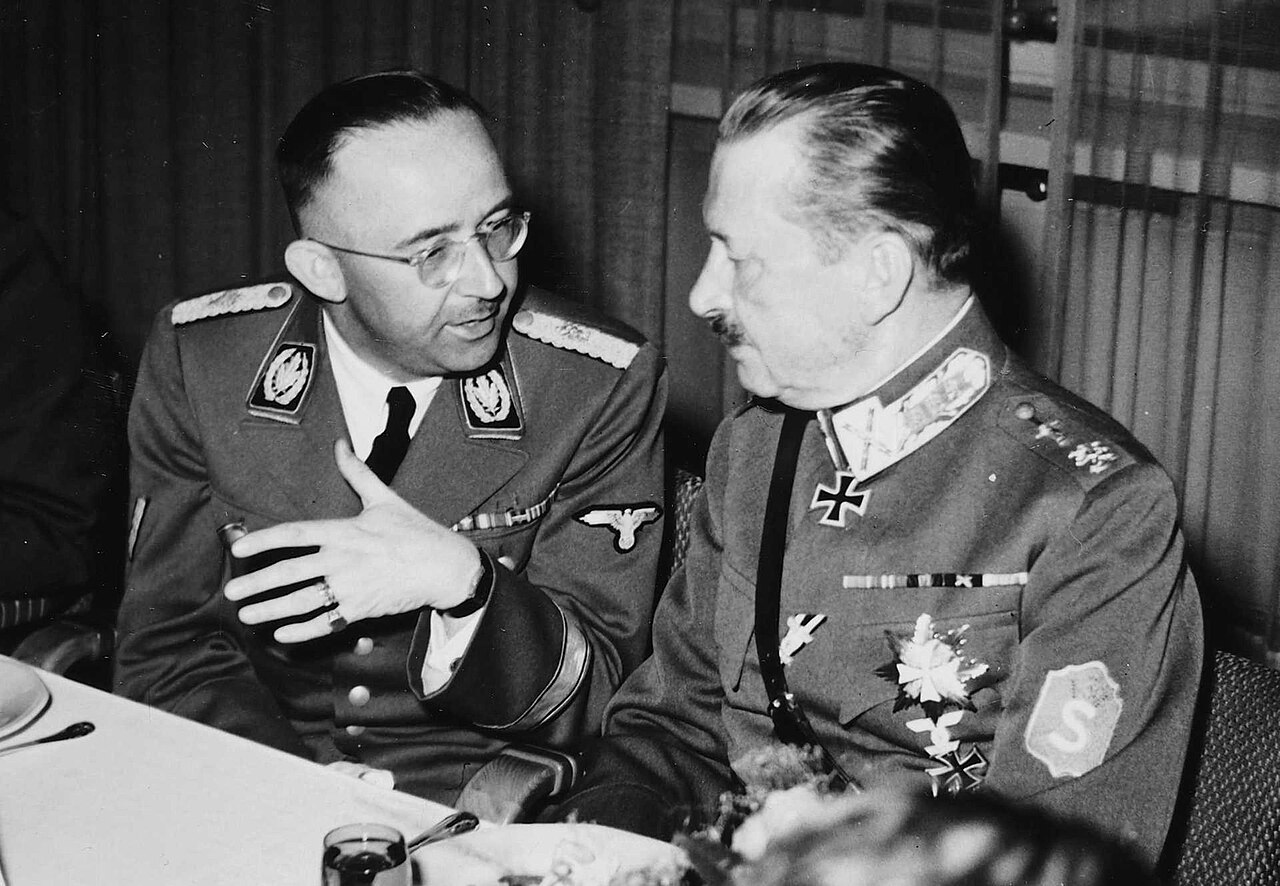


Rise and official roles
Himmler joined the growing Nazi Party in the early 1920s and, over the following decade, rose through its ranks to become Reichsführer-SS. In that capacity he transformed the SS from a small personal guard into a multi-branch organization that included armed units, intelligence and administrative departments. In the 1930s he also gained control over the civil police and security services, bringing the Gestapo and other police agencies under SS influence. His formal titles and powers gave him both political and policing authority within the German state.
Institutions and responsibilities
- SS (Schutzstaffel): Himmler oversaw its growth into a key instrument of state power; see Schutzstaffel (SS).
- Criminal and secret police: Centralized police functions under SS leadership.
- Concentration camp system: Administrative control over camps and prisoner labor.
- Security services and intelligence: Coordination with departments responsible for surveillance, deportation and occupation security.
Policies and wartime actions
Under Himmler's leadership the SS became the principal instrument for implementing the regime's programs of racial exclusion, forced displacement and mass murder. Personnel and units connected to the SS were responsible for many of the atrocities committed across occupied Europe during the Second World War. His subordinates, including prominent figures such as Reinhard Heydrich, played major roles in planning and executing these policies. Himmler's career also intersected with notable Nazi events, including the Beer Hall Putsch era, the Night of the Long Knives and the pogroms of Kristallnacht, which reshaped German politics and the regime's methods of coercion.
Capture, death and historical assessment
In the final days of the war Himmler attempted to negotiate with Allied forces and to distance himself from Hitler. He was detained by British forces and died in custody in May 1945. Historians regard him as a principal architect of the Nazi regime's security state and of the crimes it committed. His legacy is studied as part of examinations of state-sponsored violence, bureaucracy and ideology.
Legacy and cultural portrayals
Himmler has been depicted in numerous historical studies, documentaries and works of fiction. He appears as a character in films and television that explore the Nazi era; for example, his portrayal in popular culture includes appearances connected to Indiana Jones and the Last Crusade by Steven Spielberg in which the actor Ronald Lacey played a Nazi official. Scholarly treatments compare his bureaucratic methods with other aspects of modern governance and totalitarian control, and his actions continue to be a subject of legal, moral and historical analysis. For broader context on the First World War generation and its relation to later events see World War I.
Related articles
Author
AlegsaOnline.com Heinrich Himmler: SS leader and architect of Nazi policing Leandro Alegsa
URL: https://en.alegsaonline.com/art/120453