
Alpha helix: structure, bonding, and biological roles
The alpha helix is a common protein secondary structure: a right-handed helical backbone stabilized by regular hydrogen bonds, important in enzymes, structural proteins, and membrane-spanning segments.
Overview
The alpha helix is a recurring element of protein architecture, forming part of the protein secondary structure. It appears as a spiraling backbone in which the polypeptide chain coils in a regular, repeating pattern. Together with the beta sheet, the alpha helix is one of the principal ways that amino acid chains fold locally before assembling into a protein's overall three-dimensional shape.
Image gallery
10 Images


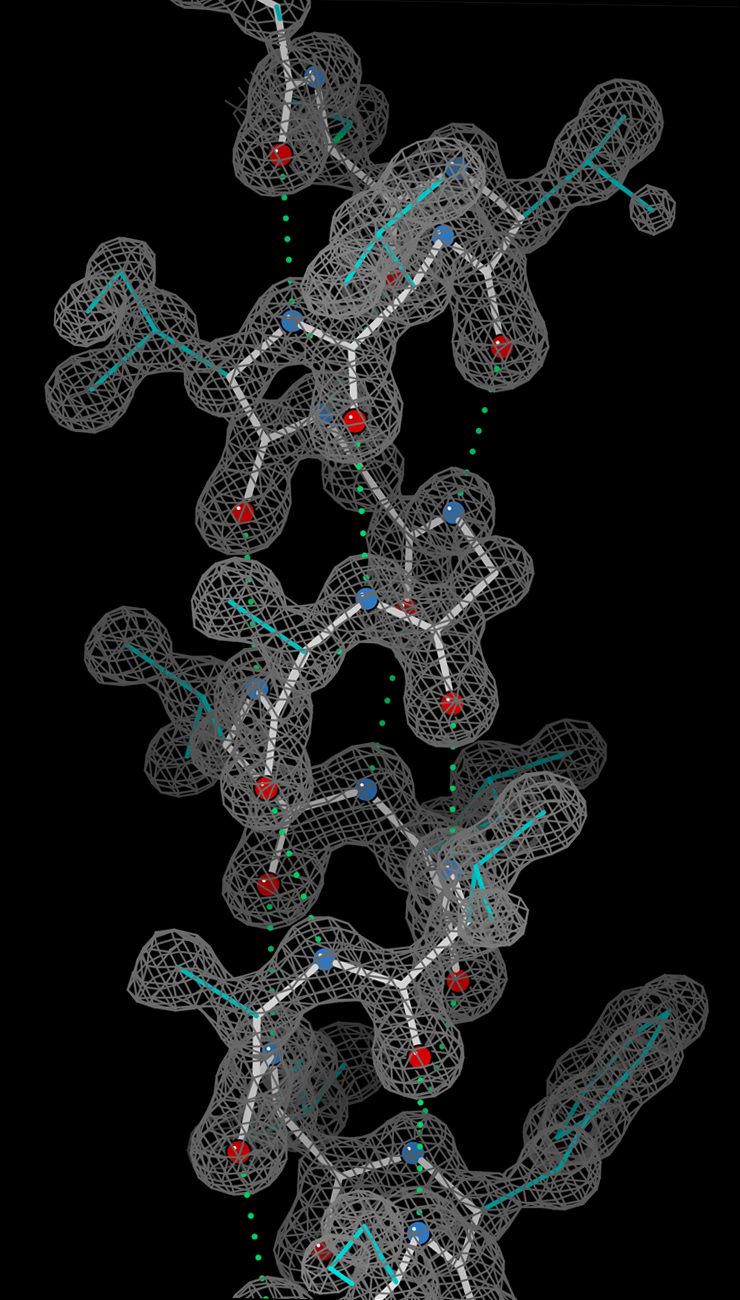




Geometry and defining features
An alpha helix is characterized by a uniform helical rise and rotation per amino acid residue: there are roughly 3.6 amino acid residues per turn, producing a compact, rod-like element. The helix has a distinct directionality (N-terminus to C-terminus) and can be described by the positions of its backbone atoms and the angles between peptide bonds. The arrangement of side chains projects outward from the helix surface, creating faces that can be polar, nonpolar, or amphipathic depending on sequence.
Backbone chemistry and hydrogen bonding
The stability of the alpha helix depends on a repeating pattern of interactions between backbone groups. Each segment of the chain contains alternating backbone groups or atoms such as the backbone atoms. A characteristic interaction involves the carbonyl group (centered on a carbon atom that is double bonded to an oxygen atom) and the amine group (with a nitrogen atom bonded to a hydrogen atom) on the backbone. In the canonical helix, the amide hydrogen of one residue forms a regular hydrogen bond to the carbonyl oxygen of the residue four positions earlier, linking the backbone into a stable coil. Each repeating unit that contributes to the chain is typically called a residue, referring to a single amino-acid contribution to the polypeptide.
History and discovery
The alpha helix was proposed in the early 1950s as a possible protein folding motif based on models of peptide geometry and hydrogen bonding. Experimental techniques such as X-ray crystallography and later nuclear magnetic resonance (NMR) spectroscopy confirmed its presence in many proteins. Since its discovery, the alpha helix has been a central concept for understanding how sequence encodes local structure and how local structure contributes to overall protein function.
Biological roles and examples
Alpha helices fulfill a wide range of roles in biology. They frequently form the cores of globular proteins, provide rigid segments in fibrous proteins, and serve as membrane-spanning helices in integral membrane proteins. Helices can pack together into bundles, form coiled-coil motifs that mediate protein–protein interactions, or line the pores of ion channels. Examples include the helical bundles in hemoglobin subunits, the transmembrane segments of G protein–coupled receptors, and the long helices of structural proteins such as keratin.
Distinguishing features and notable facts
- Alpha helices are usually right-handed in natural proteins and differ from beta sheets by having local, helical hydrogen bonding rather than the extended hydrogen-bond network of sheets.
- Helices can be amphipathic: one side of the helix may present hydrophobic residues while the opposite side is polar, guiding how the helix interacts with membranes or other proteins.
- Helix ends are often stabilized by specific side-chain interactions or "capping" motifs that reduce unsatisfied hydrogen bonding at the termini.
- Multiple helices assemble into tertiary structures such as helix bundles or barrels, and their packing geometry is a major determinant of protein stability and function.
Alpha helices are readily detected in experimental structure determinations and predicted by many computational tools; understanding their formation and context within a protein is essential for interpreting function, engineering new proteins, and designing drugs that target helical regions. For further reading and resources see protein databases and structural biology references at backbone geometry summaries or methodology pages at carbonyl descriptions, carbon atom chemistry, and bonding concepts. Additional background is available on topics such as oxygen-containing groups, amine chemistry, nitrogen in peptides, hydrogen atom roles, residue definitions, and the nature of the hydrogen bonds that stabilize helices.
Tags
Related articles
Author
AlegsaOnline.com Alpha helix: structure, bonding, and biological roles Leandro Alegsa
URL: https://en.alegsaonline.com/art/2958