
Hydrogen bond: definition, mechanism, examples, and significance
A hydrogen bond is a directional, noncovalent attraction in which a hydrogen atom bound to an electronegative atom interacts with another electronegative atom; crucial in water, biology, and materials.
A hydrogen bond is a specific type of attractive interaction that involves a hydrogen atom and at least two electronegative atoms. It is a form of noncovalent attachment that helps hold molecules together, influence molecular shape, and determine many physical properties of substances. For a concise conceptual introduction see chemical bond and the definition of a molecule. The interaction originates in uneven electron distribution and resulting electric charges within bonds.
Image gallery
4 Images

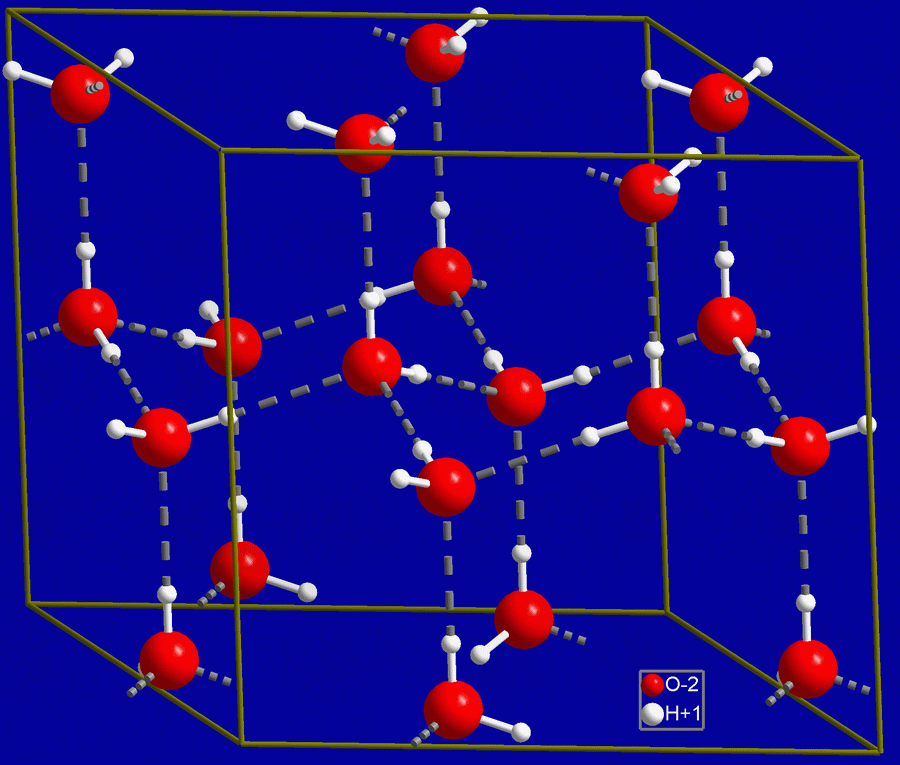

How hydrogen bonds form
At the molecular level, a hydrogen bond requires a hydrogen atom that is covalently bonded to an atom with high electronegativity. That covalent partner shifts electron density away from the hydrogen, leaving the hydrogen with a partial positive charge. This partially positive hydrogen can then be attracted to a lone pair on another electronegative atom, producing the hydrogen bond. Common partners that accept hydrogen bonds include oxygen and nitrogen, but other electronegative atoms with lone pairs can also participate.
- Donor: the atom–hydrogen unit (for example O–H or N–H).
- Acceptor: an electronegative atom possessing a lone pair.
- Directionality: hydrogen bonds are partially directional—geometry affects their strength.
Where hydrogen bonds appear and why they matter
Hydrogen bonding plays a central role in liquids and biological macromolecules. In polar liquids such as polar solvents and notably water, networks of hydrogen bonds give rise to high cohesion, surface tension, and anomalous density behavior. Alcohols and many organic compounds also engage in hydrogen bonding; see alcohol chemistry for examples. Hydrogen bonds occur between separate molecules (intermolecular) and within different parts of the same molecule (intramolecular), influencing boiling points, solubility, and three-dimensional structure.
In biology, hydrogen bonds are essential for the structure of proteins and nucleic acids: they help stabilize alpha helices and beta sheets, and they pair complementary bases in DNA and RNA. These bonds are individually weaker than covalent links but collectively determine folding, specificity, and molecular recognition.
Strength and comparison with other interactions
Hydrogen bonds are stronger than many dispersion interactions but weaker than true covalent, ionic, and metallic bonds. They are often compared with van der Waals forces on the weaker end, and contrasted with covalent, ionic, and metallic bonding on the stronger end. Because hydrogen bonds are directional and sensitive to distance and angle, they can create defined arrangements of molecules without forming permanent chemical links.
History, measurement, and applications
The concept of hydrogen bonding emerged as chemists sought to explain unusual properties of water and the behavior of organic compounds. Experimental techniques such as infrared spectroscopy, X-ray crystallography, and neutron diffraction reveal hydrogen-bond geometries and strengths. In technology and nature, hydrogen bonds are exploited in areas from polymer design and supramolecular chemistry to drug design and biomolecular engineering. Their reversible and specific nature makes them valuable for creating controlled assemblies, responsive materials, and selective recognition systems.
For further reading on foundational and applied aspects, consult resources on chemical bonds, molecular structure in molecules, and detailed discussions of water and alcohol behavior. Technical treatments explore how charge distribution, electronegativity (electronegative partners), and geometry determine the presence and influence of hydrogen bonds.
Related articles
Author
AlegsaOnline.com Hydrogen bond: definition, mechanism, examples, and significance Leandro Alegsa
URL: https://en.alegsaonline.com/art/46092
Sources
- goldbook.iupac.org : hydrogen bond