
Carbonyl group (C=O): structure, reactivity, and applications
Comprehensive overview of the carbonyl functional group (C=O): bonding and electronic structure, common derivatives, typical reactions, spectroscopy, roles in biology and industry, and practical notes.
The carbonyl group is one of the most important and widely encountered functional groups in organic chemistry, defined by a carbon atom double-bonded to an oxygen atom (C=O). The carbonyl carbon and the oxygen are typically sp2 hybridized, giving a trigonal planar geometry at the carbon. The bond is polarized because oxygen is more electronegative than carbon; this polarization makes the carbon center electrophilic and the oxygen atom relatively nucleophilic and basic. Those electronic characteristics are central to the characteristic chemistry of carbonyl compounds.
Image gallery
3 Images
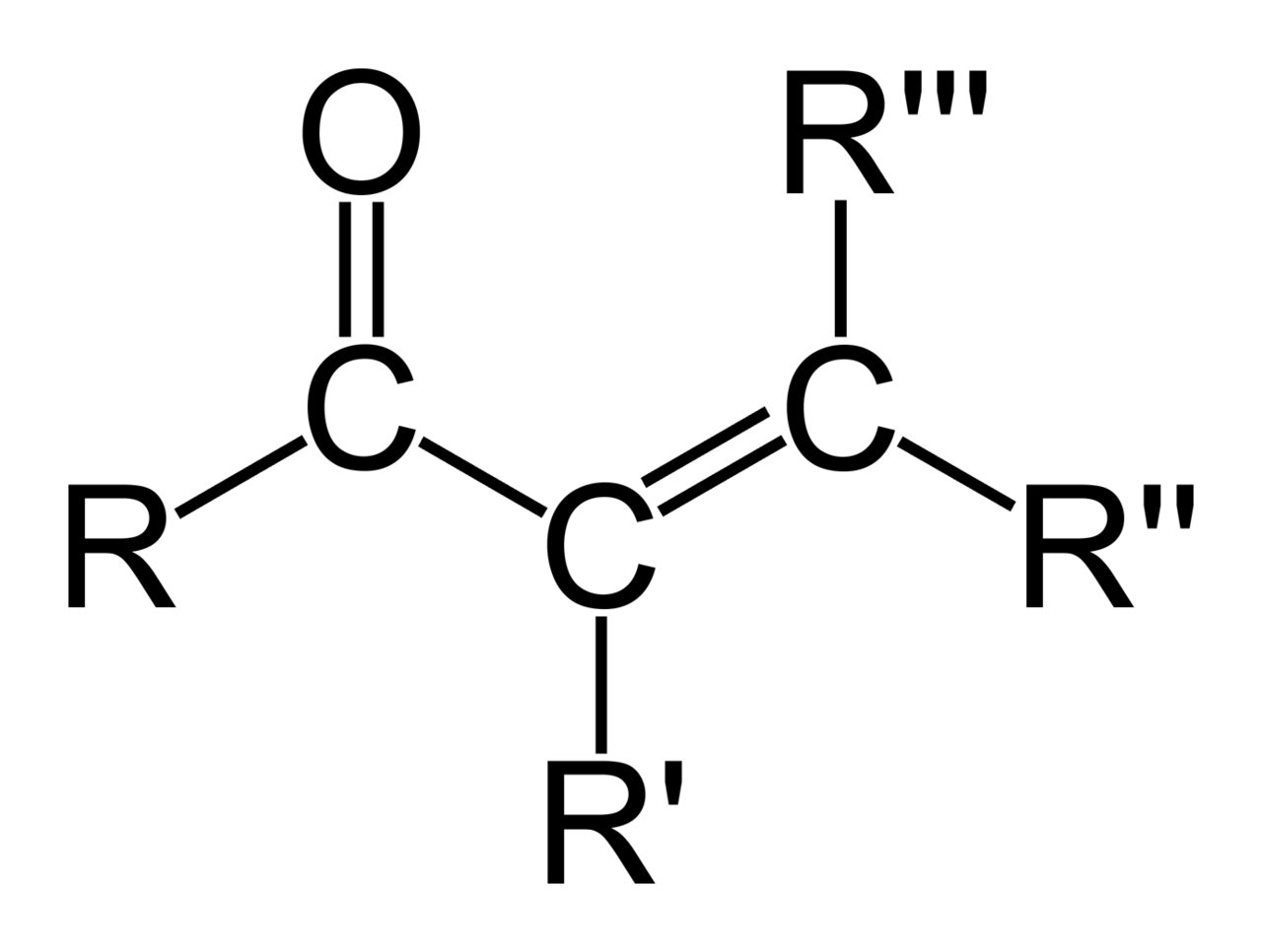

Structure, bonding and electronic effects
The C=O bond consists of a strong sigma bond and a pi bond formed by overlap of p orbitals. Resonance, inductive and conjugation effects from atoms or groups adjacent to the carbonyl alter its electron distribution and thus its reactivity. Conjugation with a nearby double bond or aromatic ring delocalizes the pi electrons and typically stabilizes the system, while donation of electron density by an adjacent heteroatom (for example in amides) reduces the electrophilicity of the carbonyl carbon. Protonation in acidic media generally occurs at the oxygen atom, and nucleophilic reagents preferentially attack the carbon atom. The acidity of hydrogen atoms alpha to a carbonyl is increased relative to ordinary sp3 C–H bonds, allowing deprotonation to give enolates that participate in many carbon–carbon bond-forming processes.
Common carbonyl-containing functional groups
- Aldehydes and ketones: the simplest carbonyls, where the carbonyl carbon is bonded to hydrogen or carbon substituents, and which typically undergo nucleophilic addition reactions.
- Carboxylic acid derivatives: esters, amides, acid chlorides and anhydrides, where the carbonyl participates in acyl substitution rather than simple addition; the attached heteroatom strongly influences reactivity.
- Conjugated carbonyls and heteroatom-stabilized systems: systems in which delocalization changes both spectroscopic signatures and chemical behavior.
Reactivity and synthetic importance
Carbonyl chemistry provides many routes to build complexity in organic synthesis. Nucleophilic addition to aldehydes and ketones gives alcohols, hemiacetals, acetals, imines and related products. Reduction and oxidation reactions interconvert carbonyls and alcohols and are commonly used in synthetic sequences. Enolate chemistry enables aldol condensations, Michael additions and alkylation reactions that form new carbon–carbon bonds. Acyl substitution at carboxylic acid derivatives is central to forming esters, amides and other materials used in polymers and pharmaceuticals. Organometallic reagents such as organolithium and Grignard reagents add to carbonyl carbons to construct complex carbon frameworks.
Factors that modify reactivity
Several practical factors influence how a particular carbonyl behaves: electronic effects from substituents (electron-withdrawing groups increase electrophilicity), resonance donation from adjacent heteroatoms (which lowers reactivity), steric hindrance around the carbonyl (which can slow attack by nucleophiles), and solvent and acid/base conditions. These factors determine whether a carbonyl undergoes nucleophilic addition, acyl substitution, enolization or other pathways under given conditions.
Spectroscopic identification and analysis
Carbonyls are readily detected by spectroscopic methods. Infrared spectroscopy shows a strong, characteristic C=O stretching band that is one of the most diagnostic features in organic analysis. In 13C NMR spectroscopy the carbonyl carbon resonates at substantially lower field (downfield) than most other carbons, which aids assignment. Ultraviolet-visible and mass spectrometry often provide complementary information, especially for conjugated or substituted carbonyl systems. Classical chemical tests and derivatization methods have been used historically to identify carbonyls in mixtures and complex samples.
Biological, environmental and industrial roles
Carbonyl-containing groups are abundant in nature and in technological applications. The peptide bond in proteins is an amide carbonyl; many sugars interconvert between cyclic hemiacetals and open-chain aldehydes or ketones; metabolic cofactors and enzyme substrates often contain reactive carbonyls. Industrially, carbonyl chemistry underpins the manufacture of polymers such as polyesters and polyamides, the synthesis of fragrances and dyes, and the preparation of active pharmaceutical ingredients. Some low-molecular-weight carbonyl compounds are volatile and can be irritants or toxic; handling and environmental considerations therefore depend on the specific compound.
Practical notes and distinctions
It is useful to distinguish simple ketones and aldehydes from carboxylic acid derivatives: the latter class generally undergo acyl substitution rather than straightforward nucleophilic addition and are often less electrophilic when resonance-stabilized. Conjugation, hydrogen bonding and steric environment all modify observable properties such as IR frequency and NMR chemical shift. In synthetic practice, chemists choose reagents and protecting groups to control which carbonyls react and which remain inert during multi-step sequences.
Further reading and resources
- Definition and basic overview
- Carbon atom hybridization and bonding
- Oxygen properties and electronegativity
- Double bonds and pi bonding
- Ketones: structure and reactions
- Aldehydes: reactivity and examples
- Esters and acyl substitution
- Acid-base behavior and protonation
- Functional group classification
- Common reactions of carbonyls
- Redox processes involving carbonyls
- Alcohol formation and reductions
- Carbonyls in medicinal chemistry
- Infrared spectroscopy of carbonyls
- 13C NMR of carbonyl carbons
- Advanced topics and conjugated systems
Questions and answers
Q: What is a carbonyl?
A: A carbonyl is a group in a molecule that consists of a carbon and an oxygen atom with a double bond between them.
Q: What are the two other bonds carbon can form in a carbonyl?
A: In a carbonyl, carbon can form another two bonds that can be with any other group.
Q: Which atom in a carbonyl will attract a proton in acid?
A: In acid, the oxygen atom in a carbonyl will attract a proton.
Q: How are both the carbon and the oxygen in the carbonyl group hybridized?
A: Both the carbon and the oxygen atoms in the carbonyl group are sp2 hybridized.
Q: Why is the carbonyl group an important functional group in chemistry?
A: The carbonyl group is an important functional group in chemistry because chemists can perform many reactions with it, including both nucleophilic additions to make the molecule bigger and redox reactions to form an alcohol.
Q: Where can carbonyls be found?
A: Carbonyls can be found in many natural substances, drugs, and medicines.
Q: How can one easily check if a molecule contains a carbonyl?
A: One can easily check if a molecule contains a carbonyl by using infrared spectroscopy, which gives a strong signal, or carbon NMR spectroscopy, in which the signal is usually at a very high frequency away from many other peaks.
Related articles
Author
AlegsaOnline.com Carbonyl group (C=O): structure, reactivity, and applications Leandro Alegsa
URL: https://en.alegsaonline.com/art/16900