
Dutch Empire
Overview of the Dutch colonial empire: institutions, expansion, major territories and voyages, decline, and lasting legacies including modern constitutional links.
The Dutch Empire refers to the overseas territories, trading posts and colonial enterprises controlled by the Dutch Republic and its successors from the late 16th century onward. Built on maritime skill, commercial finance and corporate organization, it became a global network of ports and colonies that linked Europe to Asia, Africa and the Americas. The empire grew through exploration, state-backed companies and naval power, and it left a complex legacy of trade, cultural exchange and contested sovereignty.
Image gallery
10 Images





Characteristics and institutions
The shape of Dutch expansion was shaped less by direct settler colonization than by trade, fortifications and company rule. Two chartered companies stand out: the Dutch East India Company (Vereenigde Oostindische Compagnie, VOC) focused on Asian commerce, and the Dutch West India Company (WIC) operated in the Atlantic world. These corporations combined private capital with government privileges, maintained armed fleets, made treaties, and administered settlements. Dutch maritime engineering, shipbuilding and a network of merchant houses supported long-distance commerce in spices, sugar, slaves, timber and textiles.
Exploration and major territories
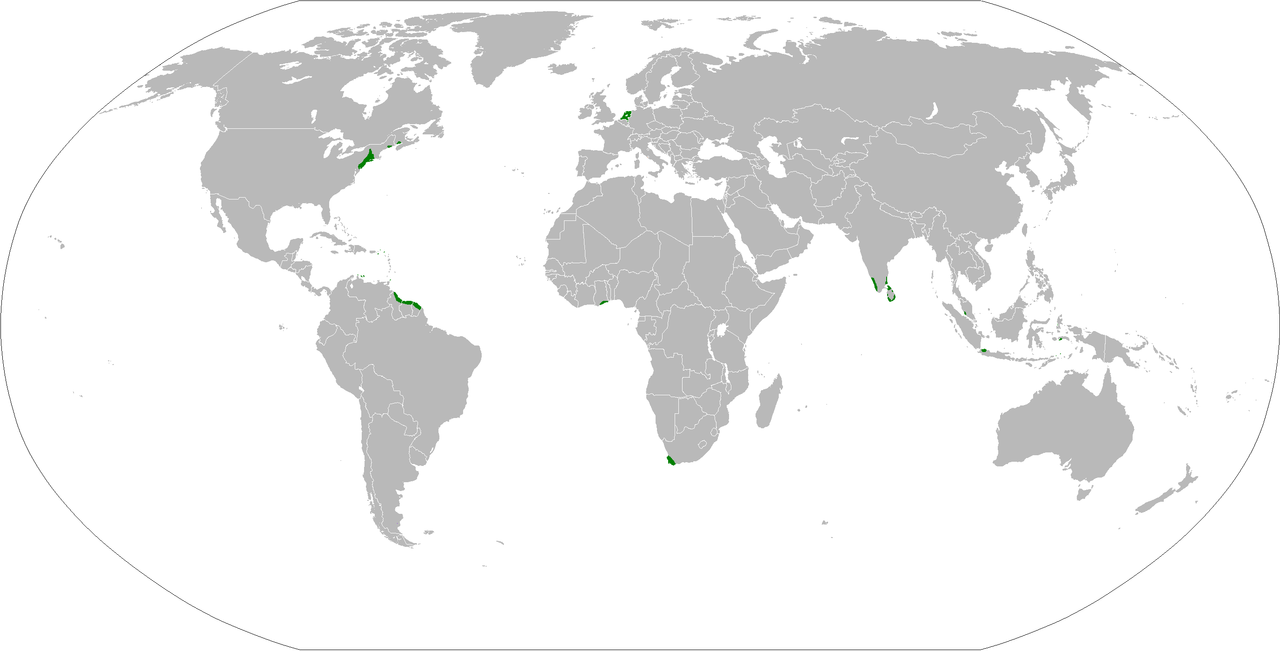
Dutch explorers and navigators mapped new sea routes and established posts across distant regions. Notable mariners associated with Dutch voyages include Willem Barents, Henry Hudson and Abel Tasman; their journeys opened Arctic, North American and Australasian waters to European charts. The larger territorial footprint included the Dutch East Indies (centred on what is now Indonesia), trading bases in Ceylon and the Cape, colonies and plantations in the Caribbean and Suriname, and North American settlements such as New Netherland. The empire relied on a chain of fortified ports and a network of local alliances and monopolies rather than continuous territorial control.
Golden Age, rivalry and decline
During the 17th century the Dutch Republic rose to preeminence in global commerce and finance in a period often called the Dutch Golden Age. Amsterdam became an international hub for shipping, banking and insurance. However, sustained rivalry with other European powers — notably England (later Great Britain), Portugal, Spain and France — produced conflict on sea and in colonies. Over the 18th and 19th centuries Britain gradually displaced Dutch dominance in many regions. The Napoleonic era and later decolonization accelerated loss of overseas possessions; after the Second World War most remaining colonies achieved independence or new constitutional arrangements.
Uses, impact and notable features
The Dutch imperial system had several distinctive consequences: it fostered global commodity chains (for spices, sugar, coffee and other goods), introduced new legal and commercial practices (joint-stock companies, maritime insurance), and promoted cultural and linguistic exchanges in port cities. It also produced enduring inequalities through systems such as forced labour and plantation slavery. Urban and architectural legacies survive in former colonial cities, while botanical and scientific networks benefited from the transport of species and knowledge between continents.
Legacy and modern arrangements
Elements of the old empire survive in constitutional and cultural ties. The modern Kingdom of the Netherlands includes metropolitan Netherlands alongside constituent countries in the Caribbean. Former colonial histories continue to shape languages, demographics and international relations. Debates about restitution, historical memory and the effects of empire are part of contemporary public discourse in the Netherlands and in former colonies.
Further reading and related links
- Dutch territories and possessions
- History of the Dutch Republic
- Early colonial enterprises
- Comparisons with Iberian empires
- Portuguese maritime expansion
- Spanish colonial systems
- Dutch independence movements
- Relations with Britain
- State-capitalist corporate colonialism
- Dutch East India Company (VOC)
- Age of exploration
- Willem Barents
- Henry Hudson
- Abel Tasman
- European discoveries
- Naval power of the Netherlands
- Dutch commercial dominance
- Decline of European empires
- Aftermath of World War II
- Kingdom of the Netherlands
- Aruba
- Curaçao
- Sint Maarten
Related articles
Author
AlegsaOnline.com Dutch Empire Leandro Alegsa
URL: https://en.alegsaonline.com/art/29350