
Distillation: principles, history, methods and common uses
Overview of distillation: the physical separation of liquids by vaporization and condensation, its types, history, industrial and household uses, limits and notable practical points.
Distillation is a physical separation technique in which components of a liquid mixture are separated by selective vaporization and condensation. It relies on differences between the components — typically different chemical species in a liquid phase — that have distinct boiling points. When the mixture is warmed, the component with the lower boiling point begins to boil and form vapour, which is then routed to a condenser where it cools and returns to liquid form as the distillate; the remaining liquid in the source vessel is the residue. Distillation is a physical process, not a chemical reaction, so the chemical identity of each component remains the same.
Image gallery
10 Images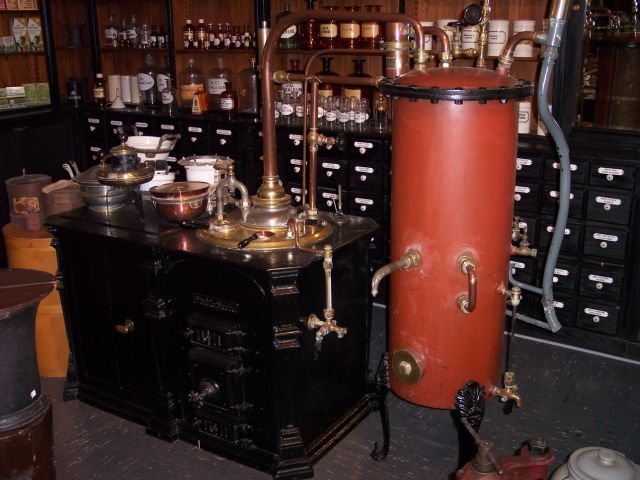




How it works and common equipment
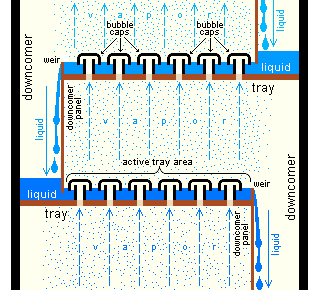
The basic apparatus consists of a heated pot, a vapor path, a condenser and a receiver. Practical distillation often uses additional elements to improve separation: fractionating columns or packing increase contact between rising vapour and descending liquid to produce repeated vaporization-condensation steps (enriching the vapour in the more volatile component). Reflux control, condensers, and reboilers are familiar in laboratory and industrial setups. Operating conditions such as pressure and temperature affect composition; lowering pressure (vacuum distillation) permits separation at lower temperatures for heat-sensitive materials.
Types of distillation
- Simple distillation: suitable for substances with large boiling point differences or to remove a volatile component from nonvolatile impurities.
- Fractional distillation: uses a column to separate mixtures into multiple fractions based on volatility differences; widely used in chemical plants.
- Steam distillation: used for temperature-sensitive organic compounds, where steam carries volatile components without overheating them.
- Vacuum distillation: lowers operating pressure to reduce boiling temperatures.
- Azeotropic and extractive methods: used when mixtures form constant-boiling compositions that simple techniques cannot separate completely.
History and cultural context
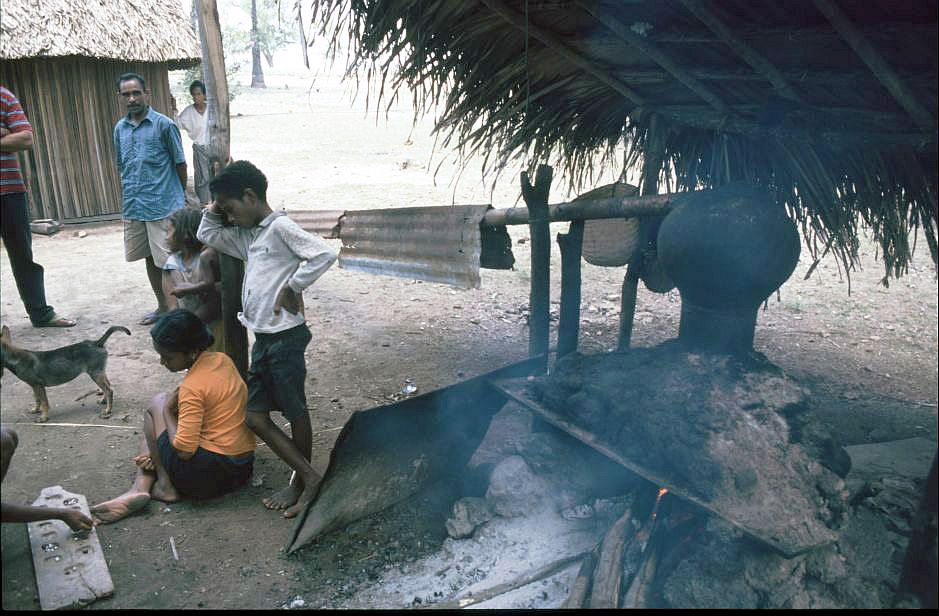
Distillation has a long history, with early practical uses in producing perfumes and medicines and later in alcohol production. Alchemists and early chemists refined techniques and apparatus that evolved into modern stills and columns. Distillation of spirituous liquids is a major cultural and economic activity worldwide; historically and legally it has also been associated with illicit production, commonly called "moonshine" in some regions when done without authorization.
Industrial and household uses
Industrial-scale distillation is central to petroleum refining where a crude oil oil refinery separates crude into fuels, lubricants and feedstocks by fractional distillation. Chemical manufacturing, solvent recovery, and water purification are other major applications: thermal distillation remains a primary method of desalination, leaving behind dissolved salt as residue. Distillation is also the traditional route to produce distilled spirits; many producers legally distill alcohol to make alcoholic drinks, though regulations vary and licensing is required in many countries.
Practical limitations and notable facts
Limitations include energy consumption and difficulty separating mixtures that form azeotropes or have very similar boiling points. Design and operation influence purity and yield: factors such as number of theoretical plates, reflux ratio, and column packing determine performance. Distillation remains a foundational separation method because it is robust, scalable and applicable to a wide range of industries from laboratories to large chemical plants.
Related articles
Author
AlegsaOnline.com Distillation: principles, history, methods and common uses Leandro Alegsa
URL: https://en.alegsaonline.com/art/27736
Sources
- bbc.co.uk : "Moonshine 'tempts new generation'"