
Boiling: the phase change of a liquid into gas
Boiling is the rapid vaporization of a liquid that occurs when its vapor pressure equals surrounding pressure; affected by temperature, pressure and surface conditions, distinct from evaporation.
Boiling is the rapid phase transition in which a liquid becomes a gas throughout its volume rather than only at the surface. In everyday language boiling is identified by vigorous bubble formation and continuous vapor release. For a concise definition see phase change, and for the visible bubbles that form during the process see bubble formation.
Image gallery
3 Images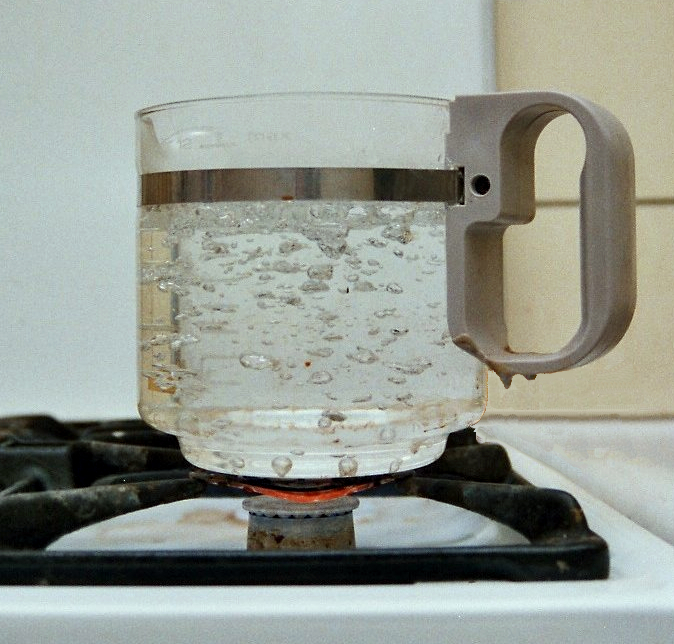


Basic characteristics
The temperature at which a liquid boils is called the boiling point. That temperature is not fixed for every situation: it depends on the identity and purity of the liquid and on the external pressure. For example, pure water at standard atmospheric pressure boils at about 100 °C (Celsius), and the vapor released is commonly termed water vapor or simply vapor.
How boiling occurs
Boiling begins when pockets of vapor form at nucleation sites within the liquid or at heated surfaces. These vapor pockets grow into bubbles that rise and escape. This bulk vaporization contrasts with evaporation, which is a slower surface process occurring at temperatures below the boiling point. The liquid's composition and impurities also influence where and how bubbles form; see substance properties for factors such as intermolecular forces.
Factors and regimes
- Pressure: Raising pressure generally raises the boiling point; lowering pressure lowers it (used in vacuum distillation).
- Surface and nucleation: Smooth or clean containers may delay boiling until superheating occurs; rough surfaces promote nucleation.
- Heat flux and regimes: As heating increases, boiling passes through nucleate boiling, transition, and film boiling regimes with different heat-transfer behavior.
Uses, examples and importance
Boiling is central to cooking, sterilization, power generation, chemical separation (distillation), and industrial drying. Practical examples include boiling water to make tea, pressure-cooker cooking that raises the boiling point, and using reduced pressure to boil solvents at lower temperatures for sensitive compounds.
Distinction and notable facts
Unlike slow evaporation, boiling produces bubbles throughout the liquid and typically requires reaching a condition where vapor pressure matches ambient pressure. Small variations in pressure or impurities can significantly change behavior, which is important to consider in laboratory procedures and food preparation.
For further reading on phase changes and related phenomena see these resources: phase change overview, nucleation and bubbles, evaporation comparison, boiling point details, material effects, water properties, temperature scales, vapor definition, water vapor specifics.
Related articles
Author
AlegsaOnline.com Boiling: the phase change of a liquid into gas Leandro Alegsa
URL: https://en.alegsaonline.com/art/12719