
Fractional distillation: principles, equipment, uses and industrial practice
Fractional distillation separates mixtures into components by exploiting differences in boiling points. This article explains how columns work, equipment, applications (especially oil refining), limitations and key distinctions.
Fractional distillation is a technique used to separate a liquid mixture into a series of fractions, each enriched in a particular component, by repeated vaporization and condensation. It relies on differences in boiling points among the mixture's constituents and the establishment of vapor–liquid equilibria so that each fraction can be collected with higher purity. For general background on the kinds of chemical mixtures involved, see chemical compounds. The procedure depends fundamentally on differences in boiling points, and on controlled heating so that components evaporate and then condense at different positions within the apparatus.
Image gallery
4 Images

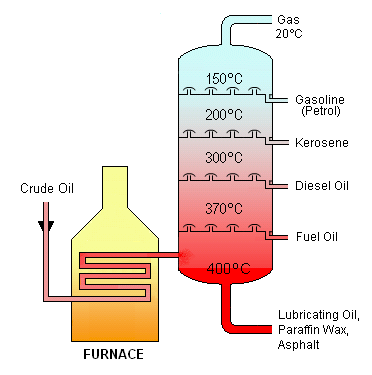

How fractional distillation works
In fractional distillation a mixture is heated to produce vapour that rises through a fractionating column. Within the column the vapour repeatedly condenses and revaporizes, a process that increases the separation between more and less volatile components. Each condensation–evaporation step acts like a simple distillation stage; an efficient column therefore produces many such steps and yields purer fractions. The overall outcome is governed by relative volatility and the shapes of phase equilibrium curves rather than any single boiling point value.
Equipment, concepts and common terms
- Boiling flask or reboiler: provides the heat and initial vapour.
- Fractionating column: the core device where separation occurs; it may be packed with material to increase surface area or fitted with trays (plates). Modern descriptions and designs are discussed at fractionating column.
- Condenser and receivers: cool vapour back to liquid at chosen collection points.
- Reflux: portion of condensed liquid returned to the column to improve separation efficiency.
- Theoretical plates: a way to quantify the column's resolving power; more plates generally mean better separation.
- Relative volatility: a measure of how easily two components separate by distillation.
Industrial and laboratory applications
Fractional distillation appears at many scales. In the laboratory a glass fractionating column is used to purify solvents, separate close‑boiling liquids, or isolate reaction products. In industry the same principles are applied on a much larger scale. The most prominent example is the crude oil refinery, where atmospheric and vacuum fractionation towers separate petroleum into useful product streams; introductory material on large‑scale implementations can be found at oil refineries. Typical refinery fractions include:
- Refinery gases (light hydrocarbons)
- Gasoline (petrol)
- Naphtha (feedstock for petrochemicals)
- Kerosene and jet fuels
- Diesel
- Fuel oils and lubricants
- Residue, which can be processed to make bitumen or subjected to further cracking
Other important uses include the production of high‑purity solvents, separation of air into oxygen and nitrogen by cryogenic fractional distillation, and the preparation of distilled spirits (where a similar column is used to concentrate ethanol).
Limitations, special methods and notable distinctions
Fractional distillation is most effective when components differ sufficiently in volatility. In laboratory practice a working rule often cited is that simple distillation suffices when boiling points differ by more than about 25 °C at atmospheric pressure; closer boiling mixtures, or those forming azeotropes, typically require fractional techniques or alternative methods. Azeotropes — mixtures that boil at a constant composition — cannot be fully separated by ordinary distillation without special measures. To handle very high boiling substances or to avoid thermal decomposition, distillation under reduced pressure (vacuum distillation) is used, while steam distillation can help separate temperature‑sensitive, water‑immiscible organics.
Historical notes and development
Distillation has ancient roots, but fractional distillation in a recognizable technical form developed as chemists and engineers sought to separate complex mixtures more efficiently. Advances in column design, the use of reflux and theoretical plate concepts during the 18th–20th centuries improved both laboratory and industrial practice. Today, sophisticated packing materials, computer control of column conditions and combined processes such as catalytic cracking extend the range and productivity of fractionation systems.
Practical considerations and safety
Effective fractional distillation requires proper control of heat, attention to column packing or tray condition, and careful collection of fractions. Many distillation processes handle flammable or toxic substances, so ventilation, inert atmospheres and explosion‑proof equipment may be necessary. For further technical guidance and troubleshooting, introductory resources on general distillation and more specialized texts are recommended.
For more detailed explanations of vapor–liquid equilibrium, laboratory setups and industrial tower operation, consult introductory chemical engineering or organic laboratory references and the resources linked at chemical compounds, boiling point, evaporation, condensation, and fractionating column. Additional practical case studies and schematics are available through technical guides and educational portals referenced at oil refineries.
See also: laboratory fractional distillation setups, azeotrope behavior, vacuum and steam distillation techniques, and comparative descriptions of simple versus fractional distillation.
Related articles
Author
AlegsaOnline.com Fractional distillation: principles, equipment, uses and industrial practice Leandro Alegsa
URL: https://en.alegsaonline.com/art/35963