
Double bond (chemistry): structure, types, properties and significance
A chemical bond in which two atoms share four electrons (bond order 2). Covers bonding (σ and π), geometry, types (alkenes, carbonyls, imines), reactivity, and notable distinctions.
A double bond is a covalent connection between two atoms in which they share two pairs of electrons, giving a bond order of two. It is commonly symbolized in structural formulas by two parallel lines (=) between the bonded atoms. Double bonds appear widely across organic and inorganic chemistry; the C=C linkage of alkenes and the C=O group of carbonyl compounds are among the most familiar examples. Compared with a single bond, a double bond is generally shorter and stronger and imparts distinctive geometric and electronic properties to molecules.
Image gallery
4 Images
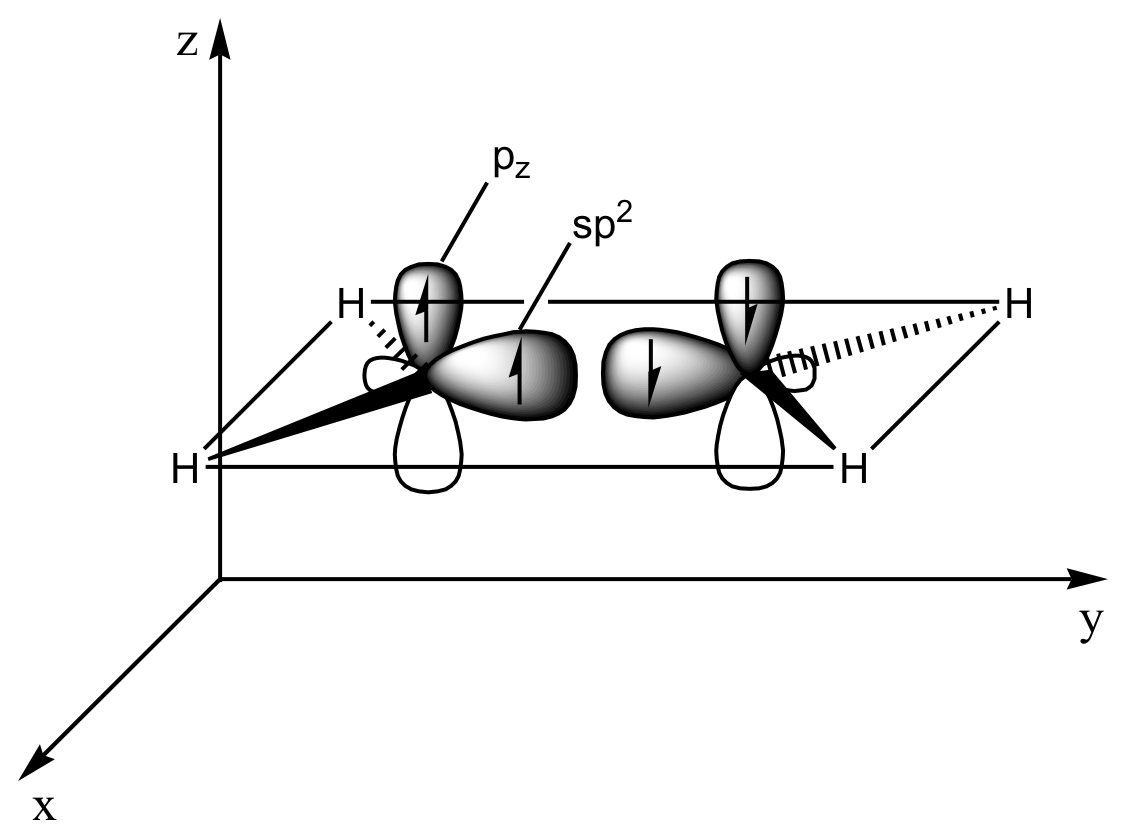


Bonding and geometry
From a valence perspective, the two electron pairs that make up a double bond do not occupy identical spatial roles. One pair forms a sigma (σ) bond: an electron cloud concentrated along the internuclear axis that provides the primary overlap and strongest part of the bond. The other pair forms a pi (π) bond: side-to-side overlap of p orbitals that creates electron density above and below the bond axis. The combination of σ and π bonding accounts for the higher bond order and reduced bond length. Because the π component requires parallel alignment of orbitals, rotation about a true double bond is restricted, producing fixed spatial arrangements that can lead to stereoisomerism such as cis/trans or E/Z isomers.
Types, examples and structural variants
Double bonds occur between many element pairs. In organic chemistry, carbon–carbon (C=C) double bonds define alkenes; carbon–oxygen (C=O) double bonds characterize carbonyl-containing functional groups such as aldehydes, ketones and carboxylic derivatives. Double bonds also occur as nitrogen–nitrogen (N=N) in azo compounds, carbon–nitrogen (C=N) in imines, sulfur–oxygen (S=O) in sulfoxides and in other heteroatomic combinations. Double bonds can be isolated, conjugated (alternating single and double bonds), or cumulated (consecutive double bonds as in allenes), with each arrangement affecting stability and reactivity differently.
Reactivity and applications
Because double bonds concentrate electron density in the π system, they are frequent sites for chemical reactions. Electrophilic addition to C=C bonds is a cornerstone reaction in organic synthesis, allowing construction of new bonds and functional groups. Conjugation with adjacent π systems or heteroatoms alters absorption of light and redox behavior—important features in dyes, polymers, and biological chromophores. Partial double-bond character also plays a critical role in biomolecules: for example, peptide bonds have restricted rotation due to resonance, giving proteins defined backbone geometry.
Theoretical and historical context
The modern description of double bonding arises from both valence-bond concepts (σ and π overlap) and molecular orbital theory, which treats bonding and antibonding combinations across the whole molecule. Early structural chemists recognized double bonds through reactivity patterns and bond measurements; later quantum chemistry provided a unified picture of orbital interactions, resonance stabilization, and the influence of substituents on bond order and length.
Distinctions and notable facts
Not all "double bonds" are equivalent: polarity, substituent effects, and resonance can make a C=O very different chemically from a C=C, even though both have bond order near two. Conjugated double bonds stabilize adjacent positive charge and lower the energy gap for electronic transitions, which is exploited in organic electronics and dyes. Geometric restriction of rotation leads to stereochemical isomerism that is fundamental to material properties and biological activity.
- General overview of double bonds
- Atoms commonly forming double bonds
- Definition of chemical bond
- Electron pairing and bonding electrons
- Carbon chemistry and C=C bonds
- Examples of carbon-containing double bonds
- Alkenes and their properties
- Carbonyl group overview
- Oxygen in double bonds
- Skeletal formula conventions
- Typographic representation of double bonds
- Comparing single and double bonds
- Reactivity of electron-rich π systems
- Sigma (σ) bonding explained
- Pi (π) bonding and orbital shapes
Related articles
Author
AlegsaOnline.com Double bond (chemistry): structure, types, properties and significance Leandro Alegsa
URL: https://en.alegsaonline.com/art/28629
Sources
- chemguide.co.uk : "covalent bonding - double bonds"
- chemwiki.ucdavis.edu : chemwiki.ucdavis.edu/Theoretical_Chemistry/Chemical_Bonding/Pictorial_Molecular_Orbital_T…