
Age of Discovery: European maritime expansion and global contact
Period from the early 15th to early 17th century when European seafaring expanded globally, seeking new trade routes, resources and knowledge; it reshaped world trade, mapping and cross-cultural contact.
Overview
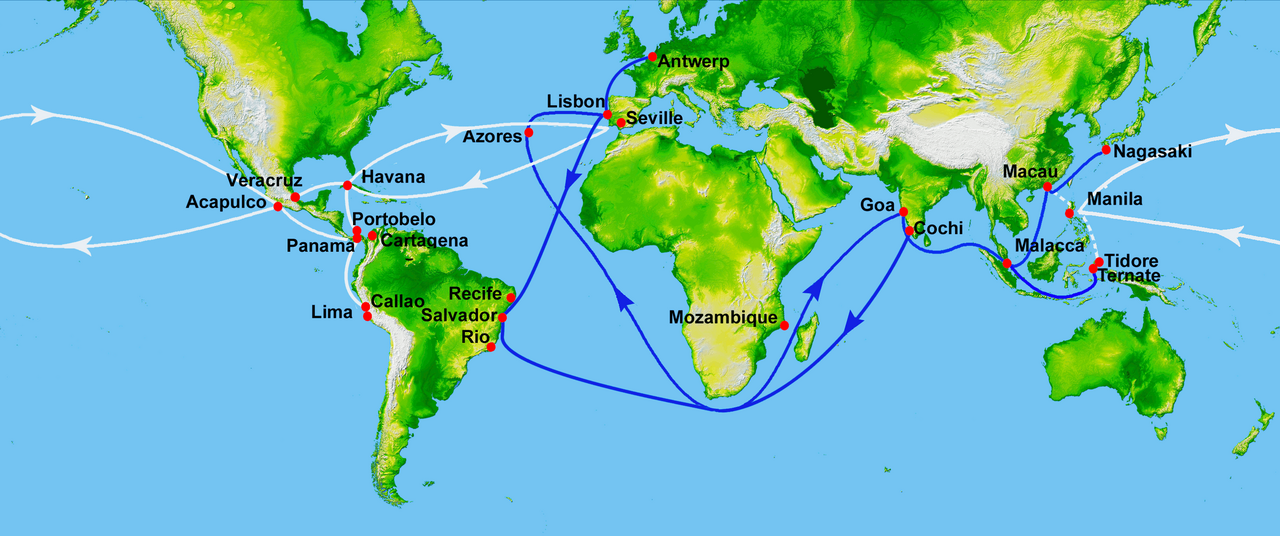
The Age of Discovery, often called the Age of Exploration, describes the era when European maritime powers extended regular long-distance sea travel beyond familiar coastal waters into transoceanic routes. It began in the early 15th century (early 1400s) and carried through into the early 17th century (1600s). This movement was driven primarily by states, merchants and navigators from Europe (European kingdoms and republics), who sought new trading possibilities, political advantage and geographic knowledge.
Image gallery
10 Images




Motives and objectives
Economic motives were central: traders and monarchs wanted direct access to valuable commodities and markets. Expeditions aimed to reach regions rich in gold gold, silver silver and spices spices, bypass intermediaries and secure profitable trade routes. Other motives included the search for alternative passages to Asia, the desire to expand influence and convert non-Christian populations, and scientific interest in mapping and natural history.
Technology, ships and navigation
Advances in ship design and navigational instruments made sustained ocean voyages practical. Smaller, maneuverable vessels such as caravels and later galleons combined with improved charts, the magnetic compass, the astrolabe and techniques of dead reckoning allowed crews to cross open waters with greater confidence. Cartography improved as coastal surveys and recorded routes were consolidated into nautical charts used by later mariners.
Consequences and historical significance
European voyages produced profound and lasting effects. They connected previously separated continents, initiating the exchange of plants, animals, people, technologies and diseases often summarized as the Columbian exchange. New maritime empires and trade networks emerged, transforming global commerce, agriculture and population movements. These contacts also sparked colonization, warfare and cultural disruption for many indigenous societies; historians emphasize both the economic integration and the human costs of this period.
Notable explorers and voyages
- Christopher Columbus — voyages across the Atlantic that opened sustained contact between Europe and the Americas.
- Vasco da Gama — sailed from Europe to India by rounding Africa, establishing a sea link to Asian markets.
- Pedro Álvares Cabral — claimed parts of South America for Portugal during voyages to India.
- John Cabot — explored parts of northeastern North America under English commission.
- Yermak — led Russian expansion eastward into Siberia by river and steppe routes.
- Juan Ponce de León — explored parts of the Caribbean and the southeastern coast of North America.
- Juan Sebastián Elcano — completed the first recorded circumnavigation after Magellan's death.
- Bartholomeu Dias — first European to round the southern tip of Africa, opening the route to the Indian Ocean.
- Ferdinand Magellan — initiated the first expedition to sail around the world.
- Willem Barentsz — explored Arctic routes and sought a Northeast Passage.
- Abel Tasman — charted parts of Australasia, including Tasmania and New Zealand.
- Jean Alfonse — navigator and pilot who contributed to early Atlantic and Indian Ocean charts.
- Jacques Cartier — explored the St. Lawrence River and laid groundwork for French claims in North America.
- Samuel de Champlain — mapped and settled parts of eastern Canada and helped establish New France.
- Willem Blaeu — notable cartographer whose atlases reflected accumulated geographic knowledge.
- Captain James Cook — later voyages charted Pacific islands, Australia and New Zealand with scientific precision.
- Jean Alfonse — (additional mention for navigational writings and pilot manuals).
- Willem Barentsz — (additional note on Arctic exploration).
- Other navigators — many lesser-known pilots and indigenous pilots contributed to mapping and knowledge exchange.
Legacy and interpretations
The Age of Discovery marks a major turning point in world history: it extended networks of exchange, produced new geographic knowledge and laid foundations for the modern global economy. At the same time, it initiated processes of colonization and cultural disruption that are central to contemporary debates about empire, restitution and historical memory. Scholars continue to revise understandings of the era by highlighting non-European actors, environmental impacts and the complex local consequences of early modern globalization.
Questions and answers
Q: What is the Age of Discovery?
A: The Age of Discovery is a period from the early 15th century to the early 17th century during which European ships traveled around the world to search for new trading routes and partners.
Q: What were Europeans searching for during the Age of Discovery?
A: Europeans were in search of trading goods such as gold, silver and spices during the Age of Discovery.
Q: What was the result of the Age of Discovery?
A: Europeans met people and mapped lands previously unknown to them during the Age of Discovery.
Q: Who were some of the famous explorers of the Age of Discovery?
A: Christopher Columbus, Vasco da Gama, Pedro Álvares Cabral, John Cabot, Yermak, Juan Ponce de León, Juan Sebastian Elcano, Bartholomeu Dias, Ferdinand Magellan, Willem Barentsz, Abel Tasman, Jean Alfonse, Jacques Cartier, Samuel de Champlain, Willem Blaeu and Captain James Cook were among the most famous explorers of the Age of Discovery.
Q: What were Europeans hoping to achieve through their travels during the Age of Discovery?
A: Europeans were hoping to find new trading routes and partners during the Age of Discovery.
Q: What trading goods were Europeans searching for during the Age of Discovery?
A: Europeans were searching for trading goods such as gold, silver and spices during the Age of Discovery.
Q: What did Europeans discover during the Age of Discovery?
A: Europeans discovered new lands and people previously unknown to them during the Age of Discovery.
Related articles
Author
AlegsaOnline.com Age of Discovery: European maritime expansion and global contact Leandro Alegsa
URL: https://en.alegsaonline.com/art/1355