
Vanadium: properties, occurrence, chemistry, uses and biological roles
Vanadium (V, atomic number 23) is a silvery transition metal used mainly to strengthen steel, with diverse oxidation states, catalytic roles, marine and biological occurrences, and applications in energy storage.
Overview
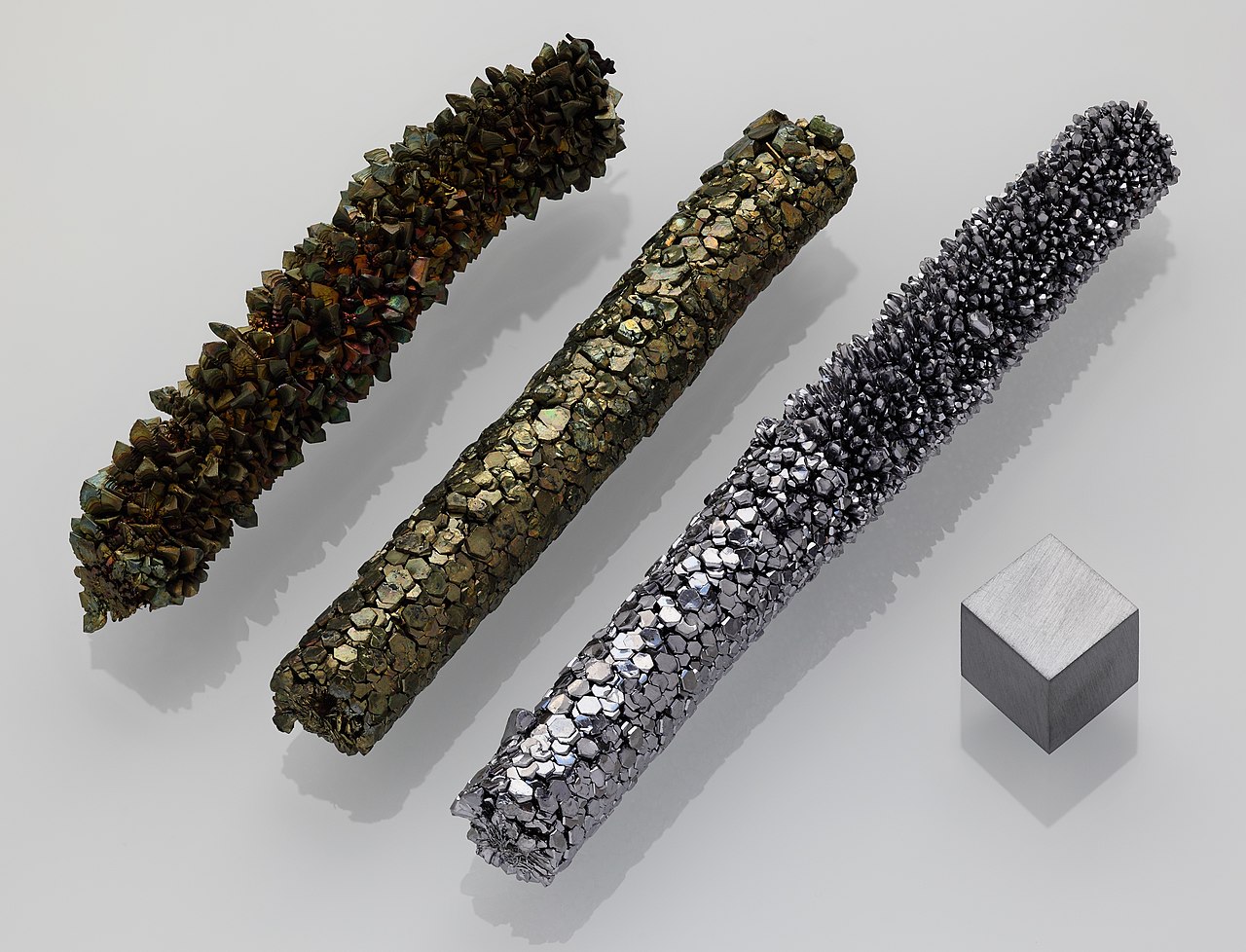
Vanadium is a chemical element with the symbol V and atomic number 23. It belongs to the transition metals and appears as a hard, silvery-grey metal that forms a variety of compounds in multiple oxidation states. The element's name derives from Vanadis, a poetic name for the Norse goddess Freyja, reflecting the often colorful nature of vanadium compounds. Vanadium atoms are detected in the light of the Sun and other stars by spectroscopic methods, which reveal its presence in cosmic and terrestrial matter (element entry, periodic table, solar spectroscopy).
Image gallery
10 Images




Chemical characteristics
Vanadium exhibits several common oxidation states, notably +2, +3, +4 and +5, each with distinct chemistry and appearances. The +5 state, found in the vanadate ion, typically forms oxoanions that are often yellow or orange, while lower oxidation states can give green, blue or violet compounds. Vanadium readily forms complexes with oxygen, sulfur and nitrogen donors and participates in redox reactions. These varied oxidation states make vanadium compounds useful as catalysts and in redox-based technologies (name origin, metal class).
Occurrence and geological distribution
Vanadium is widely distributed in the Earth's crust and appears in many minerals rather than as a native metal. Notable ore minerals and deposits include vanadinite and patronite among others, and vanadium is commonly obtained as a byproduct of titaniferous magnetite processing and petroleum residues. It is present in soils, sediments and waters in trace concentrations and is also a frequent component of airborne dust and combustion emissions. Spectroscopic observations extend its detection to the Sun and other stellar sources, showing that vanadium is not rare in the cosmos (transition metals, steel alloying, cosmic abundance).
Vanadium in the environment and the oceans
In natural waters vanadium is typically present as oxoanions (vanadate species) that are soluble and fairly mobile. Seawater carries dissolved vanadium at concentrations that make it one of the more abundant transition metals in the marine environment, where it participates in geochemical cycles and is supplied by rivers, dust, volcanic emissions and human inputs. Vanadium can undergo redox transformations that affect its speciation, adsorption to particles and eventual burial in sediments. These redox-driven changes also influence isotopic fractionation: variations in vanadium isotope ratios in sediments and crusts record past oxygenation and local redox conditions, and they are used in paleoenvironmental studies to infer ocean chemistry and the extent of anoxic conditions (marine biology, stellar detection, spectroscopy methods).
Biological role and biochemical uses
Vanadium is used by a range of organisms. Certain marine algae and bacteria produce vanadate-dependent haloperoxidases, enzymes that use vanadium in their active sites to catalyze halogenation reactions important for secondary metabolite formation and defense. Some nitrogen-fixing bacteria utilize vanadium-containing nitrogenases as alternative enzymes to the more common molybdenum-based systems. In a few marine invertebrates, notably some tunicates and ascidians, vanadium accumulates in specialized proteins called vanabins. The role of vanadium in higher animals, including humans, remains uncertain: it is a trace element that may have biochemical effects at low concentrations, but clear evidence of an essential requirement in humans is lacking.
Major uses and applications
By far the largest industrial use of vanadium is as an alloying element in steels and other alloys. Small amounts of vanadium added to steel greatly enhance strength, hardness and resistance to shock and wear, which makes vanadium-alloyed steels important for tools, structural components and springs. Vanadium pentoxide (V2O5) serves as a catalyst in several chemical processes, most prominently in the oxidation of sulfur dioxide to sulfur trioxide in the manufacture of sulfuric acid. More recently, vanadium redox flow batteries have attracted attention for large-scale energy storage because they use vanadium in multiple oxidation states to store and release electrical energy reversibly (steel uses, industrial chemistry, metal classification).
History and notable facts
The discovery history of vanadium involved several early reports and re-evaluations. First observations of vanadium-containing minerals occurred in the early 19th century, and the element was later recognized and named in the 1830s. Over time chemists isolated pure vanadium metal and characterized its compound chemistry. Vanadium compounds are notable for their vivid colors, wide range of oxidation states and redox versatility. Environmentally, vanadium has both natural and anthropogenic sources; fossil fuel combustion and certain industrial processes contribute to atmospheric and terrestrial inputs. Its mobility and transformations in the environment make vanadium an element of interest in geochemistry, marine science and environmental monitoring (general reference, periodic context, transition metal group).
Summary and distinctions
- Atomic symbol: V; atomic number: 23 (periodic table).
- Common oxidation states: +2, +3, +4, +5; the +5 vanadate forms dominate in oxidizing aqueous environments.
- Main uses: strengthening steels, catalysts (e.g., V2O5), and emerging energy storage applications.
- Biological and environmental significance: present in marine enzymes and bacteria; isotopic variations used to interpret redox history of sediments.
For additional technical or historical reading consult elemental and geochemical references and spectroscopic surveys (etymology, abundance comparison, stellar observations, solar studies, analytical methods, marine occurrences, industrial context, element data, metal classifications, group overview, commercial applications, periodic reference).
Related articles
Author
AlegsaOnline.com Vanadium: properties, occurrence, chemistry, uses and biological roles Leandro Alegsa
URL: https://en.alegsaonline.com/art/104162
Sources
- doi.org : 10.1002/9780470994429
- ui.adsabs.harvard.edu : 1978PASP...90..536C
- doi.org : 10.1086/130379
- mindat.org : "Vanadium: Vanadium mineral information and data"
- minerals.usgs.gov : "Mineral Commodity Summaries 2015: Vanadium"