
Stone circle (megalithic monuments)
Prehistoric rings or arcs of standing stones whose purposes ranged from ritual and burial to calendrical and social functions; commonly found across Britain, Ireland and parts of Europe.
Overview
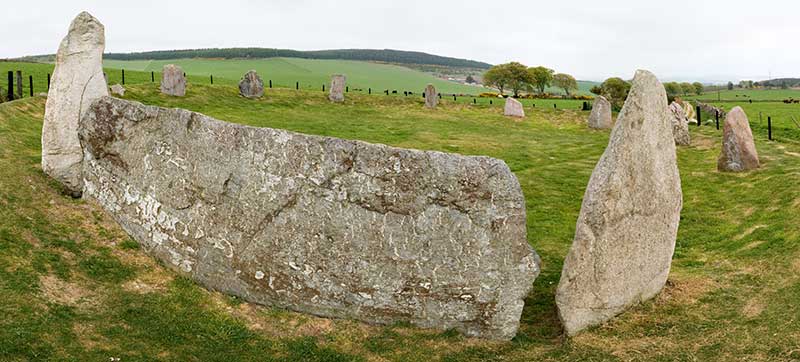
A stone circle is a prehistoric monument made by placing upright stones, often called menhirs, in a deliberate arrangement. Many take the form of circles or ellipses, but layouts vary widely. These monuments are known from the late Neolithic and Bronze Age and appear across northwestern Europe. Archaeologists study their form, setting and context to understand changing community practices and beliefs. For general background see stone circle resources and descriptions of standing stones.
Image gallery
10 Images



Design and common features
Stone circles may consist of a handful to several dozen stones set on a flat surface or within a raised area. Some are simple rings, others include inner rings, radial stones, or surrounding banks and ditches. Typical elements include:
- vertical orthostats or menhirs
- settings that form a roughly circular or elliptical plan (circular arrangements / elliptical plans)
- associated features such as cairns, tombs or funerary deposits and occasionally timber or stone avenues
Some stone rings are described as "henges" when they sit within a bank and ditch; related well-known examples are discussed via henge monuments.
Distribution and chronology
Concentrations of stone circles occur in Britain and Ireland, with additional examples on the continent and in Atlantic Europe. Estimates of numbers vary by region and definition; hundreds of examples survive in the British Isles while others are fragmentary or lost. For regional surveys see resources for Great Britain and Ireland.
Function and interpretations
The precise purposes of stone circles remain debated. Interpretations include community ritual and assembly places, monuments marking ancestral or burial sites, and observational stations for tracking seasonal events. Some rings show alignments or sightlines that make particular stones stand out at sunrise or sunset on key dates; this has led to hypotheses that they had calendrical or astronomical roles (ritual uses, calendar interpretations). Famous alignments associated with solstices and equinoxes illustrate how light interacts with stones on special days (summer solstice examples).
Construction, social context and legacy
Building a circle required planning, transport and cooperation, implying social organisation and shared purpose. Materials, stone sourcing and construction techniques differed by locality, reflecting local traditions and resources. Stone circles continue to attract scholarly attention and public interest for their archaeological value and cultural resonance; they are protected and interpreted at many sites for visitors and researchers alike. For further reading and conservation information consult regional and thematic studies linked above.
Related articles
Author
AlegsaOnline.com Stone circle (megalithic monuments) Leandro Alegsa
URL: https://en.alegsaonline.com/art/94035