
Stone of Scone (Stone of Destiny)
Historic carved sandstone block used in Scottish and British coronations; long-associated with Scottish kingship, English conquest, legends, thefts, and modern ceremonial use.
The Stone of Scone, often called the Stone of Destiny or the Coronation Stone, is a historic block of red sandstone traditionally integral to the crowning of Scottish and later British monarchs. It has served as a symbol of kingship and national identity for centuries, and its custody and location have been matters of political and cultural importance. Coronation ceremonies across the British Isles have linked the stone to monarchical legitimacy.
Image gallery
5 Images


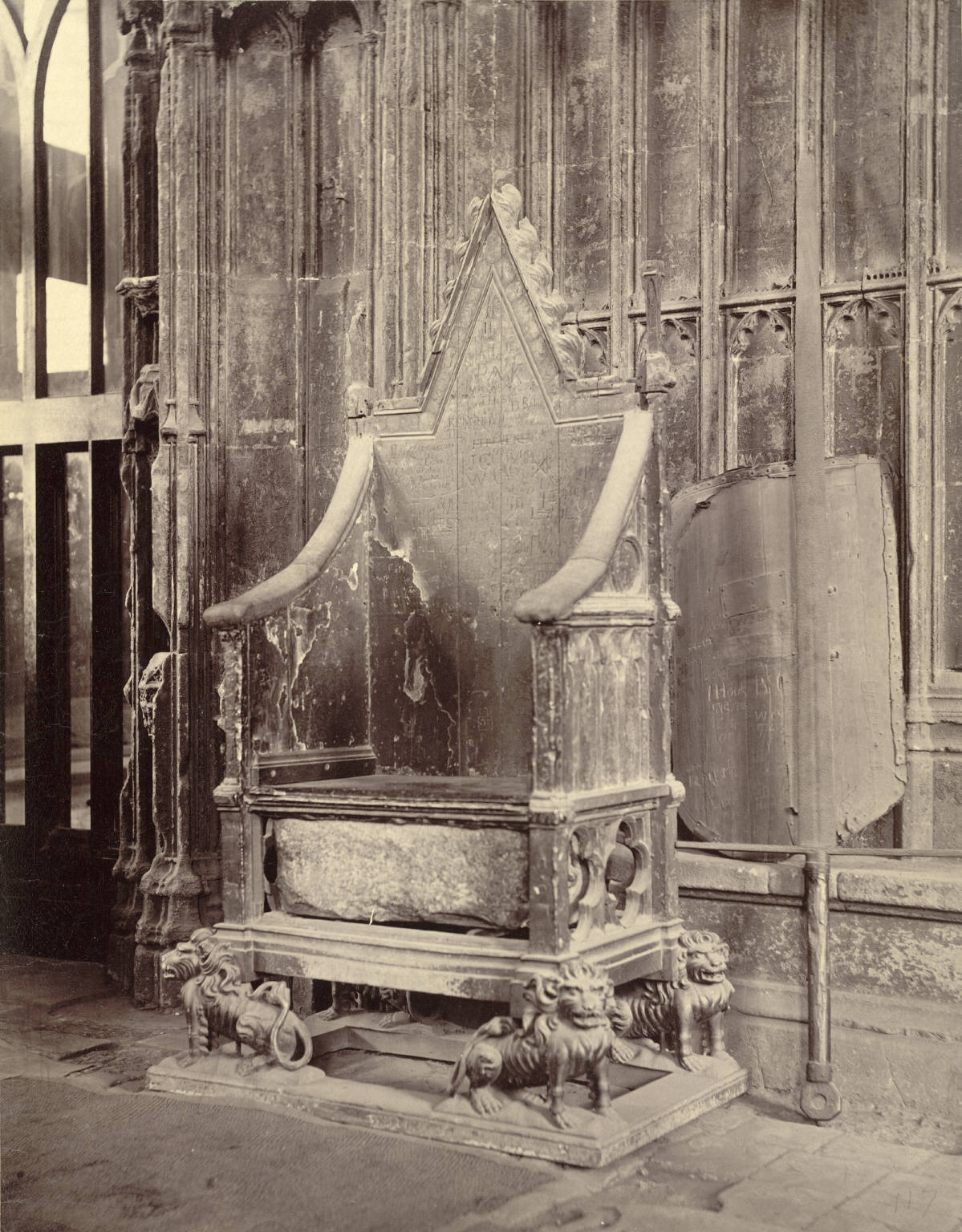

Physical characteristics
Physically, the stone is an oblong block of red-tinged sandstone thought to come from the region around Scone. Measurements are commonly given as about 26 inches by 16.75 inches by 10.5 inches and a weight of roughly 336 pounds (about 152 kg). The surface is smoothed and worn in places from use; it has been described as plain rather than elaborately carved. The stone's material and appearance are often cited in discussions about its origins and authenticity. See also material references such as red sandstone.
History and movement
Originally kept at Scone, near Perth, the stone was associated with the ancient coronation site of Scottish kings at Scone Abbey. In medieval times it formed part of the inauguration ritual for Scottish monarchs. In 1296, during his campaigns in Scotland, King Edward I of England removed the stone and took it to Westminster Abbey, placing it beneath the Coronation Chair as a visible statement of authority. For centuries it remained under English—later British—custody.
Modern era: theft, return, and ceremony
In the 20th century the stone continued to attract attention. A well-known removal by Scottish students in 1950 briefly brought it back to Scotland before it was recovered and returned to Westminster. It was used at the coronation of Queen Elizabeth II in 1953 and, after a 1996 decision to allow greater Scottish stewardship, the government placed the stone on long-term loan to Scotland, where it is normally displayed near Perth at a secure location linked to Scone Abbey and Scotland. For state ceremonies the stone has been returned to Westminster when required; it was brought back for high-profile coronation ceremonies including that of Elizabeth II, and has been discussed in relation to later coronations.
Significance, legends, and controversies
The Stone of Scone occupies a place in folklore and national myth. Legends link it to biblical or ancient origins—most famously an association with Jacob's pillow-stone—though such claims are treated as symbolic rather than historical. Over time questions have arisen about whether the current stone is the original or a medieval replacement; scientific and documentary evidence has not resolved every claim, and debate continues among historians and antiquarians. The stone's story touches on themes of conquest, cultural memory, and the ritual basis of monarchy.
Uses and public importance
Today the Stone of Scone is important both as a museum object and as a living ceremonial relic. It is cited in discussions about Scottish identity, devolution, and the monarchy's symbolic ties across the United Kingdom. Visitors and scholars study its material, provenance, and role in ritual; civic and national ceremonies continue to draw on its long history.
- Traditional use: element in coronations and inaugurations.
- Symbolic roles: national identity, conquest, continuity.
- Contested aspects: authenticity debates, custody disputes, and thefts.
Questions and answers
Q: What is the Stone of Scone?
A: The Stone of Scone is a stone used in the coronation ceremonies of England and Scotland.
Q: What are the alternative names for the Stone of Scone?
A: The alternative names for the Stone of Scone are the Stone of Destiny and the Coronation Stone.
Q: Where was the Stone of Scone kept?
A: The Stone of Scone was kept at the now-ruined Scone Abbey in Scone, near Perth, Scotland.
Q: What are the dimensions of the Stone of Scone?
A: The dimensions of the Stone of Scone are about 26 inches (660 mm) by 16.75 inches (425 mm) by 10.5 inches (270 mm).
Q: How much does the Stone of Scone weigh?
A: The Stone of Scone weighs about 336 pounds (152 kg).
Q: When was the Stone of Scone last used and for whom?
A: The Stone of Scone was last used in 1953 for the coronation of Elizabeth II of the United Kingdom of Great Britain and Northern Ireland.
Q: What is the composition of the Stone of Scone?
A: The Stone of Scone is an oblong shaped block of red sandstone.
Related articles
Author
AlegsaOnline.com Stone of Scone (Stone of Destiny) Leandro Alegsa
URL: https://en.alegsaonline.com/art/94043