
Shotgun: design, ammunition, types, history and uses
Comprehensive introduction to shotguns: how they work, main parts, common action types, ammunition (shot and slugs), historical development, uses in sport, hunting and policing, and safety notes.
Overview
A shotgun is a shoulder-fired firearm designed to fire a cluster of projectiles or a single large projectile from a smooth or rifled barrel. In basic terms a shotgun operates when a primer in a shotgun shell ignites propellant (gunpowder), producing expanding gas that drives shot or a slug down the barrel. Unlike rifles, which typically fire a single bullet, shotguns are often used where a spreading pattern or short-range stopping power is desired.
Image gallery
10 Images




Design and main components
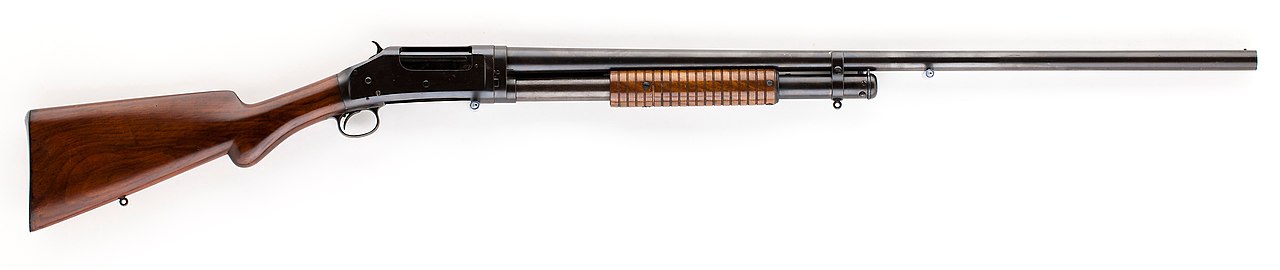
Common elements of a shotgun include the stock, receiver, action and one or more barrels. Each barrel contains a chamber that holds a loaded shell; the words barrel and chamber describe these parts respectively. Inside a shell the propellant is separated from the pellets or slug by a wad; the barrel's constriction (the "choke") influences how quickly the shot spreads. Some barrels are smoothbore, while others are rifled to stabilize a single projectile.
Action types and common layouts
Shotguns are produced in several mechanical forms. Break-open designs hinge open to expose chambers for loading and unloading; these break-open shotguns are simple and widely used for hunting and sport. Pump-action guns are cycled by sliding the fore-end back and forth to eject and chamber rounds—these pump-action models are durable and reliable. Semi-automatic shotguns use gas or recoil systems to cycle each round automatically and are referred to as semi-automatic when one trigger pull equals one shot. Fully automatic shotguns exist but are uncommon for civilian use.
Ammunition: shot, slugs and materials
Shotgun shells can contain many small pellets (shot) or a single heavy projectile (slug). Historically cartridges used lead pellets (lead), but concerns about environmental toxicity have led to widespread use of steel, iron, bismuth or other non-toxic alternatives. Larger individual projectiles are functionally similar to a bullet and are used where greater accuracy or range is required. The pattern produced by a shell depends on pellet size, choke and barrel length, which is why shooters often "pattern" their guns to understand performance.
Uses, history and non-lethal options
Shotguns evolved from early smoothbore firearms used for hunting birds and small game; over time they were adapted for sport shooting, military and law-enforcement roles. Their flexibility—multiple ammunition types, spread patterns and stopping power—makes them popular for upland game, waterfowl (with non-toxic shot), clay-target sports and home defense. Law enforcement agencies (police) sometimes use specialized less-lethal rounds such as rubber pellets, beanbags or other projectiles intended to incapacitate rather than kill.
Notable distinctions and safety considerations
Important distinctions include gauge (a traditional measure of bore size), barrel configuration (single, double in side-by-side or over-and-under arrangements), and whether a barrel is smooth or rifled. Shotguns are powerful at short range but less precise at distance with shot loads. Safe handling—treating every firearm as loaded, controlling the muzzle, and keeping the finger off the trigger until ready—is essential, as are training and familiarity with local laws. Hunters and shooters should also be aware of environmental rules governing shot materials in wetlands and protected areas.
- Common actions: break-open, pump-action, semi-automatic.
- Typical concerns: shot material (lead vs steel), patterning, choke selection.
- Key parts to know: barrel, chamber, stock, receiver, action.
For further technical descriptions, historical context and safety guidance see related resources and instructional materials available from manufacturers and certified training organizations: reference on shotguns, propellant, ammunition basics, internal ballistics, shot materials, slugs vs bullets, barrel design, chambering, break-action types, pump mechanisms, semi-auto systems, law enforcement applications.
Related articles
Author
AlegsaOnline.com Shotgun: design, ammunition, types, history and uses Leandro Alegsa
URL: https://en.alegsaonline.com/art/90024