
Silicon controlled rectifier (SCR): structure, operation, and applications
A silicon controlled rectifier (SCR) is a four-layer semiconductor switch used to control large currents and convert AC to DC. This article explains its structure, operation, history, and common uses.
Overview
A silicon controlled rectifier (SCR) is a member of the thyristor family: a four-layer, three-terminal semiconductor device used as a high-power switch. It behaves like a controlled diode, conducting current in one direction when it is triggered. SCRs are most commonly applied where large amounts of power must be switched or regulated, for example in power conversion, motor drives and industrial heating.
Image gallery
3 Images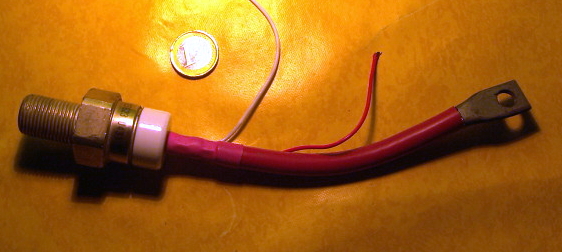


Structure and basic operation
An SCR consists of alternating layers of p- and n-type semiconductor material (a PNPN stack) with three electrical terminals: the anode, the cathode and the gate. In normal use the anode and cathode carry the main current, while a small gate current controls switching. Operating modes include:
- Forward blocking: the device is forward-biased but not yet triggered, so very little current flows.
- Forward conduction (latched): once a sufficient gate pulse or anode current is applied, the SCR switches to a low-resistance state and conducts until the current falls below a holding level.
- Reverse blocking: when the polarity is reversed the SCR blocks current like a reverse-biased diode.
Control characteristics and practical considerations
Key practical attributes include the gate trigger current, holding current, and the device's sensitivity to voltage change rate (dv/dt). Because an SCR latches on, it cannot be turned off by the gate; it requires the main current to fall below the holding current or an external commutation circuit to cease conduction. In many applications designers add snubber networks, gate resistors and heat sinks to manage false triggering, voltage transients and thermal dissipation.
History and development
Thyristor technology emerged in the mid-20th century as solid-state alternatives to vacuum tubes and mechanical switches for high-power control. SCRs became commercially important in the 1960s and have been refined since, spawning related devices such as TRIACs (bidirectional control for AC), gate turn-off thyristors (GTOs) and transistorized or MOS-controlled thyristors that offer different switching characteristics.
Applications and examples
SCRs are widely used where controlled rectification or high-power switching is required. Common applications include:
- Phase-controlled rectifiers and dimmers for converting AC to DC or adjusting delivered power.
- High-voltage direct-current (HVDC) converter stations, where banks of SCRs handle large currents and voltages.
- Industrial heating and electric arc processes, such as resistance and induction heating and welding power supplies.
- Motor controllers, battery chargers, crowbar protection and static switching elements in power systems.
Distinctions and notable facts
Unlike bipolar junction transistors, an SCR is designed to switch and sustain large currents once triggered rather than amplify small signals. Compared with a TRIAC, which can conduct in both directions for AC control, the SCR is unidirectional and often better suited for high-voltage DC or single-direction high-current tasks. Modern power electronics sometimes replace SCRs with faster insulated-gate devices (IGBTs, MOSFETs) in applications where rapid switching or fine pulse-width control is required, but SCRs remain cost-effective and robust for many heavy-duty roles.
For further technical references and application notes consult dedicated power-electronics sources and manufacturer datasheets.
Questions and answers
Q: What is a Silicon Controlled Rectifier (SCR)?
A: A Silicon Controlled Rectifier (SCR) is a type of thyristor, which is a four-layer solid-state current-controlling device that conducts current only in one direction.
Q: How are SCRs triggered?
A: SCRs are triggered only by currents going into the gate.
Q: What is a rectifier?
A: A rectifier is an electrical device that converts alternating current (AC) to direct current (DC).
Q: What is the use of SCRs in high-voltage direct current power transmission?
A: SCRs are used for rectification of high-power AC in high-voltage direct-current power transmission.
Q: What is the use of SCRs in welding machines?
A: SCRs are used in the control of welding machines.
Q: What is the main use of SCRs?
A: SCRs are mainly used in devices for the control of high power, perhaps with high voltage.
Q: In what applications are SCRs suitable for use?
A: SCRs are suitable for use in medium- to high-voltage AC power control applications, such as lamp dimming, power regulators and motor control.
Related articles
Author
AlegsaOnline.com Silicon controlled rectifier (SCR): structure, operation, and applications Leandro Alegsa
URL: https://en.alegsaonline.com/art/90401