
Saurolophus: duck‑billed dinosaur with a distinctive forehead crest
Saurolophus was a Late Cretaceous hadrosaur (duck‑billed dinosaur) known for a short bony spike on its forehead, with many specimens and skin impressions found in North America and Asia.
Overview
Saurolophus was a genus of duck‑billed, plant‑eating dinosaur belonging to the hadrosaur family. It lived near the end of the Mesozoic Era, during the Upper Cretaceous, about 69.5 to 68.5 million years ago. As a member of the group commonly called "duck‑billed dinosaurs," it shared features typical of hadrosaurs such as broad grinding teeth and a wide, flat beak for cropping vegetation. duck‑billed dinosaur and related terminology are often used to describe this family; more technically it is a hadrosaurid (hadrosaurid) from the latest Cretaceous (Upper Cretaceous) portion of the Mesozoic Era.
Image gallery
10 Images



Anatomy and distinctive crest
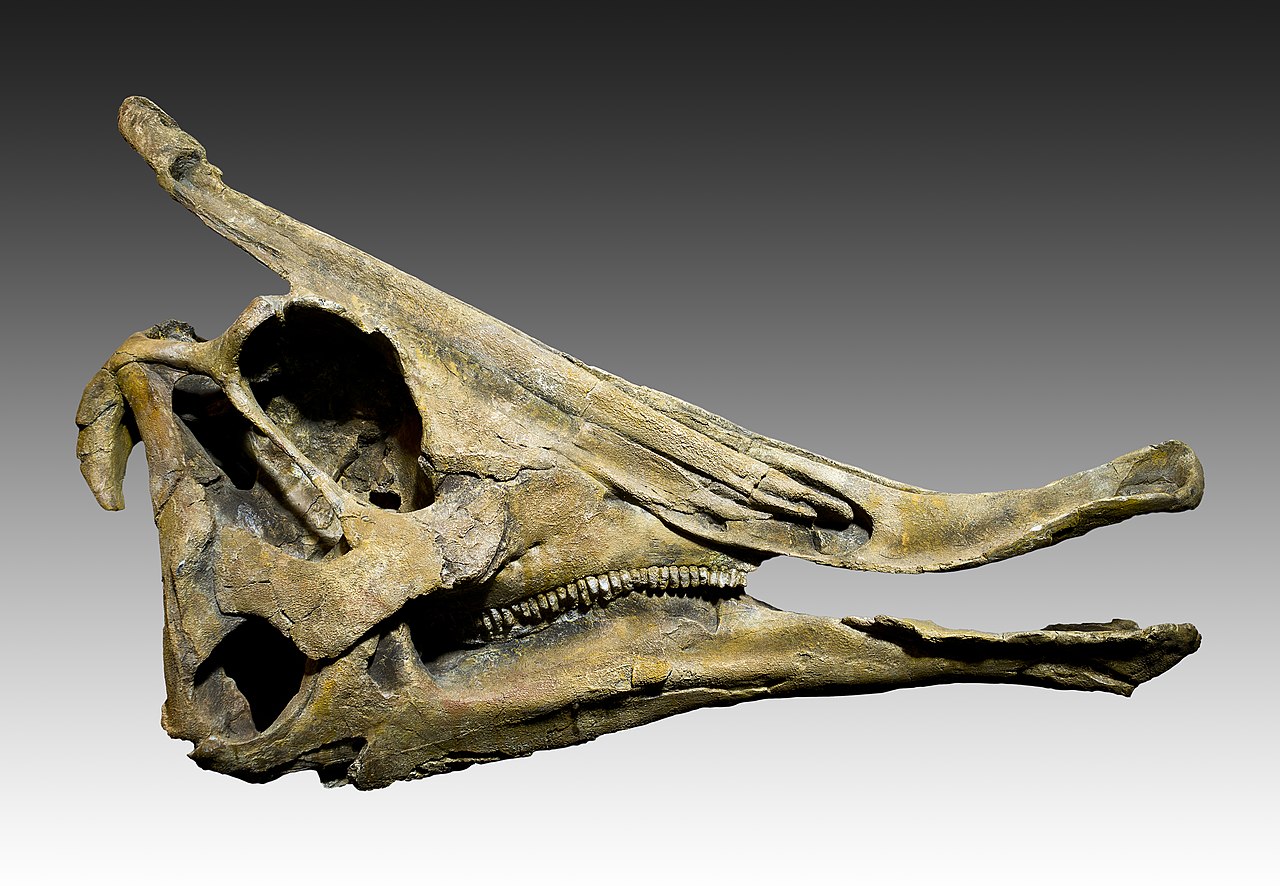
Among hadrosaurs, Saurolophus is notable for a short, solid bony spike projecting from the forehead. The crest measured roughly 13 cm (about 5 inches) in length on some specimens and arises from the skull as a triangular, upturned protuberance. This structure differs from the elaborate hollow crests of related lambeosaurines: Saurolophus has a solid spike rather than a large hollow resonating chamber. Paleontologists have offered several functional ideas for the crest, from visual display to social signaling and sound modification. Some researchers have suggested the spike might have supported soft‑tissue structures, perhaps an inflatable nasal sac, that could be used in bony spike display or display and noise‑making, though such reconstructions remain hypotheses.
Species, skin and fossils
Fossils of Saurolophus are relatively common compared with many dinosaurs, and include two widely recognized species found on different continents. Substantial material with impressions of skin and scale patterns is known, making Saurolophus important for studies of hadrosaur integument. Large collections of bones and skin impressions come from deposits in western Canada and parts of Asia. Significant localities include sites in Alberta and elsewhere in Canada, as well as finds reported from Mongolia and regions of China.
Paleobiology and behavior
Saurolophus, like other hadrosaurs, was a herbivore that processed plant material with closely packed dental batteries capable of grinding. Limb proportions and joint anatomy suggest it could move on both two and four legs, likely foraging in groups across floodplains and coastal plain environments. The crest and skin impressions provide clues to social behavior: visual display, species or sex recognition, and possibly sound production are all plausible functions in herd communication.
Notable facts and distinctions
- Distinctive short, solid forehead spike sets Saurolophus apart from hollow‑crested hadrosaurs.
- Exceptional fossil record includes specimens with detailed skin impressions, informing reconstructions of scales and textures.
- Found in both North America and Asia, illustrating faunal connections during the Late Cretaceous.
Synthesizing skeletal anatomy, fossil occurrence, and preserved soft‑tissue traces, Saurolophus remains a well‑studied example of a late hadrosaurid and helps clarify how display structures evolved among duck‑billed dinosaurs.
Related articles
Author
AlegsaOnline.com Saurolophus: duck‑billed dinosaur with a distinctive forehead crest Leandro Alegsa
URL: https://en.alegsaonline.com/art/87571
Sources
- doi.org : 10.1671/039.029.0405