
Regular polytope
A regular polytope is a highly symmetric generalization of regular polygons to any dimension; this article explains definition, properties, classification by dimension, history, examples and applications.
A regular polytope is a geometric figure in any number of dimensions that is maximally symmetric: all its facets (faces of one lower dimension), edges and vertices are equivalent under the symmetry group of the shape. In two dimensions regular polytopes are the familiar regular polygons; in three dimensions they are the five Platonic solids; in four dimensions there are six convex regular 4-polytopes; and in dimensions five and higher the convex regular polytopes fall into just three infinite families. Regularity is often expressed by a Schläfli symbol {p,q, ...} that compactly encodes how faces, edges and higher faces fit together.
Image gallery
7 Images



Definition and key properties
Formally, a convex polytope is regular if its automorphism group acts transitively on its flags (a flag is a nested sequence of faces of all dimensions). Informally this means the figure is vertex-transitive, edge-transitive and face-transitive simultaneously. Regular polytopes have regular facets and regular vertex figures. Many regular polytopes come in dual pairs: exchanging faces and vertices yields the dual, which is regular if the original is.
Classification by dimension
The family of regular polytopes depends strongly on the ambient dimension. In summary:
- 2D: infinitely many regular n-gons (for every integer n ≥ 3).
- 3D: five Platonic solids (tetrahedron, cube, octahedron, dodecahedron, icosahedron).
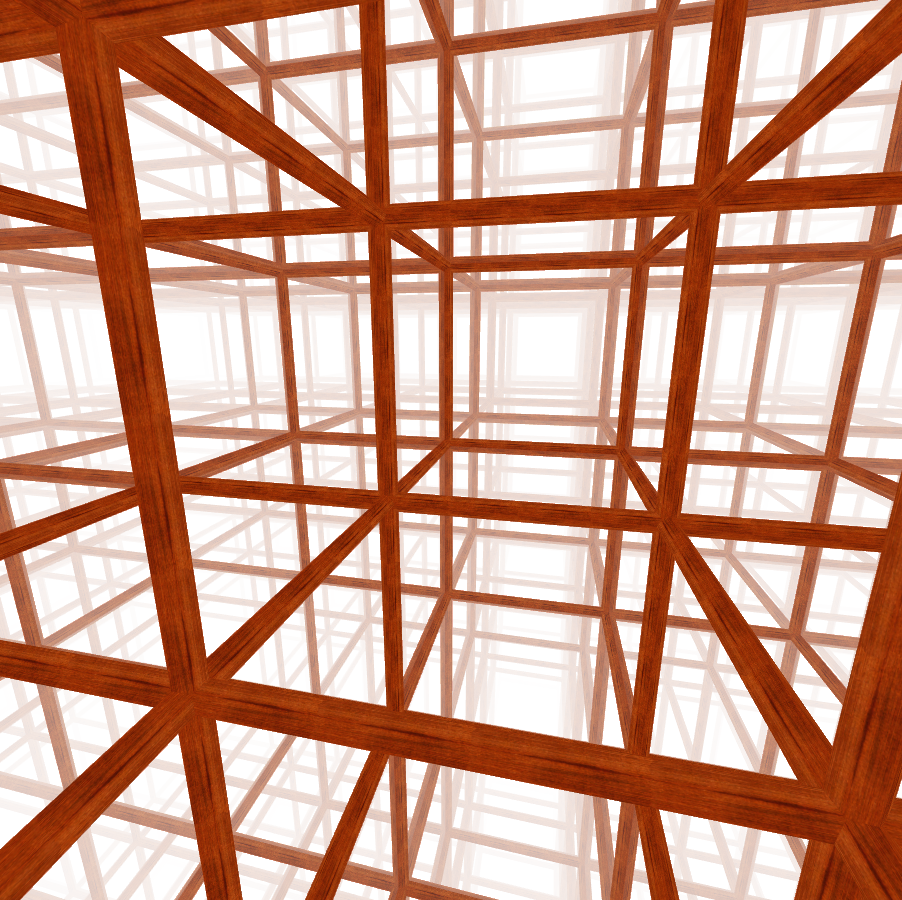
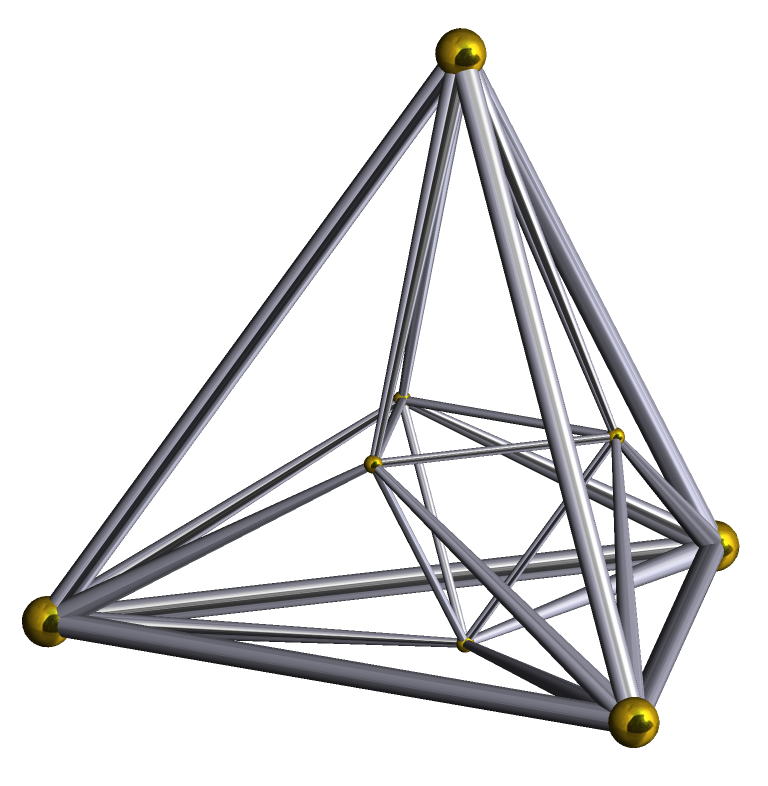
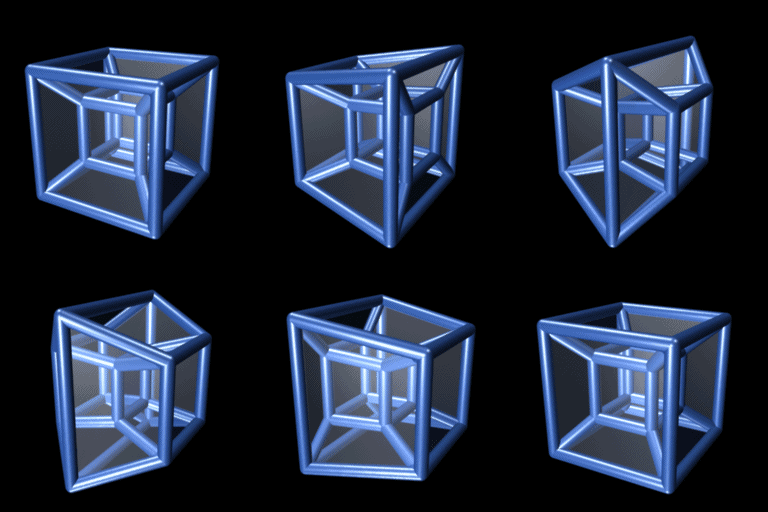
- 4D: six convex regular 4-polytopes including the 4-simplex (pentachoron) and the tesseract.
- n ≥ 5: exactly three families — the n-simplex, the n-cube (hypercube), and the n-orthoplex (cross-polytope).
History, notation and extensions
Study of regular figures goes back to classical Greece with the Platonic solids. In the 19th century Ludwig Schläfli extended the concept to higher dimensions and introduced the symbol that bears his name; later work by mathematicians such as H. S. M. Coxeter developed the symmetry and group-theoretic framework used today. Beyond convex examples, there exist nonconvex regular star polytopes in three and four dimensions and the notion of regularity can be generalized to tessellations and abstract polytopes.
Examples, uses and notable facts
Regular polytopes appear in many areas: they illustrate symmetry and group actions in algebra, provide test cases in computational geometry and optimization, and serve as models in theoretical physics and crystallography. Famous examples include the pentachoron (4-simplex) and the tesseract (4-cube). Key facts: regular polytopes are centrally important to the study of symmetry, they are typically described by Schläfli symbols, and in dimensions five and above the landscape of convex regular polytopes is surprisingly limited.
Further reading
- General overview of regular polytopes
- Regular polygons and 2D examples
- Polytopes: definitions and basic facts
- Dimensional concepts and the meaning of "n"
- Higher-dimensional geometry resources
- Regular polyhedra (Platonic solids)
- Symmetry groups and Coxeter theory
- Vertex figures and facet structure
- Convex regular 4-polytopes
- Pentachoron (4-simplex) description
- Tesseract (4-cube) description
Related articles
Author
AlegsaOnline.com Regular polytope Leandro Alegsa
URL: https://en.alegsaonline.com/art/81922