
Pentachoron (4‑simplex) — the regular 5‑cell of four‑dimensional space
A pentachoron (5‑cell, pentatope or 4‑simplex) is the simplest regular convex polytope in 4D, made of five tetrahedral cells arranged with full symmetry and self‑duality.
Overview
The pentachoron is the four‑dimensional analogue of the triangle (2‑simplex) and the tetrahedron (3‑simplex). In classical geometry it is classified as a regular convex regular polytope and specifically as a 4‑simplex. Common English names include 5‑cell, pentatope and hyperpyramid. As the simplest nontrivial regular 4‑polytope, every edge, face and cell of the pentachoron is congruent and arranged under a transitive symmetry group.
Image gallery
2 Images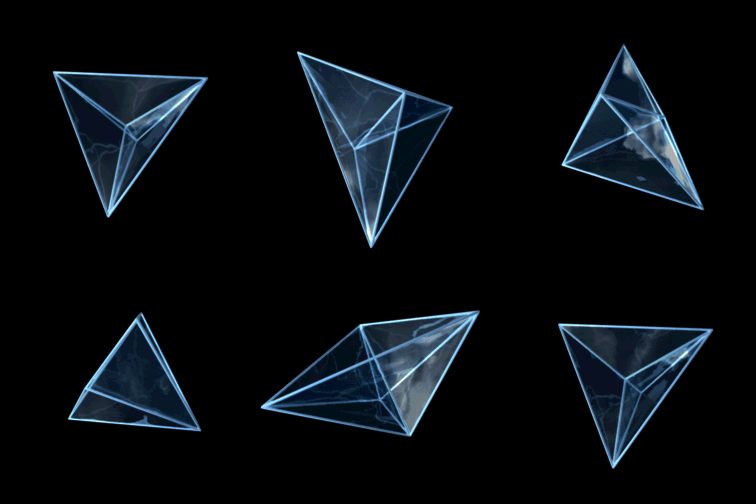

Structure and characteristics
Combinatorially the pentachoron consists of 5 vertices, 10 edges, 10 triangular faces and 5 tetrahedral cells. Each three‑dimensional cell is a regular tetrahedron, and each triangular face belongs to exactly two cells. Its Schläfli symbol is {3,3,3}, indicating that three triangles meet around each edge in a fully regular arrangement. The pentachoron is self‑dual and its symmetry group is that of permutations of five objects (the Coxeter group A4, isomorphic to the symmetric group S5).
Representation and coordinates
A regular 4‑simplex can be realized as the convex hull of five points in general position in four‑dimensional Euclidean space with equal pairwise distances. A standard construction places five equidistant points in a four‑dimensional hyperplane of R5 (for example by taking the five standard basis vectors and removing their centroid); the resulting set of four independent displacement vectors spans a regular pentachoron. This construction shows directly that all edges have the same length and that the figure is centrally symmetric only up to permutation symmetry, not by inversion.
Visualization and projection
Because human perception is limited to three spatial dimensions, the pentachoron is usually understood through three‑dimensional projections, Schlegel diagrams and animated rotations. Typical projections depict a central tetrahedron surrounded by four others joined to its faces, emphasizing adjacency relations and the full symmetry. Schlegel diagrams project the 4‑polytope into 3‑space so that one cell appears as an outer boundary containing a connected arrangement of the remaining cells.
Topological and combinatorial notes
As a convex 4‑polytope, the pentachoron satisfies the alternating sum relation for its boundary: V − E + F − C = 0 (here 5 − 10 + 10 − 5 = 0), a manifestation of the Euler–Poincaré characteristic for the 3‑sphere that bounds the 4‑polytope. Its self‑duality means that the pattern of vertices corresponds to the pattern of cells under duality, and its simple combinatorics make it the basic building block for simplicial decompositions of 4‑dimensional spaces.
History, naming and significance
Interest in higher‑dimensional regular polytopes dates to the 19th century with work classifying regular figures in dimensions greater than three; names such as pentachoron and pentatope reflect Greek roots and analogies with lower‑dimensional simplices. Besides theoretical interest in symmetry and group actions, the 4‑simplex plays a central role in algebraic topology as a simplex in simplicial complexes, in numerical methods (higher‑dimensional finite element meshes), and in combinatorial studies of polytopes.
Further reading
Introductory expositions on regular polytopes and higher‑dimensional geometry provide diagrams, coordinate constructions and group theoretic descriptions. See general resources on geometry, surveys of regular polytopes, material on 4‑simplices, discussions of four‑dimensional visualizations, and entries expanding on the tetrahedron for related three‑dimensional structure.
Related articles
Author
AlegsaOnline.com Pentachoron (4‑simplex) — the regular 5‑cell of four‑dimensional space Leandro Alegsa
URL: https://en.alegsaonline.com/art/75621