
Polytope — geometric figure with flat sides in any number of dimensions
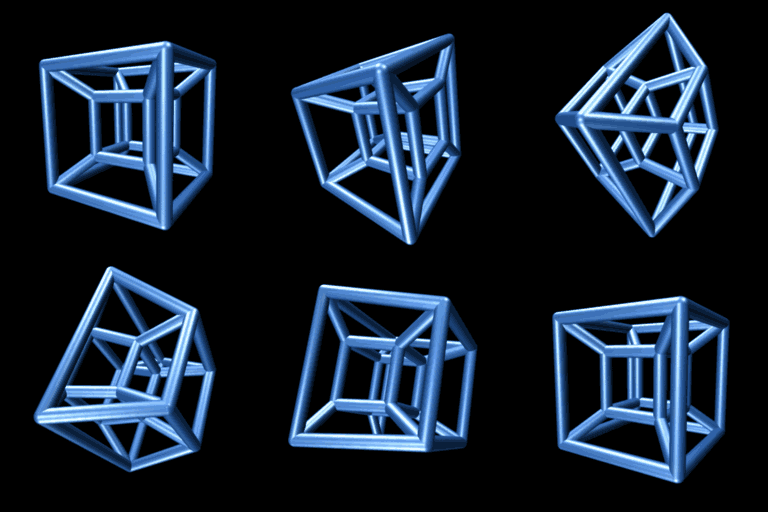
A polytope is a geometric object bounded by flat faces in any dimension. Polygons, polyhedra and higher-dimensional polytopes (like the tesseract) appear across mathematics, optimization and science.
A polytope is a geometric object with flat sides that generalizes the notion of polygons and polyhedra to any number of dimensions. In elementary terms a polytope is built from vertices, edges and higher-dimensional flat boundary elements and can be studied from geometric, combinatorial and topological perspectives. The concept is central in geometry and applies equally when one changes the number of dimensions.
Image gallery
2 Images
Common examples
In two dimensions a polytope is a polygon, and in three dimensions a polytope is often called a polyhedron. In four dimensions familiar examples include the tesseract and the 4-simplex; collections of highly symmetric four-dimensional examples are known as regular 4-polytopes. More generally, names such as n-polytope or k-face indicate the dimension of the object or of a boundary element.
Basic structure and terminology
- Vertices: the corner points where edges meet.
- Edges: segments joining pairs of vertices.
- Faces: polygonal 2D boundary elements (in 3D these are the familiar faces of a polyhedron).
- Facets: the (n−1)-dimensional boundary pieces of an n-polytope; in four dimensions these are often called cells.
- Polytopes may be convex (every line segment between two points lies inside) or nonconvex, and they may be regular, semi-regular, simple, simplicial, or self-intersecting (star) depending on symmetry and construction.
Classification and relationships
Classification uses symmetry, combinatorial type, and convexity. Regular polytopes are maximally symmetric and are described by compact symbolic notations such as the Schläfli symbol; duality is a fundamental relation that pairs polytopes so that vertices of one correspond to facets of the other. Classical results such as the Euler characteristic apply to convex polyhedra and have generalizations in higher dimensions that constrain how faces of different dimensions fit together. Star polytopes and other nonconvex examples extend the family of polytopes by allowing self-intersection while preserving combinatorial structure.
Historical context and study
The study of polytopes began with planar polygons and the Platonic solids familiar to the ancient Greeks. Work on higher-dimensional analogues developed in the 19th and 20th centuries as mathematicians formalized concepts of dimension, symmetry and combinatorial structure. Modern treatments combine algebraic, geometric and computational methods to enumerate, construct and analyse polytopes.
Applications and ongoing research
Polytopes appear across pure and applied mathematics. In optimization and linear programming the feasible region is a convex polytope whose extreme points often yield optimal solutions. Combinatorics and computational geometry study incidence relations, enumeration of faces and efficient algorithms for construction and recognition. In topology and group theory, polytopes provide concrete models for cell complexes and for actions of symmetry groups. Applications reach into physics, crystallography and computer graphics where polyhedral models and their higher-dimensional analogues are used to represent symmetry, packing and spatial structure. Contemporary research includes classification problems, metric properties, connections to polytopal subdivisions and applications to data analysis and discrete geometry.
Related articles
Author
AlegsaOnline.com Polytope — geometric figure with flat sides in any number of dimensions Leandro Alegsa
URL: https://en.alegsaonline.com/art/77888