
Relational model (database design)
A conceptual framework for organizing data into relations (tables) using tuples and predicates; introduced by E. F. Codd and realized widely via SQL-based relational database systems.
Overview
The relational model is a theoretical framework for structuring, storing and querying data in a database. At its core the model represents information as relations: mathematically defined sets of tuples that correspond to rows in a table. It emphasizes a declarative style of interaction, in which users express what information they want rather than how to obtain it; the database management system decides the physical storage and retrieval strategy.
Image gallery
1 Image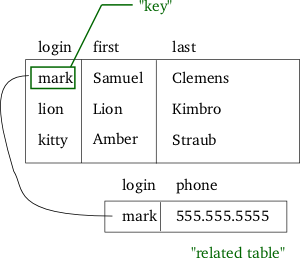
Core concepts and components
Key elements of the relational model include attributes, tuples, relations and schemas. An attribute defines a named column and a domain of valid values; a tuple is an ordered set of attribute values; a relation is a set of tuples sharing the same attributes; and a schema describes the structure and constraints of a relation. Practical implementations also define keys and integrity constraints to preserve data correctness.
- Attributes: column names and data types.
- Tuples: individual records (see tuple).
- Relations: sets of tuples stored as tables.
- Keys and constraints: rules to enforce uniqueness and relationships.
History and development
The relational model was introduced in 1969 by Edgar F. Codd as an application of first-order predicate logic to data management. Codd proposed replacing navigational database approaches with a simpler, mathematically grounded representation. Over subsequent decades the model influenced both academic research and commercial products; SQL emerged as the dominant language for defining and querying relational data, becoming the standard interface for most implementations.
Implementation and SQL
Although SQL-based systems are commonly described as "relational databases," most are pragmatic implementations that depart from some of Codd's formal principles for performance and usability reasons. Tables in SQL correspond to relation variables and rows correspond to tuples, but null values, duplicate rows and certain update behaviors show differences from the pure theoretical model. For practical guidance and standards information consult vendor documentation or general references such as relational model resources.
Uses, advantages and examples
Relational databases power a wide range of applications from enterprise transaction systems to web back ends. Advantages include a clear logical data model, standardized query language (SQL), strong support for ACID transactions, and a rich set of tools for reporting and analytics. Typical use cases involve structured data with well-defined relationships where integrity and consistency matter, such as accounting systems, inventory management and customer records.
Limitations and notable distinctions
While the relational model excels at structured, transactional workloads, it can be less natural for highly hierarchical or graph-like data, large-scale unstructured information, or workloads requiring flexible schemas. These needs have led to non-relational systems (NoSQL) and extensions such as object-relational features. For a historical perspective and criticisms of deviations from the original design see Codd's writings and follow-up discussions about relational principles.
Further reading and practical examples are available through many textbooks and online references; for formal definitions and proofs consult foundational literature and academic courses that explain the model in terms of predicate logic and set theory.
Questions and answers
Q: What is the relational model for database management?
A: The relational model for database management is a database model based on first-order predicate logic.
Q: Who proposed the relational model for database management and when was it proposed?
A: Edgar F. Codd proposed the relational model for database management in 1969.
Q: How is data represented in the relational model of a database?
A: In the relational model of a database, all data is represented in terms of tuples, grouped into relations.
Q: What is a database organized in terms of the relational model called?
A: A database organized in terms of the relational model is called a relational database.
Q: What is the purpose of the relational model?
A: The purpose of the relational model is to provide a declarative method for specifying data and queries.
Q: What language do most relational databases use?
A: Most relational databases use the SQL data definition and query language.
Q: How do table, contents of table, key constraints, other constraints, and SQL queries correspond to predicates in the relational model?
A: In the relational model, a table in an SQL database schema corresponds to a predicate variable; the contents of a table to a relation; key constraints, other constraints, and SQL queries correspond to predicates.
Related articles
Author
AlegsaOnline.com Relational model (database design) Leandro Alegsa
URL: https://en.alegsaonline.com/art/82000
Sources
- acm.org : "A Relational Model of Data for Large Shared Data Banks"
- doi.org : 10.1145/362384.362685
- knowledge.fhwa.dot.gov : Data Integration Glossary