
Rho (Greek letter)
Rho (Ρ, ρ) is the 17th letter of the Greek alphabet, representing the r sound. It has numeric value 100 and appears widely in science, mathematics and alphabets derived from Greek.
Overview
Rho is the 17th letter of the Greek alphabet, written as uppercase Ρ and lowercase ρ. In both Ancient and Modern Greek it denotes an r-like consonant. As part of the classical Greek alphabet it carries the numeral value 100 in the system of Greek numerals.
Image gallery
1 Image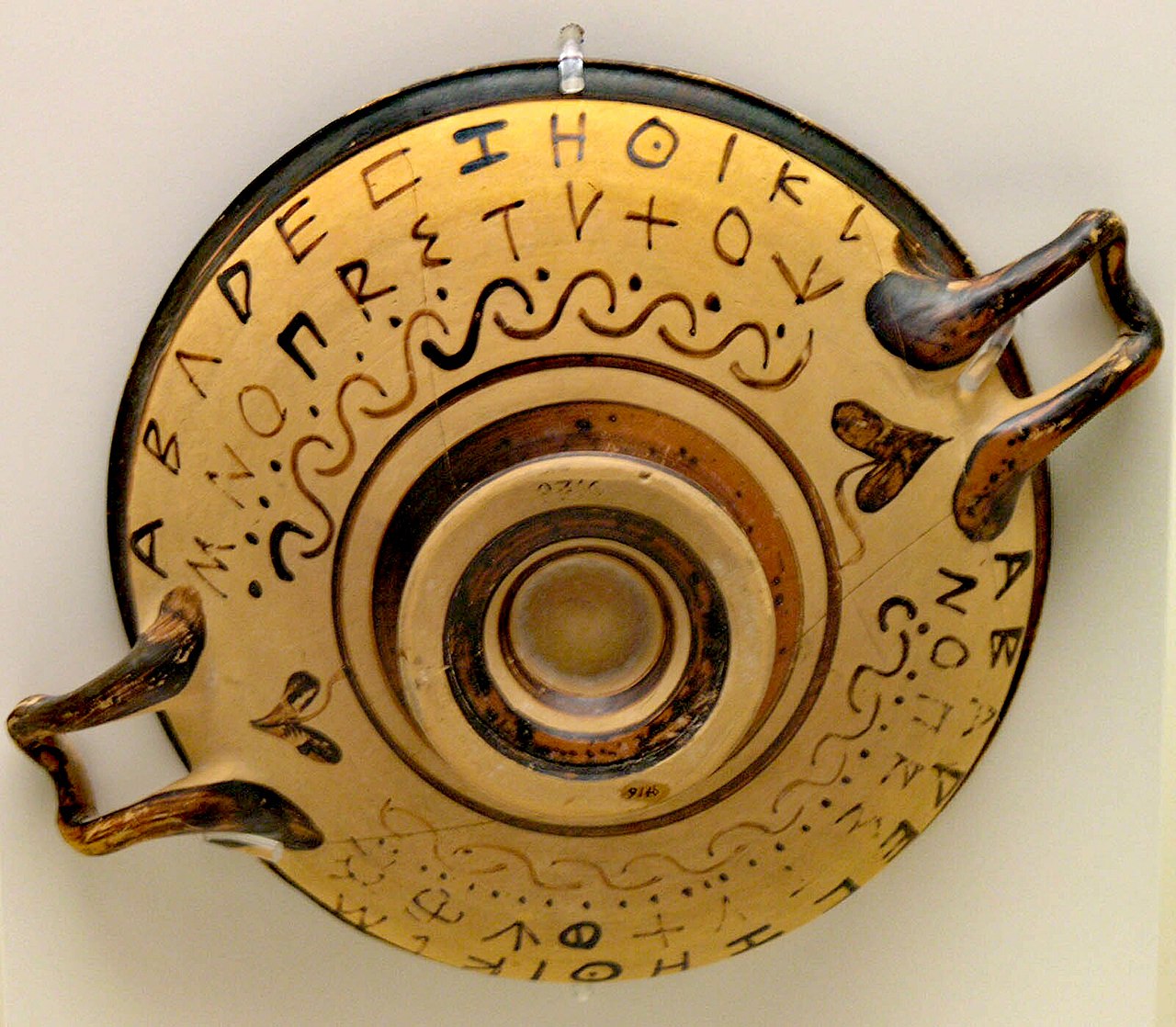
Origins and development
The letter traces its ancestry to the Semitic letter resh and entered Greek along with other alphabetic signs borrowed from Phoenician sources. From Greek forms of rho came alphabetic descendants in other writing systems: the Roman R and the Cyrillic Р both reflect this lineage.
Form and phonetics
Historically, rho represented a trilled or tapped r in Ancient Greek and a similar rhotic sound in Modern Greek. Its written shapes—rounded lowercase ρ and a form resembling the Latin P for uppercase—have varied in handwriting and typographic traditions.
Common uses in science and mathematics
The lowercase rho (ρ) is a versatile symbol used across disciplines. In physics it commonly denotes mass density or volume charge density and also electrical resistivity. In statistics and probability contexts the letter frequently represents a population correlation coefficient, including Spearman's rank correlation (often written ρ); for references see materials on statistics and population correlation.
Examples and notation
- Greek numeral value: ρ = 100 in the traditional Greek numerals system.
- Physics: ρ often labels mass density or charge density; consult general density and electromagnetism texts for standard usage.
- Mathematics: ρ may mark a radial coordinate in polar, cylindrical or spherical systems, or a generic parameter in formulas.
Notable distinctions
Do not confuse Greek rho with visually similar letters: the Latin P represents a different sound and origin despite its similar form. Notation can vary by field and author, so context determines whether ρ denotes density, correlation, resistivity or a coordinate; consult disciplinary conventions for precise meanings.
Usage
- In physics, the small Rho
- the sign for density, for example, the mass density of water (~) 1 kilogram per liter,
- and that for the specific electrical resistance, a temperature-dependent material constant,
- the identifier of a meson,
- the sign for the charge density,
- the density matrix, a representation of the density operator (for systems in quantum mechanically defined states).
- In chemistry, the small Rho is a (non-standard) formula symbol for mass concentration.
- In statistics, the small Rho is a commonly used symbol for the correlation coefficient.
- In linear algebra and functional analysis, the spectral radius is denoted by a small Rho.
- In surveying, the conversion factor between radians and other angular measures is denoted by a small Rho: ρ = 180/π for alt degree, ρ = 200/π for gon, ... It finds use, for example, in formulas such as α/ρ = b/r, which is usually written α = b/r as the ratio of the central angle to the arc piece outside of surveying.
- In linguistics, the sound change to r is called rhotacism.
- In queueing theory, it is the utilization rate.
- In economics, ρ
- one of the key figures for valuing an option and
- in growth models is usually a parameter that reflects the time preference of household consumption.
Character encoding
| Majuscule Ρ | minuscule ρ | Minuscule ϱ (variant) | |
|
|
|
|
Related articles
Author
AlegsaOnline.com Rho (Greek letter) Leandro Alegsa
URL: https://en.alegsaonline.com/art/82522