
Polyhedron
A polyhedron is a three-dimensional solid with flat polygonal faces, straight edges, and vertices. Covers types (convex, concave, regular), basic formulas, history, examples, and applications.
Overview
A polyhedron is a solid in three-dimensional space whose surface is made up of flat polygonal faces joined along straight edges and meeting at vertices. In ordinary usage a polyhedron is described by the numbers of its faces, edges and vertices, and by the shapes of its faces. The phrase geometrical shape highlights that polyhedra are objects studied in geometry, and they are examples of three-dimensional or three-dimensional solids built from flat parts.
Image gallery
10 Images


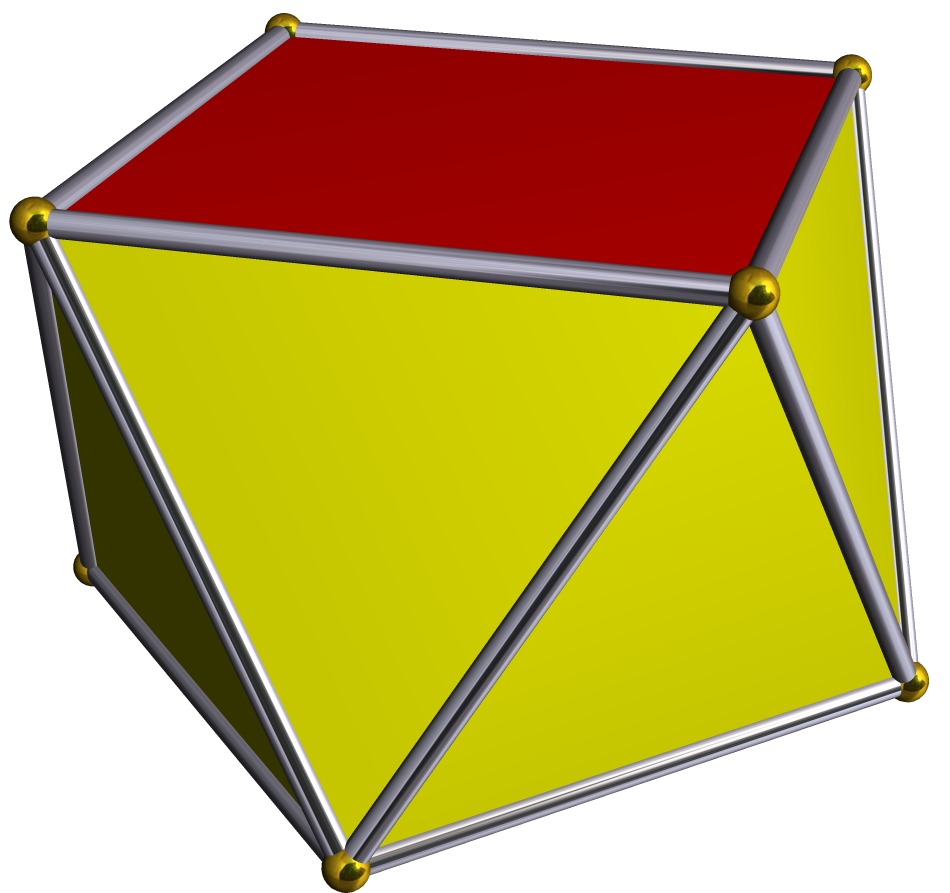


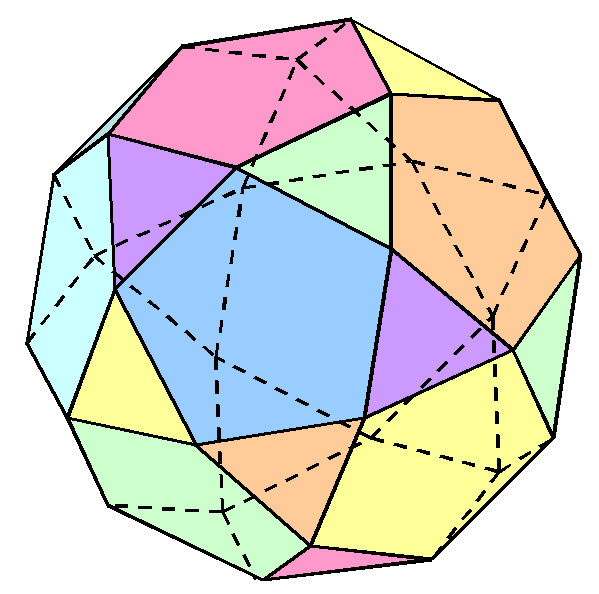
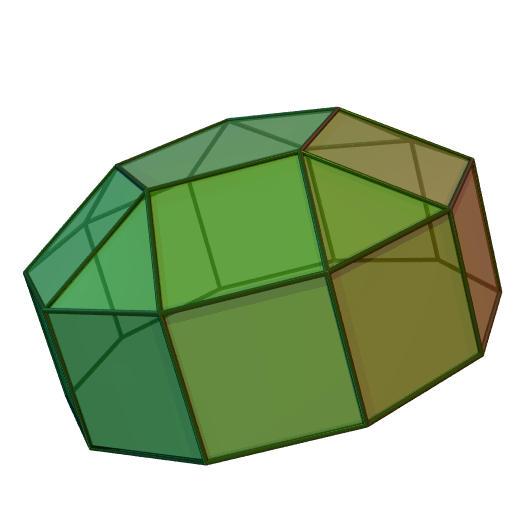


Elements and notation
The basic elements of a polyhedron are its faces (each a polygon), edges (line segments where two faces meet) and vertices (points where edges meet). Each face is a polygonal face, usually simple and flat. For many polyhedra a fundamental relation holds: Euler's formula V − E + F = 2, where V, E and F are the counts of vertices, edges and faces, respectively; this holds for polyhedra that are topologically equivalent to a sphere (simple, non-self-intersecting solids).
Classification and common examples
Polyhedra are classified in several overlapping ways. One basic distinction is between convex and concave forms: a convex polyhedron contains the whole segment joining any two of its points, while a concave polyhedron does not. Other important categories include:
- Regular polyhedra (Platonic solids): five highly symmetric forms in which all faces and all vertices are identical; the five are the tetrahedron, cube (hexahedron), octahedron, dodecahedron and icosahedron. See Platonic solids.
- Archimedean solids: semi-regular solids with regular polygonal faces of more than one type but identical vertices.
- Catalan solids: duals of the Archimedean solids, typically face-transitive but not vertex-transitive.
- Johnson solids and other convex but non-uniform polyhedra.
- Star and self-intersecting polyhedra, for example the Kepler–Poinsot solids, which generalize regularity to non-convex forms.
History and theory
Polyhedra have been studied since antiquity for their mathematical beauty and symmetry. Classical Greek mathematicians classified the five regular solids, and later work in topology and combinatorial geometry clarified general properties such as Euler's characteristic and duality (every convex polyhedron has a dual where faces and vertices are interchanged). Notation such as the Schläfli symbol {p,q} compactly describes regular tessellations and regular polyhedra: each face is a p-gon and q faces meet at each vertex.
Uses and examples
Polyhedra appear across science, engineering and art. Architects use polyhedral frameworks for geodesic domes and complex roof structures; chemists model molecules and cages (for example, fullerenes) with polyhedral graphs; computer graphics and 3D modelling represent surfaces by meshes of polygonal faces; crystallography and materials science analyze polyhedral coordination in lattices. Everyday items such as dice are simple examples of polyhedra used for practical purposes.
Notable facts and distinctions
There is some variation in formal definitions used by mathematicians: some restrict polyhedra to convex solids or to objects homeomorphic to the sphere, while others allow non-convex or even self-intersecting surfaces. Practical descriptions often require faces to be flat polygons and the solid to have a well-defined interior. Polyhedra can be unfolded into nets (connected arrangements of faces in the plane), and many operations connect different polyhedra: truncation, stellation, dualization and augmentation produce related solids. For further reading on geometric terminology and examples, see sources linked above and introductory texts in geometry.
Related articles
Author
AlegsaOnline.com Polyhedron Leandro Alegsa
URL: https://en.alegsaonline.com/art/77855