
Convex Regular 4‑Polytopes (Regular Polychora)
A concise overview of convex regular 4‑polytopes: their defining properties, the six examples discovered by Schläfli, structure and symmetries, historical context, and why they are important in geometry and related fields.
In mathematics a convex regular 4‑polytope, often called a regular polychoron, is the four‑dimensional analogue of a Platonic solid: a convex 4‑dimensional mathematical polychoron that is both four‑dimensional and 4D, and whose symmetry group acts transitively on its flags. Informally, each such figure is highly symmetric, with all vertices, edges, faces and three‑dimensional cells equivalent under its full symmetry group. They generalize the idea of regular polygons and Platonic solids to a higher dimension.
Image gallery
10 Images


Defining characteristics
Convex regular 4‑polytopes are characterized by three combined properties: convexity (they form a convex set), regularity (full transitivity of flags under isometries), and finiteness (a bounded finite polytope). Each is bounded by congruent regular Platonic solid cells, arranged so that a fixed number of cells meet at every face, a fixed number of faces meet at every edge, and so on. Their local combinatorial structure is encoded by a Schläfli symbol of the form {p,q,r}, which compactly records how p‑gons form faces, q faces meet at each vertex of a cell, and r cells meet around each face.
List of the six convex regular 4‑polytopes
- 5‑cell (4‑simplex), Schläfli symbol {3,3,3}; bounded by five regular tetrahedra. Self‑dual.
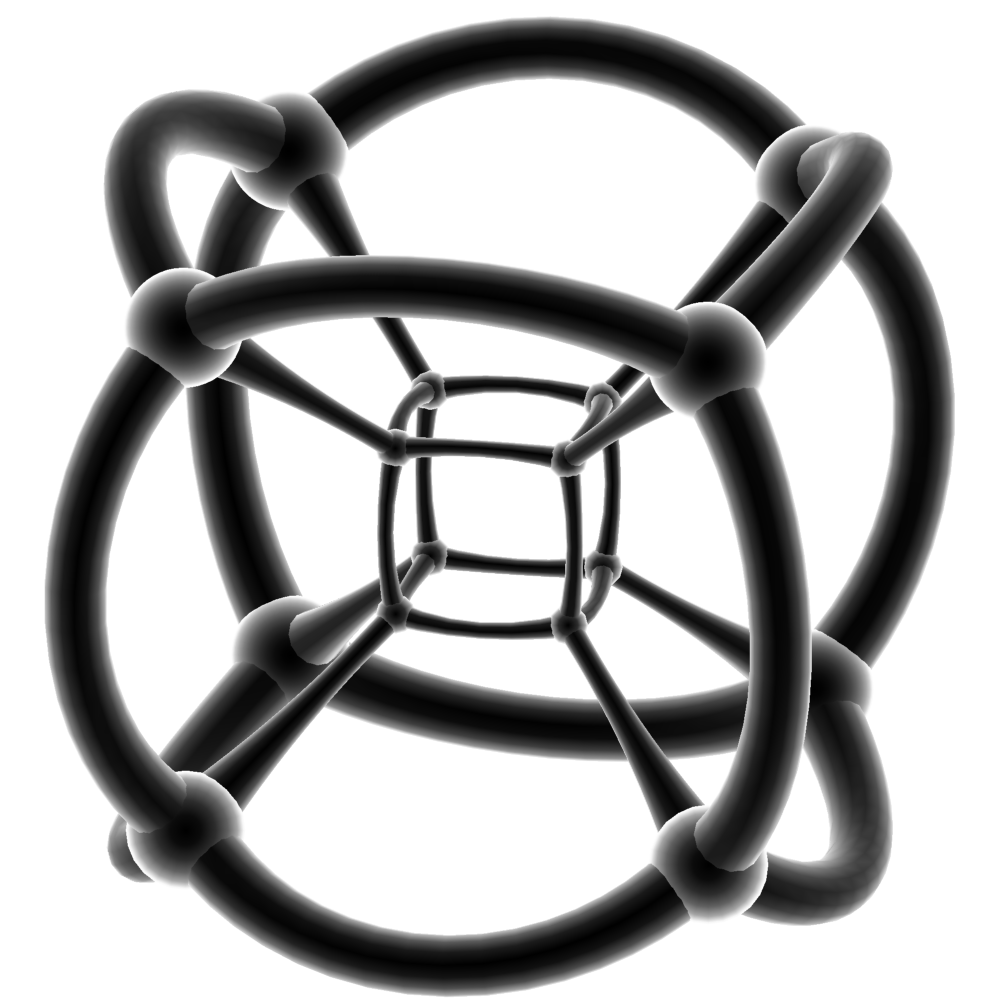
- Tesseract (8‑cell, hypercube), {4,3,3}; bounded by eight cubes. Dual to the 16‑cell.
- 16‑cell (cross polytope), {3,3,4}; bounded by sixteen tetrahedra. Dual to the tesseract.
- 24‑cell, {3,4,3}; bounded by twenty‑four octahedra. Has no direct three‑dimensional analogue and is self‑dual.
- 120‑cell, {5,3,3}; bounded by one hundred twenty dodecahedra. Dual to the 600‑cell.
- 600‑cell, {3,3,5}; bounded by six hundred tetrahedra. Dual to the 120‑cell.
These six exhaust the possibilities in four dimensions: Ludwig Schläfli proved in the 19th century that only these convex regular polychora can exist. Their dual relationships pair the 8‑cell with the 16‑cell and the 120‑cell with the 600‑cell, while the 5‑cell and 24‑cell are self‑dual.
Historical and mathematical context
Schläfli's classification was later refined and popularized by geometers such as H.S.M. Coxeter, who connected these objects to reflection groups and root systems. Each regular 4‑polytope corresponds to a well‑known Coxeter group: for example, the 24‑cell is linked to the exceptional group usually denoted F4, while the 120‑ and 600‑cells relate to the noncrystallographic H4 symmetry. In higher dimensions (five and above) the landscape simplifies: only three families of regular convex polytopes persist — the simplex, hypercube and cross‑polytope — making four dimensions uniquely rich.
Uses, examples and notable facts
Convex regular 4‑polytopes are studied for their intrinsic geometric interest and for applications in topology, group theory and theoretical physics. Their boundaries form 3‑spheres tiled by Platonic cells, so they provide concrete combinatorial models of 3‑manifolds and of highly symmetric tessellations. Visualizations of tesseracts and 600‑cells appear in computer graphics and education to illustrate properties of higher dimensions; they also inspire constructions in four‑dimensional crystallography and in the study of polytopal analogues of lattices. An important combinatorial identity for any convex regular 4‑polytope is the alternating Euler relation for its boundary: V − E + F − C = 0, reflecting that the boundary is topologically a 3‑sphere.
For further technical detail see treatments of regular polytopes and reflection groups, which explain Schläfli symbols, duality and symmetry in full: the subject connects elementary polyhedral combinatorics to deep algebraic structure (convex, Platonic solids, regular polygons, and modern expositions on mathematical symmetry). Additional historical and visual resources are available for readers who wish to explore models, projections and coordinate descriptions of each polychoron (polychoron, four‑dimensional, 4D, and studies of Coxeter groups in geometry Schläfli symbol).
Questions and answers
Q: What is a convex regular 4-polytope?
A: A convex regular 4-polytope is a 4-dimensional polytope that is both regular and convex.
Q: What are the analogs of convex regular 4-polytopes in three and two dimensions?
A: The analogs of convex regular 4-polytopes in three dimensions are the Platonic solids, while in two dimensions, they are the regular polygons.
Q: Who first described convex regular 4-polytopes?
A: The Swiss mathematician Ludwig Schläfli first described convex regular 4-polytopes in the mid-19th century.
Q: How many convex regular 4-polytopes are there?
A: There are precisely six convex regular 4-polytopes.
Q: What is the unique feature of the 24-cell polytope among the convex regular 4-polytopes?
A: The 24-cell polytope has no three-dimensional equivalent among the convex regular 4-polytopes.
Q: What are the 3-dimensional cells that bound each convex regular 4-polytope?
A: Each convex regular 4-polytope is bounded by a set of 3-dimensional cells that are all Platonic solids of the same type and size.
Q: How are the 3-dimensional cells fitted together in a convex regular 4-polytope?
A: The 3-dimensional cells are fitted together along their respective faces in a regular fashion in a convex regular 4-polytope.
Tags
Related articles
Author
AlegsaOnline.com Convex Regular 4‑Polytopes (Regular Polychora) Leandro Alegsa
URL: https://en.alegsaonline.com/art/22844