
Provinces and territories of Canada
Overview of Canada's ten provinces and three territories: their roles, differences in powers, geography, capitals, standard abbreviations, and significance within the federal system.

Overview
Canada Canada is a large North American country country and sovereign state sovereign state located in North America. It is divided into thirteen primary administrative units administrative divisions: ten provinces provinces and three territories territories. These units are the principal subnational jurisdictions in Canada and form the basis for local government, regional services and many public policies.
Image gallery
10 Images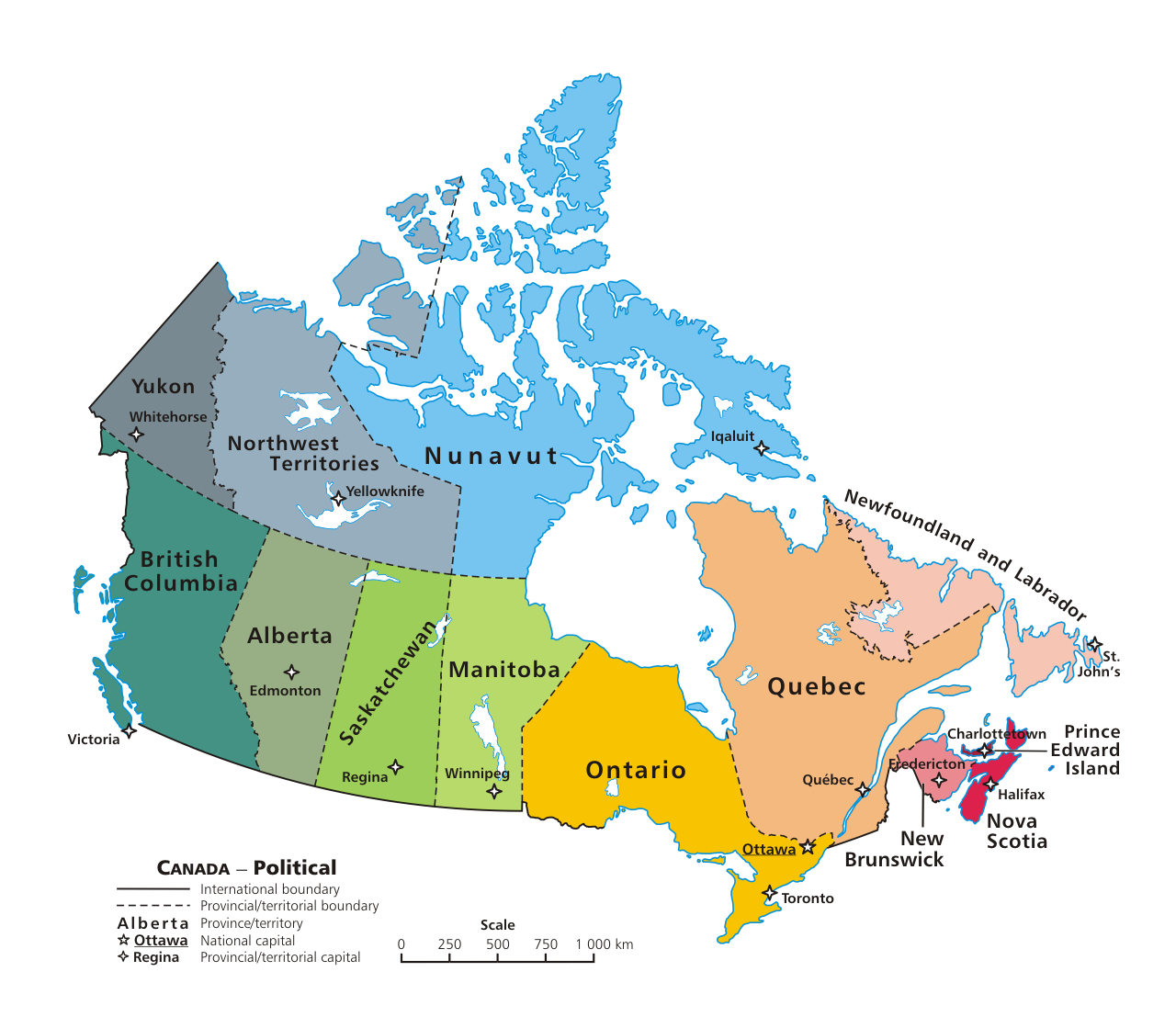



Government and powers
Canada’s different levels of government are arranged on federal principles. The various levels of government levels of government allocate responsibilities between Ottawa and the provinces and territories; this arrangement reflects the idea of a federation federation. The federal government federal government retains national powers such as defence and trade, while provinces generally control areas like education, health care and property law. Territorial governments operate with powers delegated by the federal government and therefore have a more limited constitutional status than provinces.
Geography and settlement
The ten provinces are mostly situated in the southern part of the country, near the international border border with the United States. They stretch from the Atlantic Ocean in the east to the Pacific Ocean in the west. The three territories lie to the north, closer to the Arctic Circle and the Arctic Ocean, and have much lower population densities. This north–south pattern helps explain why most Canadians live in a relatively narrow band along the southern border while large tracts of sparsely populated land remain in the north.
Provinces and territories: names, capitals and abbreviations
Each province and territory has an official capital city where its government sits; common two-letter abbreviations are used in addresses and data. The national capital is Ottawa, the seat of the federal government. Below is a concise listing of the provinces and territories with standard postal abbreviations, their capitals, and their largest population centres.
- Ontario (ON) — capital: Toronto; largest city: Toronto.
- Quebec (QC) — capital: Quebec City; largest city: Montreal.
- Nova Scotia (NS) — capital and largest city: Halifax.
- New Brunswick (NB) — capital: Fredericton; largest city: Moncton.
- Prince Edward Island (PE) — capital and largest city: Charlottetown.
- Newfoundland and Labrador (NL) — capital and largest city: St. John's.
- Manitoba (MB) — capital and largest city: Winnipeg.
- Saskatchewan (SK) — capital: Regina; largest city: Saskatoon.
- Alberta (AB) — capital: Edmonton; largest city: Calgary.
- British Columbia (BC) — capital: Victoria; largest city: Vancouver.
- Yukon (YT) — capital and largest city: Whitehorse.
- Northwest Territories (NT) — capital and largest city: Yellowknife.
- Nunavut (NU) — capital and largest city: Iqaluit.
These names and abbreviations are commonly used in official documents and by postal services; see resources on standard provincial abbreviations abbreviations, the location of capitals capitals, and lists of the largest cities largest cities for more detail.
History and development
The present map of provinces and territories reflects historical processes including colonial settlement, regional agreements and legislation that created and adjusted jurisdictions over time. The original provinces emerged from British North American colonies and later joined Confederation; additional provinces and territories were formed through federal statutes and negotiations. Over the 19th and 20th centuries, boundaries shifted and new administrative arrangements were adopted to respond to settlement, resource development and Indigenous relationships.
Role and importance
Provinces and territories are central to everyday life in Canada. They design and manage schooling, hospitals, provincial roads and many social programs, and they regulate natural resources, land use and local commerce. Differences between provinces — for example, Quebec’s distinct language laws and Alberta’s resource-based economy — illustrate regional diversity. Territorial governments work closely with the federal government and Indigenous governments to address unique northern challenges such as remote infrastructure, climate impacts and preserving traditional ways of life. For introductions and official overviews consult government portals and regional information sites such as federal overviews and provincial or territorial pages provincial resources.
Questions and answers
Q: What is Canada?
A: Canada is a country and sovereign state in the north of North America.
Q: How many administrative divisions does Canada have?
A: Canada has thirteen administrative divisions, which are ten provinces and three territories.
Q: What are the different levels of government in Canada based on?
A: The different levels of government in Canada are based on the principles of a federation, where each of the provinces and territories share power with the federal government.
Q: Where are the provinces located?
A: The provinces are located in the south of Canada, near the border with the United States. They go from the Atlantic Ocean in the east to the Pacific Ocean in the west.
Q: Where are most of Canadian territories located?
A: Most Canadian territories are located to the north, close to Arctic Circle and Arctic Ocean, where fewer people live.
Q: What is Canada's national capital?
A: Ottawa is Canada's national capital, where its federal government meets.
Q: What cities serve as capitals for each province or territory?
A: Each province or territory has its own capital city where their governments are based, as well as largest cities within them.
Tags
Related articles
Author
AlegsaOnline.com Provinces and territories of Canada Leandro Alegsa
URL: https://en.alegsaonline.com/art/79730