
Provinces of Cuba
Summary of Cuba's first-level divisions: the fourteen provinces and the special municipality Isla de la Juventud, their roles, history, geography, and notable distinctions.
Overview
Cuba is administratively organized into fourteen provinces and one special municipality, together forming the country's primary first-level divisions. These units serve as the main framework for regional administration, planning and the delivery of public services. For official classification and further administrative details consult official sources.
Image gallery
7 Images



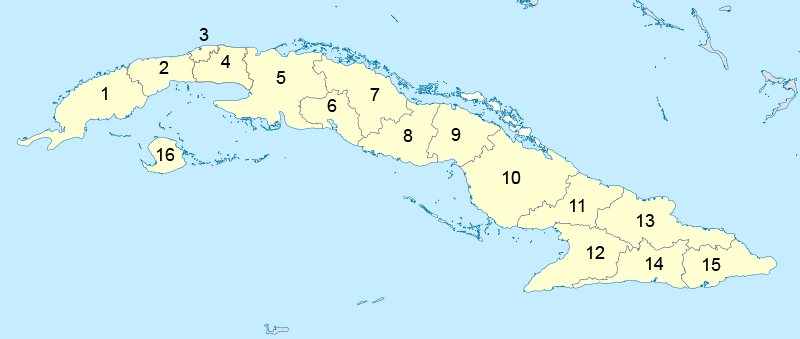

List of provinces and the special municipality
- Pinar del Río
- Artemisa
- La Habana (Havana)
- Mayabeque
- Matanzas
- Cienfuegos
- Villa Clara
- Sancti Spíritus
- Ciego de Ávila
- Camagüey
- Las Tunas
- Holguín
- Granma
- Santiago de Cuba
- Guantánamo
The island of Isla de la Juventud is treated separately as a special municipality rather than as a province-level unit.
Functions and organization
Provinces coordinate regional economic planning, health and education systems, infrastructure and emergency response, while municipalities beneath them handle local administration. Provincial bodies implement national policies at a regional level and adapt planning to local conditions. They vary considerably in area, population and economic profile, from the densely urban Havana area to largely rural eastern provinces.
History and development
Modern provincial boundaries reflect administrative reforms of the late 20th and early 21st centuries. A comprehensive reorganization in the 1970s established the framework still in use, and subsequent adjustments have refined province limits. In 2011 a reconfiguration divided the former Havana province into smaller units, creating some of the present provinces to improve regional administration.
Geography, economy and notable facts
Cuba's provinces encompass contrasting landscapes: western limestone plains and fertile tobacco valleys, central lowlands and northern beaches, and mountainous areas in the east. Economic activities differ by region — tobacco cultivation in parts of the west, sugar and mixed agriculture in central areas, and important ports and mining in the east. Tourism clusters around coastal resorts such as those in Matanzas province, while Guantánamo is regionally notable for its coastal bay. Isla de la Juventud has a distinct administrative status reflecting its island character and historical role.
Understanding Cuba's provinces provides context for the island's political geography, regional economies and cultural diversity. For maps and official descriptions see administrative division resources.
Related articles
Author
AlegsaOnline.com Provinces of Cuba Leandro Alegsa
URL: https://en.alegsaonline.com/art/79736
Sources
- cubagob.cu : Cuba Census 2002
- cubagob.cu : Population table