
Provinces of Greece: historical subdivisions and their role
Overview of the provinces (eparchies) of Greece, their place within the prefectures, historical development, functions, numbers, and their eventual replacement by modern administrative units.
Overview
The provinces of Greece, often referred to by the Greek term eparchies, were intermediate territorial subdivisions used within the country's system of local government. They formed a layer between municipalities and the larger prefectures, serving both administrative and practical purposes across diverse parts of the Greek state. For general reference see Greece and more specific notes on the country’s local units at provinces.
Image gallery
3 Images
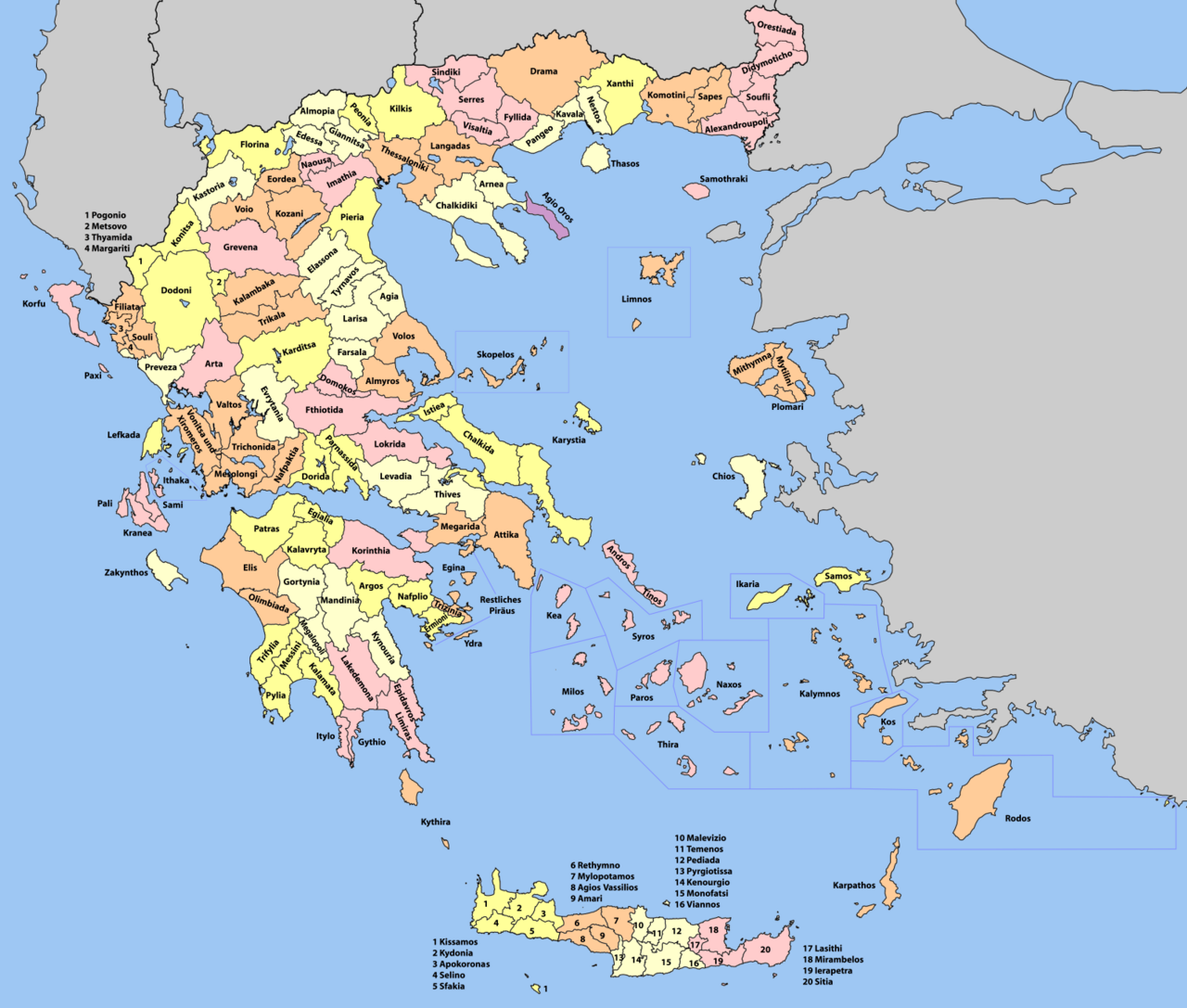

Structure and characteristics
Provinces varied widely in area and population. They were not autonomous bodies with independent governments; instead, they functioned as subdivisions of prefectures and relied on prefectural administrations for major decision-making. Typical characteristics included:
- Clear territorial boundaries within a prefecture;
- Use as organizational units for certain state services and records;
- Variation in size: some provinces covered extensive rural districts while others comprised small urban zones.
Their direct superior administrative unit was the prefecture (prefectures), and beneath them sat municipalities and communities.
History and development
Provincial divisions were formalized in the late 19th century, with laws and regulations establishing them as administrative units in the 1880s. Their number and boundaries evolved through the 20th century as Greece’s territory changed and as the state adapted its internal organization. After the Second World War, the incorporation of additional islands into the Greek state increased the count of provinces.
Functions and use
Although provinces did not have elected provincial governments in the way modern regions do, they served several practical functions for the central state and for local administration. Common uses included:
- Administration of certain state services, notably finance-related offices and elements of public education;
- Acting as convenient units for electoral organization and judicial districts in some contexts;
- Providing a territorial framework for statistical and planning purposes.
Numbers, examples and notable facts
Before the Second World War there were 139 provinces; following territorial additions in the post-war period, notably the union of the Dodecanese islands with Greece, their number rose to 147. The province of Dodoni is often cited as one of the largest by area. Because provinces were intended mainly as administrative subdivisions of prefectures, their significance depended on how central departments used them rather than on independent powers.
Legacy and replacement
During the late 20th and early 21st centuries a series of administrative reforms reorganized Greece’s local government. The role of provinces was progressively reduced and their functions absorbed into newer structures such as municipalities, regions and regional units. Today they remain a historical layer of Greece’s territorial administration and are encountered primarily in historical records, older legal texts and some continuing service boundaries rather than as active units of self-government.
Related articles
Author
AlegsaOnline.com Provinces of Greece: historical subdivisions and their role Leandro Alegsa
URL: https://en.alegsaonline.com/art/79737