
Provinces of Chile — second-level administrative divisions
Overview of Chile's provinces: their place within the regional system, administration, subdivisions into communes, functions, history, and notable distinctions.
The province is the second-level administrative division in Chile, ranking below a region and above the local communes. Chile is organized into 54 provinces in total, each serving as an intermediate tier that links regional authorities with municipal governments. Provinces are a key component of the country's territorial organization and public administration.
Image gallery
1 Image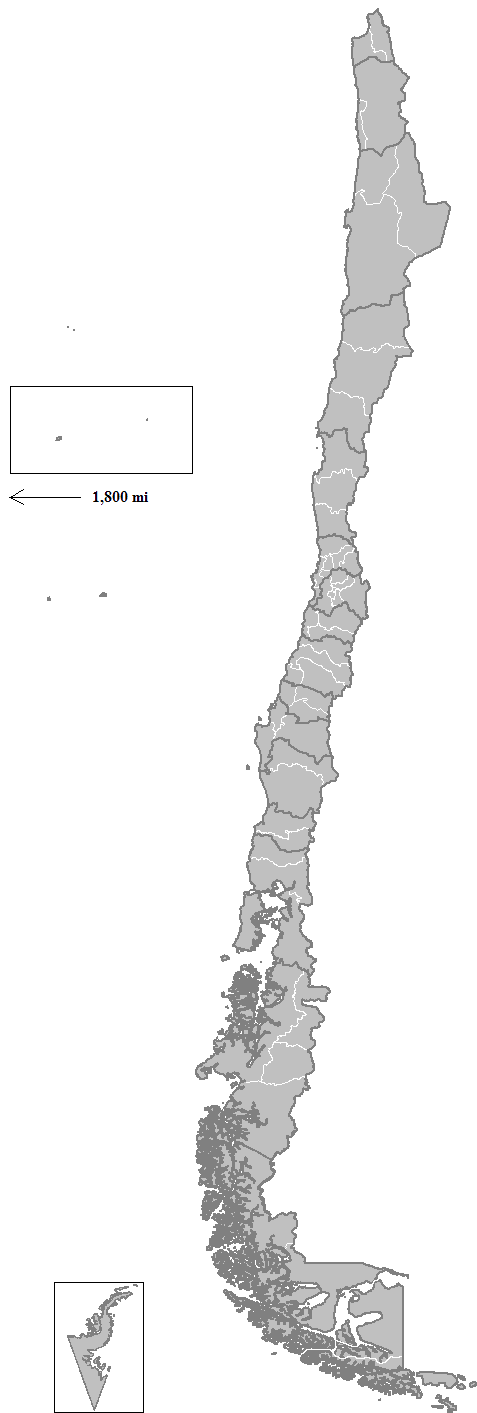
Structure and administration
Each province is headed by an executive appointed by the national government. Traditionally this official has been a governor (gobernador) designated by the president, responsible for representing central government interests within the province and coordinating public policies. Recent administrative reforms have modified the distribution of powers between national, regional and provincial offices, introducing elected regional authorities while preserving presidential representation at the provincial level.
Subdivisions and local government
Provinces are themselves subdivided into communes (comunas), which constitute the basic units of local government. Each commune is governed by a municipality (municipalidad) made up of an elected mayor and councilors. Municipalities handle day-to-day services and local development, while provincial authorities focus on coordination and oversight across communes.
Functions commonly associated with provincial administration include coordinating national public services at the provincial level, overseeing civil protection and emergency response, facilitating inter-communal planning, and serving as a channel for regional policies. The provinces do not generally exercise the same degree of autonomous legislative power as regions, but they play an important role in implementation and local coordination.
The provincial system has historic roots in colonial and republican administrative practices and has evolved through periodic territorial reorganizations. Over time, Chile has shifted toward greater regionalization and decentralization, with adjustments to provincial responsibilities reflecting broader governance reforms.
Provinces vary widely in area, population and character: some include densely populated urban centers and metropolitan suburbs, while others are sparsely inhabited, encompassing rural, mountainous or desert territory. The existence of 54 provinces provides a middle layer that balances national direction with municipal autonomy and helps manage the country's geographic and demographic diversity.
- Level: second (region > province > commune)
- Number: 54 provinces
- Leadership: presidentially designated provincial head (governor or delegate)
- Local units: communes governed by municipalities
Questions and answers
Q: What is a province in Chile?
A: A province is the second largest administrative division in Chile after a region.
Q: How many provinces does Chile have?
A: Chile has a total of 54 provinces.
Q: Who governs each province in Chile?
A: Each province in Chile is ruled by a governor (gobernador) designated by the president.
Q: What is the role of a municipality in Chile?
A: The communes in Chile are ruled by a municipality.
Q: How are the provinces and communes organized in Chile?
A: The regions in Chile are divided into provinces, and each province is divided into communes which are ruled by a municipality.
Q: Is a region larger than a province in Chile?
A: Yes, a region is larger than a province in Chile.
Q: Who designates the governor for each province in Chile?
A: The president designates the governor for each province in Chile.
Related articles
Author
AlegsaOnline.com Provinces of Chile — second-level administrative divisions Leandro Alegsa
URL: https://en.alegsaonline.com/art/79734