
Pack (canine social group)
A pack is a cooperative social group formed by certain canids for hunting, breeding and territory defence. Pack size, roles and behaviour vary by species and by ecological context.
A pack is the term commonly used for a social group formed by certain members of the dog family. In zoological classification this behaviour is most typical of the tribe Canini within the wider suborder Caniformia, and it contrasts with many foxes (tribe Vulpini) that are often solitary. A pack usually consists of closely related individuals that cooperate in hunting, defend a territory and assist in raising young, but the precise size, cohesion and social rules vary between species and populations (species variation).
Image gallery
7 Images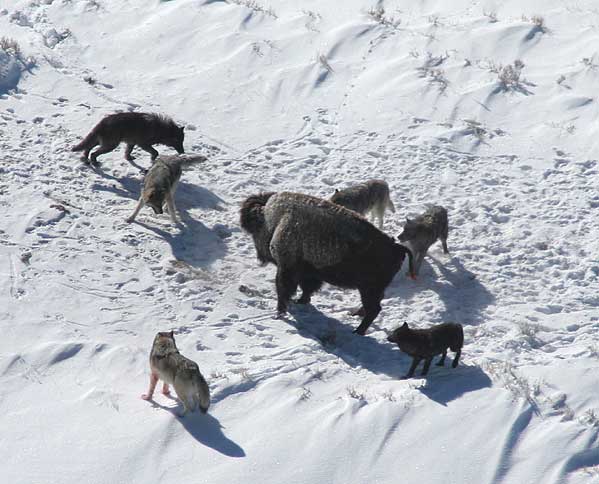



Key characteristics
Packs are defined by a set of recurring features rather than a single fixed structure. Typical characteristics include:
- Kin-based membership: most packs are family groups with a high degree of genetic relatedness, effectively an extended family.
- Cooperative hunting and food sharing that allow predators to take larger or more numerous prey than a solitary hunter could manage.
- Territorial behaviour: scent-marking, vocal signalling and patrols to protect a home range.
- A discernible social order: an observable hierarchy accompanies interactions, often maintained by ritualised gestures and occasional agonistic behaviours linked to dominance.
- Alloparental care: non-breeding pack members commonly help feed and guard pups.
Social organisation and roles
Modern research has refined older ideas about rigid "alpha" individuals. In many canid packs the core leaders are the breeding pair and their offspring; ranks can shift with age, season and circumstance. Communication within the pack uses vocalisations, body language and olfactory cues; coordination during hunts relies on role differentiation such as flanking, chasing and ambushing. Pack size is flexible: some groups are small family units, while others expand when food is abundant or when unrelated adults join temporarily.
Evolutionary and ecological context
Grouping is an adaptive response to ecological conditions. When prey species occur in sizable herds on open grassland or when prey are large relative to a predator, cooperative hunting and defence become advantageous. This principle explains the convergence of pack-like behaviour across different predator lineages: canids such as wolves and African wild dogs, felid lions and social hyaenas (members of the feliforms) show analogous group strategies. Not all carnivores follow this pattern; many mammalian predators are solitary, and some badger species form different kinds of social groups.
Species examples and notable distinctions
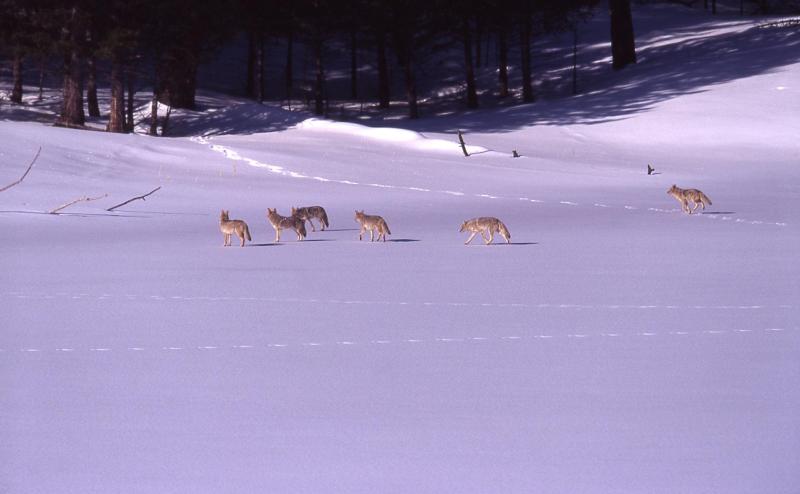
Well-known pack-forming canids include the grey wolf, African painted dog, dhole and some jackal populations. Wolf packs are typically family-based and coordinate complex hunts, while African wild dogs are notable for highly cooperative care of ill or injured packmates. Coyotes may form loose family groups or hunt singly depending on habitat. By comparison, foxes and many other caniforms do not form long-term packs. In aquatic contexts, similar grouping strategies occur among predators whose prey aggregates in schools or pods, an ecological parallel found beyond terrestrial carnivores (aquatic).
Understanding packs requires integrating behaviour, genetics and ecology: pack size and stability reflect food availability, reproductive strategy and the costs and benefits of cooperation. Though the word "pack" evokes a single image, actual canid social systems are diverse and shaped by environment and evolutionary history.
Related articles
Author
AlegsaOnline.com Pack (canine social group) Leandro Alegsa
URL: https://en.alegsaonline.com/art/73936