
Pakicetus — an early Eocene proto‑whale and transitional cetacean
Pakicetus is a genus of early Eocene protocetid cetacean from what is now Pakistan. Its anatomy shows a mix of terrestrial and aquatic traits and it is key to understanding whale origins.
Pakicetus is an extinct genus of early whale‑line mammals known from fossils recovered in what is now northern Pakistan. It lived in the early Eocene, when much of that region formed a coastal margin along the ancient Tethys Sea. Pakicetus is widely cited as one of the most primitive members of the cetacean lineage and provides direct evidence for the transition from land‑living mammals to aquatic whales.
Image gallery
6 Images

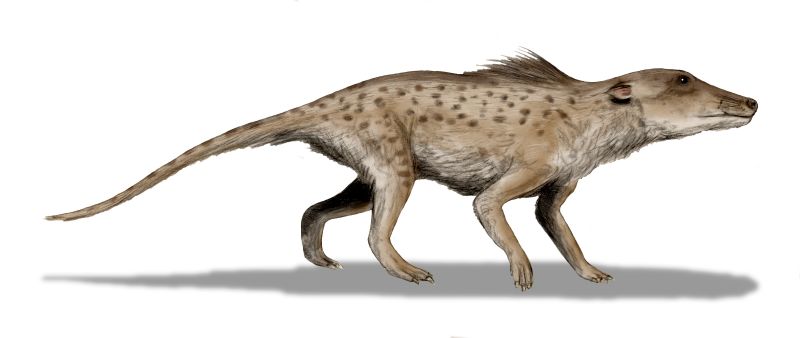


Anatomy and distinguishing features
Fossils of Pakicetus preserve a suite of features that combine terrestrial and aquatic adaptations. The skull is elongated with carnivorous teeth, while the ear region contains a dense involucrum in the auditory bulla — a characteristic associated with cetaceans. Limbs and limb bones indicate an animal capable of walking on land rather than the fully modified flippers of later whales. Overall, Pakicetus retains a body plan suitable for wading or swimming near shore rather than deep‑water life.
Key traits
- Long, narrow skull with sharp teeth adapted for eating fish and small prey.
- Periotic bone forming an involucrum in the ear — an early cetacean diagnostic.
- Well‑developed limbs for terrestrial locomotion, not fully aquatic flukes.
- Found in coastal sediments deposited along the Tethys Sea margin.
Discovery and scientific importance
Pakicetus fossils were recovered from early Eocene sediments in Pakistan and described by paleontologists during the late 20th century. Their discovery helped demonstrate that whales evolved from terrestrial artiodactyl‑like ancestors and that the shift to an aquatic lifestyle occurred in a series of stages. The fossils are often referenced in discussions of mammalian evolution and the land‑to‑sea transition.
Environment and lifestyle
Pakicetus likely inhabited river deltas, tidal flats and shallow coastal waters where it could hunt fish and other small vertebrates. Its anatomy suggests it spent time both on land and in water, using powerful limbs to move on shore and paddling or wading in shallow water. Fossil occurrences from strata deposited along the ancient Tethys coastline support this interpretation: see the early Eocene context at early Eocene, the Pakistani localities at Pakistan, and the original sedimentary strata where specimens were found.
Notable facts: Pakicetus is not a modern whale but a basal cetacean that illuminates how modern whales evolved from terrestrial mammals. Its combination of walking limbs and cetacean ear anatomy makes it a classic transitional fossil in vertebrate paleontology.
Related articles
Author
AlegsaOnline.com Pakicetus — an early Eocene proto‑whale and transitional cetacean Leandro Alegsa
URL: https://en.alegsaonline.com/art/74056
Sources
- science.sciencemag.org : science.sciencemag.org/content/220/4595/403
- ncbi.nlm.nih.gov : PMID 17831411
- wikidata.org : Q310503
- species.wikimedia.org : Pakicetus
- eol.org : 4528193
- fossilworks.org : 42935
- gbif.org : 4832588
- irmng.org : 1425454