
Feliformia: the cat-like carnivores
Feliformia is the clade of carnivoran mammals that are more cat-like in anatomy and behavior, including cats, hyenas, civets and related families; it contrasts with the dog-like Caniformia.
Overview
Feliformia is a major suborder within the carnivoran mammals. Members of this group are often described as "cat-like" because many share structural and ecological features with true cats. They belong to the larger group of mammals and are a recognized branch of the order Carnivora. Modern genetic and anatomical studies treat Feliformia as a coherent, monophyletic clade of the carnivoran suborder, distinct from the dog-like Caniformia.
Image gallery
10 Images
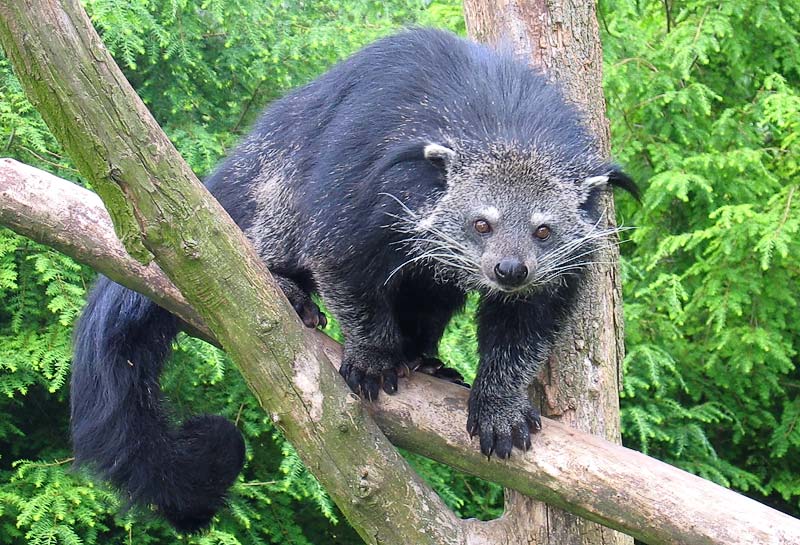
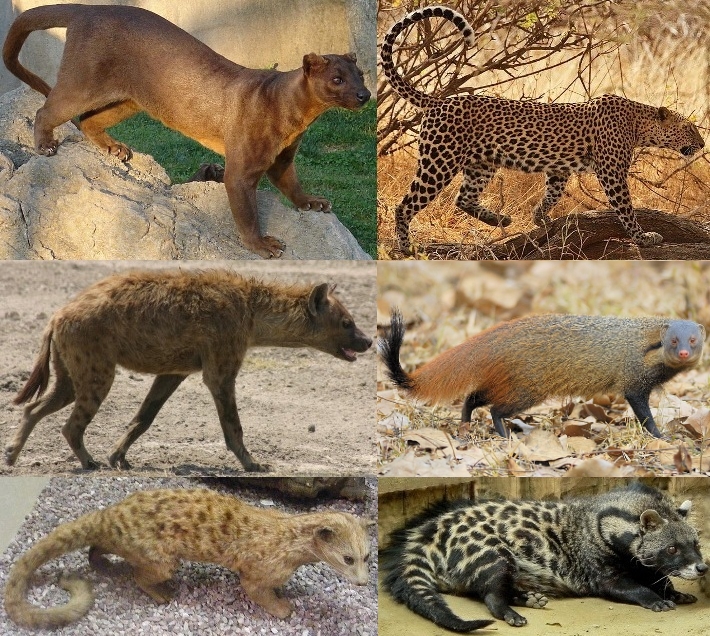


Typical characteristics
Feliforms commonly exhibit a suite of cranial and dental traits such as well-developed carnassial teeth suited for shearing meat, and a configuration of the auditory bulla (the bony capsule of the middle ear) that differs from caniforms. Many have retractable or semi-retractable claws, flexible bodies and eyesight adapted for hunting. Diets range from hypercarnivory in many cats to omnivory in some civets and mongooses, reflecting broad ecological diversity.
Taxonomy and principal groups
Taxonomic treatments vary, but feliforms are generally divided into several families. Current compilations list about six families, a dozen subfamilies, roughly 56 genera and around 114 species, though these numbers change with new research. Commonly recognized families include:
- Felidae (cats) — true cats, from small wildcats to lions and tigers.
- Hyaenidae (hyenas) — specialized scavengers and predators with strong jaws.
- Viverridae and related civet families — civets, genets and allies with diverse habits.
- Prionodontidae (Asiatic linsangs) — slender, arboreal predators sometimes separated from viverrids.
- Eupleridae — the endemic carnivores of Madagascar, derived from African ancestors.
- Herpestidae — mongooses and allied species.
Readers can consult a taxonomic summary for details on subfamilies and genera (species count and lists).
Evolutionary history
Feliforms emerged early in the evolutionary history of Carnivora and diversified during the Paleogene and Neogene. Molecular phylogenetics has clarified relationships that were previously uncertain when based on morphology alone, confirming the group's monophyly and revealing surprising affinities (for example, the distinctiveness of Madagascar's euplerids). Fossil records show a long sequence of specialized forms adapted to a variety of habitats.
Ecological roles and notable facts
Feliform species occupy roles from apex predators to small omnivores and insectivores. They influence prey populations, scavenge carrion, and can act as seed dispersers or disease reservoirs in some contexts. Conservation concerns affect many feliforms: habitat loss, persecution and prey decline threaten several species. Taxonomic revisions continue as genetic data refine our understanding of how groups such as civets, linsangs and mongooses are related; for accessible summaries see a general taxonomic overview or specialist treatments (mammal resources).
Questions and answers
Q: What is Feliformia?
A: Feliformia is a suborder in the mammal order Carnivora containing all Felidae and also includes the relatives of the cats.
Q: What animals belong to Feliformia?
A: Feliformia consists of cat-like animals such as hyaenas, civets, Asiatic linsangs, and more.
Q: How many families are in Feliformia?
A: There are six families in the Feliformia suborder.
Q: What is the number of species in Feliformia?
A: There are 114 species in the Feliformia suborder.
Q: Is Feliformia a monophyletic group?
A: Yes, Feliformia is a monophyletic group according to molecular phylogeny.
Q: What is the other suborder of Carnivora?
A: The other suborder of Carnivora is the dog-like Caniformia.
Q: How many subfamilies and genera are in Feliformia?
A: There are twelve subfamilies and 56 genera in the Feliformia suborder.
Related articles
Author
AlegsaOnline.com Feliformia: the cat-like carnivores Leandro Alegsa
URL: https://en.alegsaonline.com/art/33922
Sources
- dx.doi.org : 10.1016/j.ympev.2010.01.033
- animaldiversity.ummz.umich.edu : Diversity Web (online) - Feliformia
- itis.gov : Integrated Taxonomic Information System
- paleodb.org : The Paleaobiology Database
- taxonomy.nl : Systema Naturae 2000 / Classification - Suborder Feliformia
- journals.cambridge.org : Phylogeny of The Carnivora
- research.yale.edu : Origin of Malagasy Carnivora
- biology.duke.edu : Single origin of Malagasy Carnivora from an African ancestor – Letters to Nature