
Herd (collective group of animals)
A herd is a social grouping of animals—most often hoofed mammals—whose members move and behave together through simple local interactions. The concept is used in ecology, animal husbandry and social studies.
A herd is a social assembly of animals that remain together and often move as a unit. In ordinary usage the term applies most frequently to mammals; in particular it is common for ungulates and other grazing species. A herd can be any size from a small family cluster to very large aggregations, and the word may be applied broadly in ecological theory beyond the familiar farm or savanna scene. Researchers and lay sources use the label in different ways: for a general reference see group of animals, for its relationship to mammals see mammals, and for typical hoofed species see hoofed animals.
Image gallery
10 Images


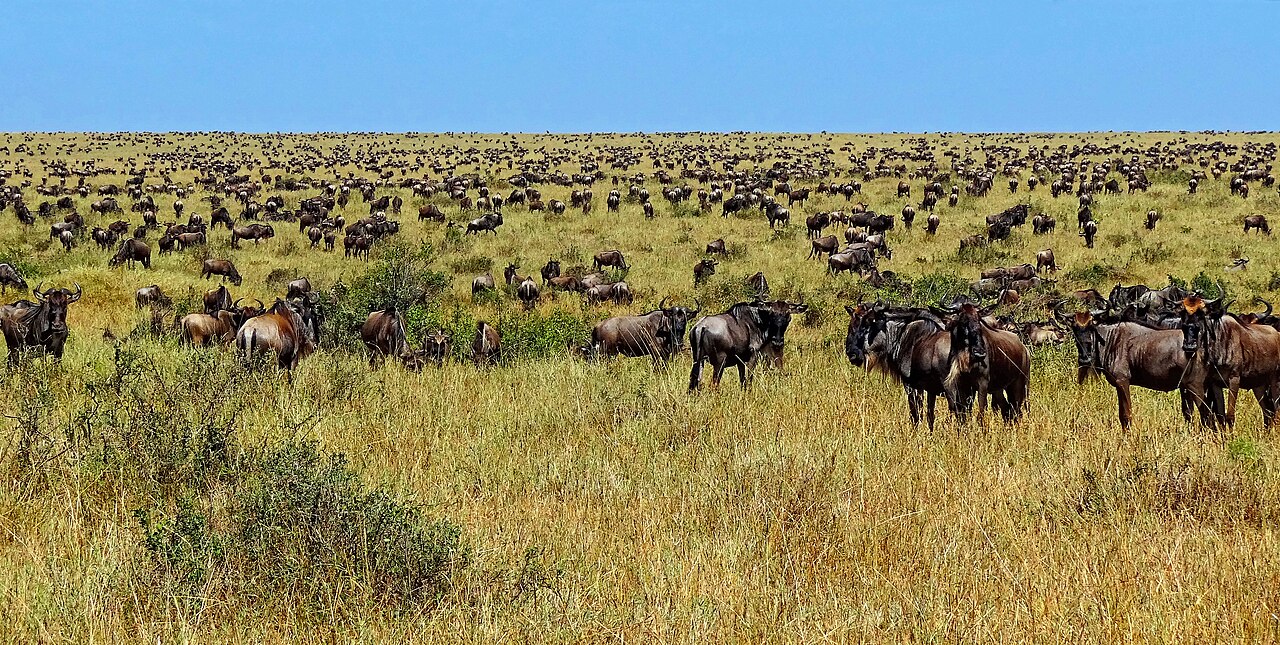

How herds form and behave
Herding arises from local interaction rules rather than from a single leader planning every movement. Each individual tends to match the behaviour of nearby conspecifics, or to react to the same local cues such as the presence of predators, food patches, or water. Simple mechanisms — imitation, alignment, attraction and repulsion at short distances — can produce coherent motion and rapid directional changes at the scale of the whole group. These emergent properties are central to the study of collective animal behaviour and self-organization in ecology and modelling literature.
Characteristics and functions
- Anti-predator benefit: safety in numbers through dilution, confusion of predators, and more eyes for vigilance.
- Foraging efficiency: locating and exploiting patches of vegetation or migrating along known routes.
- Social structure: from loose aggregations to stable groups with dominance hierarchies and kin bonds.
- Costs: competition for food, increased disease transmission, and risk of mass movement into hazards.
Different species show variation: some herds are relatively fluid with open membership, while others maintain long-term associations. Human-managed herds — sheep, cattle, goats — are often directed by people or dogs, and have been central to pastoral economies and domestication processes.
Terms, distinctions and related concepts
English uses a range of collective nouns for animal groups: a flock for many birds and some mammals, a pack for many predatory mammals, and special terms such as a gaggle for geese on the ground. In theoretical contexts, however, "herd" is sometimes used generically to describe any assemblage of animals that behaves as a unit. For comparisons see other types of animal groupings, packs of carnivores, and the example of a gaggle of geese.
Examples, human roles and notable facts
Classic examples include wildebeest migrations across grasslands, bison herds on plains, sheep flocks on hill farms and reindeer moving in large seasonal groups. People have tended herds for millennia; terms such as shepherd and goatherd reflect occupations that manage domesticated animals. In contrast to herds, some animal societies are highly coordinated with individual roles — for instance eusocial insects — which use chemical and tactile signals for organization (eusocial insects, pheromones). Animal communication in diverse modalities also shapes group behaviour (animal communication).
Herding remains important to conservation and agriculture: understanding movement patterns helps with habitat management, while herd dynamics influence disease spread and human-wildlife interactions. The term is also used metaphorically for human crowd behaviour, usually to highlight collective tendencies that arise without centralized coordination.
Questions and answers
Q: What is a herd?
A: A herd is a large group of animals, usually mammals with hooves.
Q: What other terms are used for similar types of behavior in other types of animal?
A: For example, a large group of birds is usually called a flock and a large group of carnivores is usually called a pack. In addition, special collective nouns may be used for particular cases such as a flock of geese which may also be referred to as gaggle.
Q: How does the term "herd" differ from co-ordinated groups?
A: A herd tends to act together but this does not occur as result of planning or co-ordination. Each individual chooses behaviour that corresponds to that of the majority without any specific roles or instructions whereas in co-ordinated groups individuals have distinct roles and tasks.
Q: Are there examples where human groupings behave more like herds?
A: Yes, some human groupings may behave more like herds such as an army detachments or sports teams.
Q: Is herding an example of collective animal behavior?
A: Yes, herding is an example of collective animal behavior.
Q: Are there any other forms of communication between animals besides pheromones?
A: Yes, there are other forms of communication between animals such as visual cues and vocalizations which can be used to communicate with one another.
Related articles
Author
AlegsaOnline.com Herd (collective group of animals) Leandro Alegsa
URL: https://en.alegsaonline.com/art/43736