
Grapeshot: history, design, and military use
Grapeshot is an antipersonnel artillery load of many small metal balls that scatters on firing. This article covers construction, operation, tactical uses, historical development, decline, and modern equivalents.
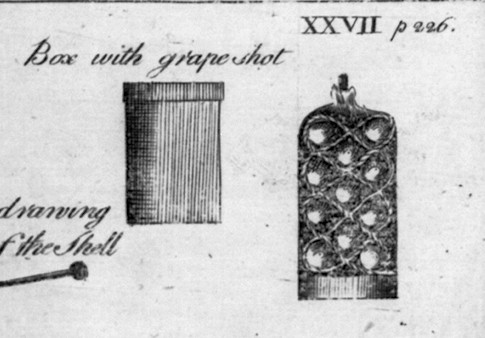
Grapeshot is a form of anti-personnel artillery ammunition made of multiple metal balls bundled so they separate and scatter on firing. The individual projectiles—often called "grapes"—were traditionally packed into a canvas or cloth bag that sat over the powder charge and was held in place by wadding. On discharge the container and wadding ruptured and the balls left the muzzle together, fanning into a conical pattern intended to wound or kill exposed soldiers, cavalry, or personnel on a ship's deck. Compared with explosive shells, grapeshot relied solely on the kinetic energy of its fragments rather than on an internal bursting charge.
Image gallery
5 Images


Design and materials
A typical grapeshot assembly consisted of several iron or lead balls, sometimes fitted between wooden or metal spacers, and held in a cloth or canvas carrier. The package was placed above the propellant charge with a layer of wadding between them; this protected the shot from direct exposure to the burning powder and helped ensure an even release. When fired from a smoothbore gun the cluster broke apart near the muzzle, and the balls spread outward in a roughly conical pattern. Because dispersion grows with distance and individual projectiles lose speed rapidly, grapeshot was most effective at short ranges.
Manufacturing and variations
Grapeshot sizes and the number of balls varied with the caliber of the gun and the intended target. For the same purpose, related munitions included canister shot—many smaller pellets packed in a metal canister that burst on firing—and specialized anti-personnel loads developed later. Other contemporaneous anti-ship and anti-structure rounds such as chain shot or bar shot used different projectiles to damage masts and rigging rather than to maximize personnel casualties. For historical images and examples of the cloth carriers and construction, see references to a typical canvas bag.
Tactical uses: land and sea
On land, commanders used grapeshot to break up infantry formations and to repel cavalry charges at close range. Its wide spread could inflict multiple casualties with a single discharge, creating both physical damage and psychological shock. At sea, shipboard guns fired grapeshot to clear enemy decks, disable gun crews, and reduce the effectiveness of close-quarters boarding actions. Its immediate effect and relative simplicity made it a valuable tool in the age of muzzle-loading artillery.
Distinctions from shells and shrapnel
- Grapeshot: A grouped cluster of larger balls that separates immediately on leaving the barrel and scatters in a cone.
- Canister shot: Numerous smaller pellets contained in a metal canister that opens on firing, producing a dense shotgun-like spray.
- Explosive shells: Hollow projectiles carrying an explosive charge and a fuse; they are intended to detonate either on impact or after a timed delay and rely on blast and fragmentation effects. See a basic description of an artillery shell and the role of fuses in timing such detonations.
- Shrapnel: A type of fused shell developed to burst at a selected point in flight and scatter many small balls or fragments; historically associated with the innovation of timed bursting rounds. See discussion of shrapnel and its development in the era of the Napoleonic Wars.
The primary practical differences are timing and mechanism: grapeshot disperses immediately on exiting the muzzle and does not rely on an internal explosive charge, while shells and shrapnel detonate to create fragments at a chosen point.
Historical development and decline
Grapeshot was widely used from the early modern period through the 18th and early 19th centuries in both field battles and naval warfare. It proved especially useful in close engagements before the advent of more accurate, longer-range artillery. With the 19th century came several technological changes—increased powder performance, the adoption of rifled barrels, better explosive fillers, and timed fuses—that favored shells and purpose-built anti-personnel munitions over simple grapeshot. Improvements in artillery range and accuracy reduced the tactical niches where immediate, short-range scatter was advantageous.
Tactical and ethical considerations
Grapeshot and related anti-personnel rounds were effective but indiscriminate, causing severe casualties among both combatants and animals. Their use, particularly against massed troops at close range or against ships' crews, contributed to debates over the morality and legality of certain weapons. While those debates took different forms over successive eras, the general concern about weapons that produce widespread, severe human injury has echoed into modern arms-control discussions.
Legacy and modern equivalents
Although the exact form known as grapeshot fell from common use, the basic concept—projecting many small fragments to affect an area—survives in several modern munitions and design principles. Examples include canister-like anti-personnel warheads, fragmentation munitions, and close-range scatter weapons that are intended to cover an area rather than penetrate heavy armor. The technological lineage also links to improvements in propellants and gun platforms; for background on the role of the charge and the delivery system see general material on propellant and the artillery cannon.
Because grapeshot is most effective at short range and against exposed targets, its historical importance lies in the way it shaped tactics for infantry, cavalry, and naval engagements prior to the dominance of longer-range, explosive artillery. Modern terminology tends to reserve the specific term "grapeshot" for historical descriptions, while contemporary systems are classified by type and effect within current munitions doctrine.
Related articles
Author
AlegsaOnline.com Grapeshot: history, design, and military use Leandro Alegsa
URL: https://en.alegsaonline.com/art/40337