
Greek shield (hoplon or aspis)
The hoplon or aspis was the principal round shield of Greek heavy infantry (hoplites). This article summarizes its form, construction, use in the phalanx, decoration, archaeological evidence and historical development.
Overview
The hoplon, also commonly called the aspis in modern scholarship, was the large round shield used by Greek heavy infantry and gives its name to the hoplite, the citizen-soldier of the classical period. In the context of Ancient Greece the hoplon was the central element of a hoplite's panoply and of the tight formation tactics known as the phalanx. The shield combined personal protection with the need to cooperate closely with neighbouring soldiers.
Image gallery
3 Images
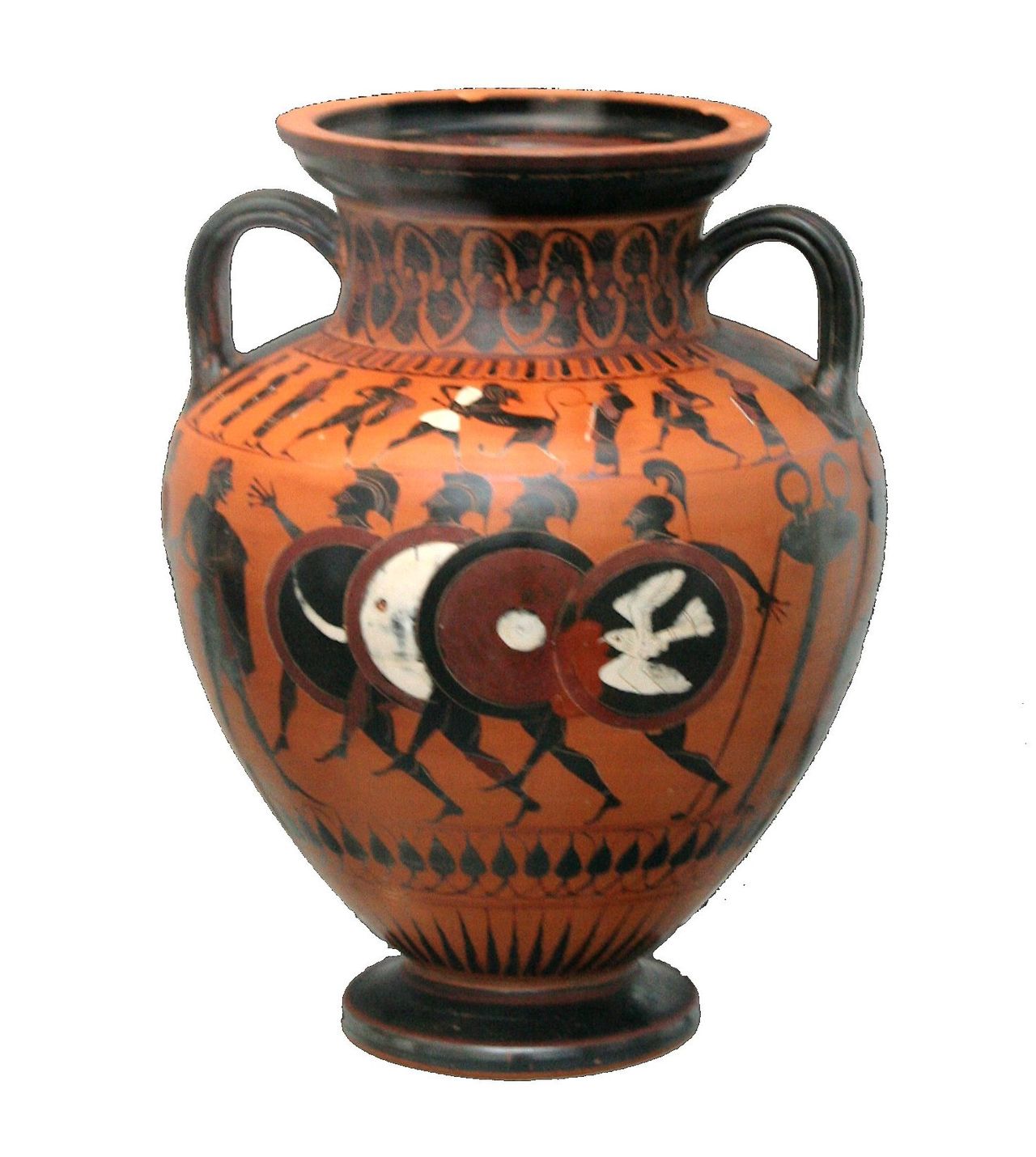

Construction and materials
Hopla were generally constructed around a laminated wooden core and often faced with leather to resist wear. Some examples — or parts of examples recovered archaeologically — show thin sheets or fittings of bronze used for edging, reinforcement or decorative detail. The shield's characteristic feature was its strong dish or bowl shape, which increased structural rigidity and helped to deflect blows. Because wood and organic coverings rarely survive intact in the ground, most reconstructions rely on literary descriptions, vase-paintings and occasional metal fragments.
Carriage and fittings
Rather than a single central boss, the classical hoplon employed a two-part carrying system: a fixed armband (porpax) near the centre and a separate handgrip (antilabe) nearer the rim. This arrangement allowed the shield to be braced on the forearm while the hand held the grip, distributing weight and enabling the soldier to wield it effectively while leaning into the formation.
Tactical use and as a weapon
The hoplon's primary role was collective defence: in a phalanx shields overlapped so each man covered part of his neighbour's body as well as his own, forming a protective surface that could be advanced as a single mass. Discipline and mutual support were therefore as important as individual skill. Contemporary and later sources also describe the shield used offensively for pushing, shoving and striking in the press of battle; some city-states, most famously Sparta, emphasised drills that treated the shield as an active instrument for close combat.
Decoration, identity and symbolism
Many hopla were painted or bore emblems that signalled civic, unit or personal identity. Patterns ranged from simple geometric designs to animals, mythic creatures and symbols associated with particular poleis. The iconic Spartan capital lambda (Λ) is one of the best known examples, while Athenian hoplites frequently used the Little Owl, a bird associated with Athena. The term hoplites itself reflects the link between soldier and shield; other motifs included the sphinx and Herakles' club used by certain units such as some Theban contingents.
Variants and historical development
Across the Archaic and Classical periods the hoplon underwent changes in depth, weight and ornament. Earlier shields could be somewhat lighter and shallower; over time the strongly-dished form became common because it offered better coverage and mechanical advantage when shields were locked together. Economic and tactical factors also influenced decoration and construction: citizen militias and city-state elites could afford painted, reinforced shields, while large levies sometimes used plainer equipment.
Archaeology and evidence
Direct archaeological evidence for wooden hopla is rare because organic materials rot; metal components such as bronze edging or fittings survive more frequently and provide useful clues. Vase-paintings, sculptures and literary sources complement the fragmentary physical record and help reconstruct how shields were made and used. Museum catalogues and studies of surviving fragments remain important resources for understanding variations in design and decoration.
Legacy and comparison
The hoplon differs from other ancient shields—such as the later Roman rectangular scutum—in being round, strongly convex and designed principally to enable mutual protection within a tight formation. Its visual emblems became powerful civic symbols and persist in literature and art. For general overviews and illustrative examples see works on Ancient Greek arms and local catalogues that reproduce finds and reconstructions, including bronze details (bronze) and discussions of Spartan practice (Spartan equipment).
Common motifs and associations
- Lambda (Λ) — commonly associated with Sparta and used as a concise unit emblem (Λ).
- Little Owl — linked to Athenian identity and Athena (Little Owl).
- Sphinx and Heraklean motifs — employed by some Theban units and others (sphinx, Herakles' club).
Because questions of exact appearance and distribution rely on incomplete evidence, statements about hoplon style or decoration are best read as general tendencies rather than absolute rules. The hoplon remains a central object for understanding Greek civic military identity and the practice of collective defence that shaped warfare in the ancient Mediterranean.
Questions and answers
Q: What was the Greek shield called?
A: The Greek shield was called a hoplon or aspis.
Q: What was a hoplon made of?
A: A hoplon was made of wood, and some shields had a thin sheet of bronze on the outer face.
Q: What was the purpose of a hoplon?
A: The hoplon shield was designed for a mass of hoplites to push forward into the opposing army, and it was their most essential equipment.
Q: How was the hoplon shield carried?
A: The hoplon shield was carried in the left hand.
Q: What was the most famous decoration on the hoplon shield?
A: The most famous decoration on the hoplon shield is the capital lambda (Λ) of the Spartans.
Q: What other decorations were used on the hoplon shield?
A: Athenians usually used the Little Owl (Athena's sacred bird), while Thebans used a sphinx, or the club of Herakles.
Q: How was the hoplon shield used by Spartans?
A: Spartans used the hoplon shield as a weapon of attack.
Related articles
Author
AlegsaOnline.com Greek shield (hoplon or aspis) Leandro Alegsa
URL: https://en.alegsaonline.com/art/40643