
Greek fire: Byzantine incendiary weapon and naval flamethrower
Greek fire was a Byzantine incendiary mixture used from the 7th century onward, notable for burning on water and projected from ships. Its composition was secret and remains uncertain; its tactical impact lasted centuries.
Greek fire was an incendiary weapon developed and employed by the Byzantine Empire that could burn while floating on water, giving Byzantine fleets a decisive advantage in naval combat. The precise formula was a military secret and has not survived; surviving descriptions and later experiments allow historians to infer likely constituents and delivery methods but not an exact recipe. For contemporary summaries and translations see primary discussions.
Image gallery
7 Images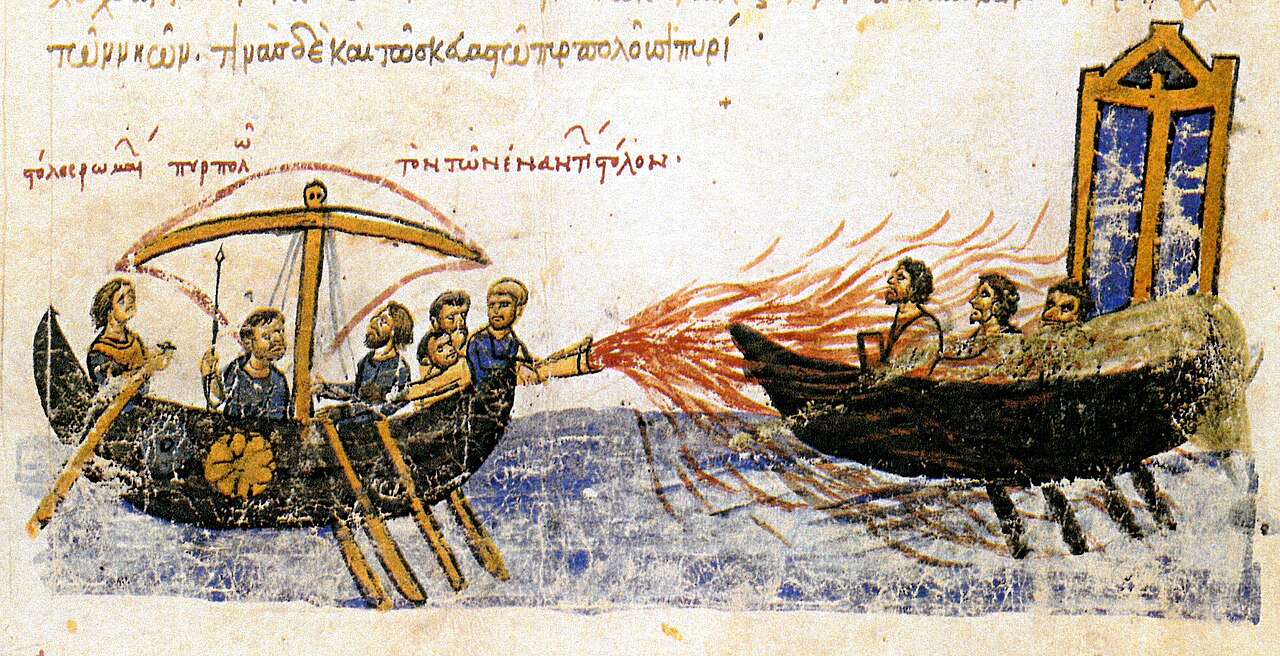



Overview and significance
Used from roughly the 7th century onward, Greek fire is best known as a shipborne weapon fired against enemy vessels and attacking forces. Its capacity to cling to surfaces and continue burning on the sea made it particularly fearsome in close naval engagements. Byzantine chroniclers and external observers repeatedly emphasize its psychological as well as physical effects on opponents. For modern analysis and reproductions, consult studies referenced at research collections.
Probable composition and properties
Contemporary sources never published a definite composition; instead they describe a thick, petroleum-based substance that burned persistently and could not be extinguished easily with water. Scholars generally agree that the core ingredient was some form of naphtha or crude oil, mixed with resins or pitch to increase adhesiveness and burning time. Other additives may have included sulphur or quicklime as accelerants, though such details remain speculative. Its essential properties were:
- ability to ignite and continue burning on water;
- adhesive quality that allowed it to stick to wood and hulls;
- deployment as a projected spray or in closed containers.
Modern comparisons often liken it to napalm in function (a thickened, sticky combustible) though the chemical makeup and intensity differed; see experimental reconstructions at technical demonstrations.
Delivery systems and tactics
Byzantine warships (dromons) were equipped to use Greek fire in several ways. Mechanical pumps and bronze tubes—sometimes called siphons—could project burning liquid at enemy ships like a crude flamethrower. Crews also used jars or pots filled with the mixture as incendiary grenades that shatter on impact, and slow-burning tablets or cloth-wrapped torches impregnated with the compound for setting structures alight. Typical delivery methods included:
- fixed siphons mounted on the prow of a ship;
- hand-thrown earthenware pots or jars;
- portable nozzles and bellows operated by trained crews.
These options let commanders choose stand-off projection or close-range incendiary attacks during boarding actions.
History, use and decline
Accounts attribute early development of the weapon to a Syrian engineer in Byzantine service during the 7th century, though precise origins are debated. Greek fire featured prominently in defensive actions against Arab fleets and in later Byzantine military campaigns. The secrecy surrounding its manufacture meant that when knowledge of the recipe was lost or became politically sensitive, later forces could not reproduce it reliably. Accidents and the changing nature of naval warfare also reduced its utility over time. For historical narratives and primary source discussion see historical sources.
Legacy, misconceptions and notable facts
Greek fire became a symbol of Byzantine technological ingenuity and statecraft. It generated fear beyond its material damage because chroniclers and opponents emphasized its inextinguishable flames. Some common misconceptions—such as claims it was identical to modern petrol-based weapons—overstate the similarity; while functionally comparable to modern incendiaries, its precise composition and delivery were products of their medieval context. Contemporary experiments and reconstructions intended to test hypotheses about the formula and mechanics can be found at experimental archaeology resources.
Although much about Greek fire remains uncertain, its role as an effective naval incendiary and the secrecy that protected its manufacture are securely attested in multiple independent accounts, making it one of the best-documented yet technically enigmatic weapons of the medieval Mediterranean.
Related articles
Author
AlegsaOnline.com Greek fire: Byzantine incendiary weapon and naval flamethrower Leandro Alegsa
URL: https://en.alegsaonline.com/art/40634